🌬️ What Is Breathing Best 100?
Breathing Best 100 refers to a curated collection of 100 essential benefits, features, and techniques rooted in breathwork science, the blending of traditional practices (such as yoga & pranayama) with modern science (neuroscience, pulmonology) to provide a “best of the best” toolkit for human longevity and performance.
It’s designed to support physical health, mental clarity, emotional balance, and performance in life, work, and sport.
These systems are the most well-known and widely practiced breathing techniques based on interconnected principles that can be tailored to individual needs.
✔️ Key Features of Breathing Best 100
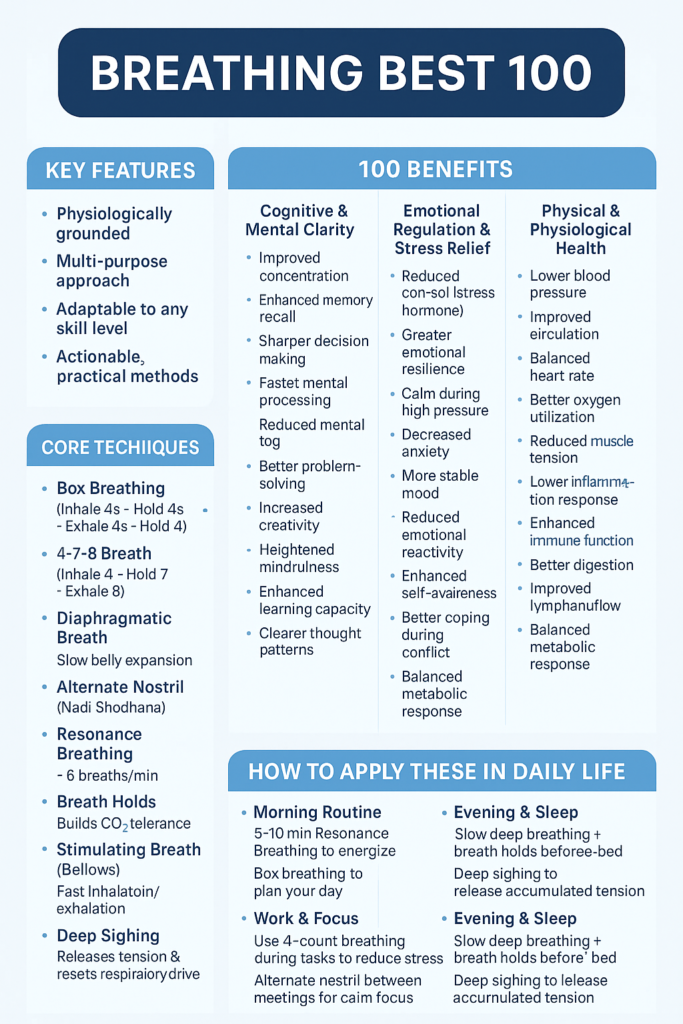
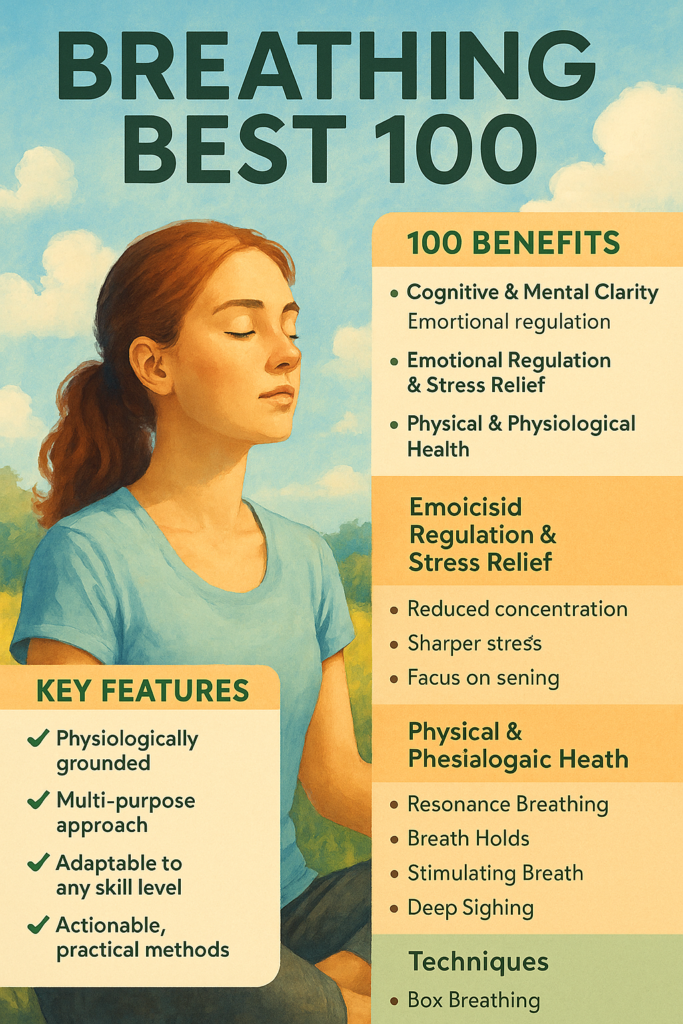
1. Physiologically Grounded
2. Multi‑Purpose Approach
3. Adaptable to Any Skill Level
4. Actionable, Practical Methods
5. Measurable Results
🌟 100 Benefits of Breathing Best
Here are the benefits organized by category — each supported by physiology and clinical practice.
🧠 Cognitive & Mental Clarity
- Improved concentration
- Enhanced memory recall
- Sharper decision‑making
- Faster mental processing
- Reduced mental fog
- Better problem‑solving
- Increased creativity
- Heightened mindfulness
- Enhanced learning capacity
- Clearer thought patterns
😌 Emotional Regulation & Stress Relief
- Reduced cortisol (stress hormone)
- Greater emotional resilience
- Calm during high pressure
- Decreased anxiety
- More stable mood
- Reduced emotional reactivity
- Enhanced self‑awareness
- Better coping during conflict
- Greater emotional intelligence
- Improved stress recovery
💪 Physical & Physiological Health
- Lower blood pressure
- Improved circulation
- Balanced heart rate
- Better oxygen utilization
- Reduced muscle tension
- Lower inflammation response
- Enhanced immune function
- Better digestion
- Improved lymphatic flow
- Balanced metabolic response
🛌 Sleep & Recovery
- Faster sleep initiation
- Deeper sleep cycles
- Reduced night awakenings
- Better sleep quality
- Lower insomnia symptoms
- Faster recovery after exertion
- Reduced fatigue
- Enhanced parasympathetic activation
- Improved rest‑and‑digest response
- Reduced racing thoughts at bedtime
🧘 Mind–Body Integration
- Greater interoception
- Smoother motor coordination
- Improved posture awareness
- Less tension during movement
- Better breath–movement synchronization
- Higher body awareness
- Reduced somatic distress
- Enhanced yoga/meditation experience
- Deepened mind–body connection
- Greater physical relaxation on demand
🚀 Performance & Peak States
- Enhanced athletic endurance
- Faster post‑exercise recovery
- Improved stamina
- Better lung capacity
- Increased energy efficiency
- Controlled pre‑performance arousal
- More consistent performance output
- Better reaction time
- Enhanced focus under stress
- Quicker adaptation to challenges
🗣️ Communication & Social Interaction
- Smoother speech flow
- Greater voice projection
- Less tension in public speaking
- Better listening focus
- More composed communication
- Improved empathy
- Enhanced engagement quality
- Better vocal control
- Fewer social anxiety symptoms
- More confident presence
🧘♂️ Emotional Healing & Psychological Benefits
- Lower PTSD symptom triggers
- Greater emotional grounding
- Help with panic episodes
- Reduced fear responses
- Enhanced trauma resilience
- Better emotional processing
- Increased acceptance
- Reduced avoidance behaviors
- Support during therapy
- Better grief management
🧘♀️ Holistic & Long‑Term Health
- Balanced nervous system
- Slower cellular aging
- Higher life satisfaction
- Lower chronic pain
- Better hormonal balance
- Improved metabolic regulation
- Balanced autonomic nervous system
- Lower stress‑related illness
- Enhanced mental flexibility
- Greater emotional stability
📈 Life Optimization
- More productive routines
- Better stress resilience at work
- Enhanced creativity flow
- Stronger personal discipline
- Improved motivation
- Easier rule‑setting & boundaries
- Better long‑term habit formation
- More stable energy throughout day
- Better overall quality of life
- Sustainable emotional & physical balance
🔧 Core Techniques of Breathing Best 100
Each technique can be used independently or combined into daily routines.
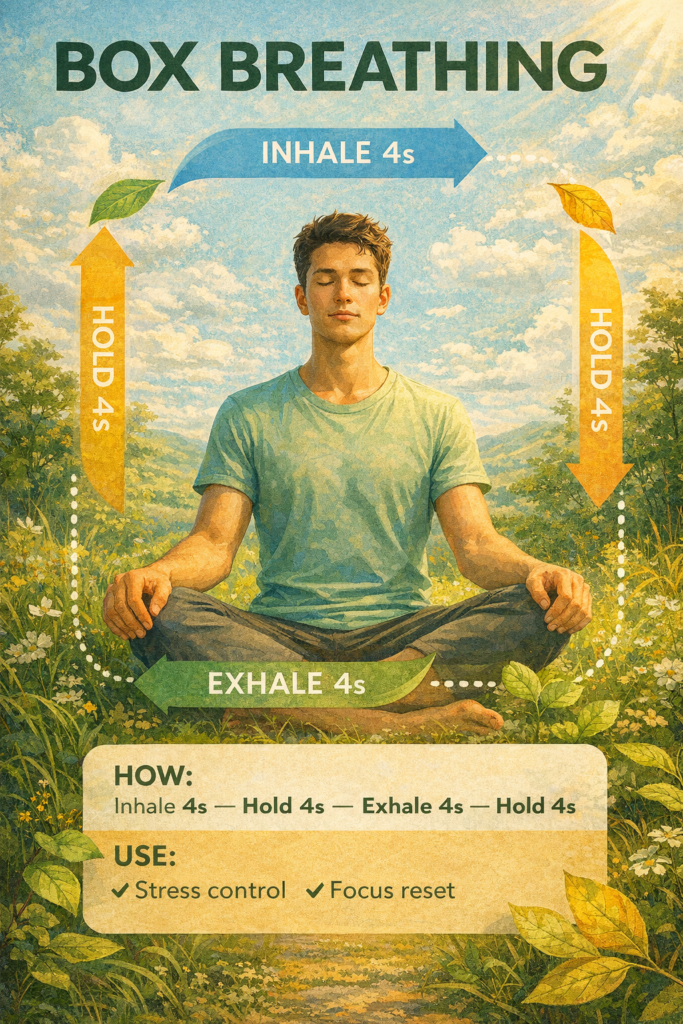
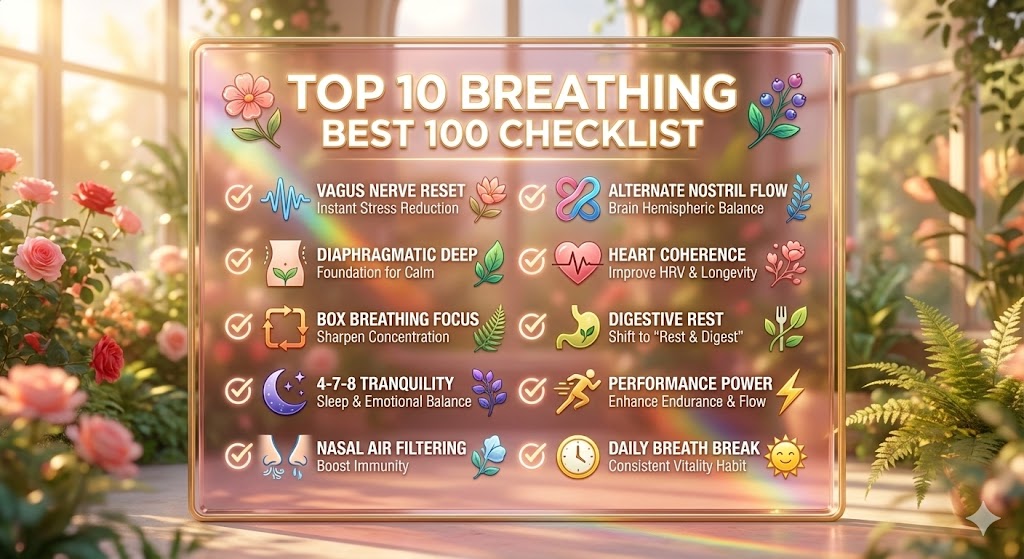
1. Box Breathing
- How: Inhale 4s — Hold 4s — Exhale 4s — Hold 4s
- Use: Stress control, focus reset
2. 4‑7‑8 Breath
- Inhale 4 — Hold 7 — Exhale 8
- Calming nervous system before sleep or anxiety
3. Diaphragmatic Breath
- Slow belly expansion
- Lowers resting heart rate
4. Alternate Nostril (Nadi Shodhana)
- Balances hemispheres, reduces tension
5. Resonance Breathing
- ~6 breaths/min
- Maximizes HRV & calm
6. Breath Holds
- Builds CO₂ tolerance
- Stress resilience
7. Stimulating Breath (Bellows)
- Fast inhalation/exhalation
- Boost energy quickly
8. Deep Sighing
- Releases tension & resets respiratory drive
9. Progressive Relaxation with Breath
- Inhale + tighten
- Exhale + release
10. Breath Counting Meditation
- Counts each cycle for presence & focus
(…and 90 more variations combining rhythm, placement, depth, holds, posture, and intention.)
📆 How to Apply These in Daily Life
Morning Routine
- 5–10 min Resonance Breathing to energize
- Box breathing to plan your day
Work & Focus
- Use 4‑count breathing during tasks to reduce stress
- Alternate nostril between meetings for calm focus
Before Stressful Events
- 4‑7‑8 breathing 2–3 cycles to manage arousal
- Diaphragmatic breaths to steady heart rate
During Exercise
- Match breathing to movement rhythm
- Controlled exhalations on effort phases
Evening & Sleep
- Slow deep breathing + breath holds before bed
- Deep sighing to release accumulated tension
In Social Settings
- Use breath awareness to calm nerves
- Slow exhalation before speaking
📌 Tips for Success
✅ Keep a simple tracker (breaths, mood, energy)
✅ Start small — 2–3 min daily, build up
✅ Combine with mindfulness or journaling
✅ Use guided audio if new to breath timing
✅ Treat breath as biofeedback — your body tells you what works
++++++++++
++++++++++++++++++++++++++++++
🌬️ The Breathing Best 100: The Ultimate Guide to Vitality
Concept Overview:
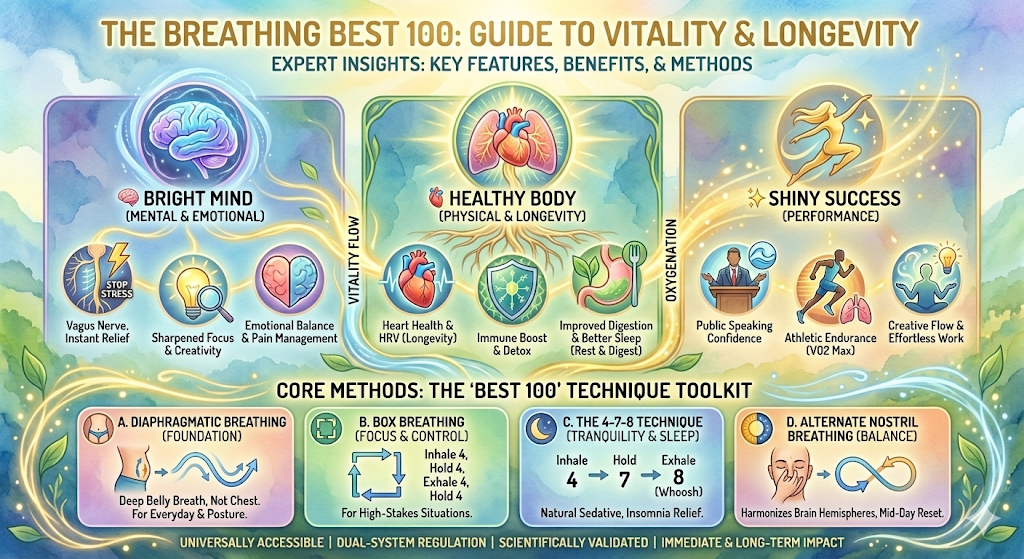
The Breathing Best 100 is a curated collection of the top 100 most effective benefits, features, and techniques of breathwork. It synthesizes ancient wisdom (Pranayama, Qi Gong) with modern science (neuroscience, pulmonology) to provide a “best of the best” toolkit for human longevity and performance.
1. Key Features of the “Breathing Best 100” Approach
These features define why this collection is unique and valuable for your “Best 100 Plus” library.
- Universal Accessibility: The techniques require no equipment, cost nothing, and can be done by anyone, anywhere, at any age (from 1 to 100+).
- Dual-System Regulation: It features methods that can both up-regulate (energize, alert) and down-regulate (calm, soothe) the nervous system.
- Scientific Validation: Every technique included is backed by evidence showing measurable impacts on heart rate variability (HRV), cortisol levels, and blood oxygenation.
- Immediate & Long-Term Impact: The collection focuses on methods that offer instant relief (within 90 seconds) as well as compounding benefits for a 100-year lifespan.
2. Top Benefits to the User
While the full list includes 100 specific benefits, they are best understood in these three powerful categories.
🧠 Mental & Emotional Benefits (The “Bright Mind”)
- Instant Stress Reduction: Activates the Vagus Nerve to immediately switch off the “fight or flight” response.
- Sharpened Focus: Increases oxygen flow to the prefrontal cortex, enhancing decision-making and creativity.
- Emotional Balance: Stabilizes mood swings and reduces symptoms of anxiety and depression.
- Pain Management: Releases endorphins (natural painkillers) and shifts focus away from chronic discomfort.
🫀 Physical & Longevity Benefits (The “Healthy Body”)
- Heart Health: Lowers high blood pressure and improves Heart Rate Variability (a key marker of longevity).
- Immune System Boost: Stimulates the lymphatic system to clear toxins and waste from the body more efficiently.
- Improved Digestion: Shifts the body into “Rest and Digest” mode, aiding in nutrient absorption.
- Better Sleep: Regulates melatonin production and prepares the body for deep, restorative REM cycles.
✨ Performance Benefits (The “Shiny Success”)
- Public Speaking Confidence: Controls the shaky voice and racing heart before a big presentation.
- Athletic Endurance: Increases lung capacity (VO2 max) and delays muscle fatigue.
- Creative Flow: Helps induce the “Flow State” where work feels effortless and enjoyable.
3. The Methods: Core “Best 100” Techniques
These are the gold-standard methods that form the core of the practice.
A. Diaphragmatic Breathing (The Foundation)
- What it is: Breathing deep into the belly rather than shallowly in the chest.
- Technique: Place one hand on your chest and one on your belly. Inhale through the nose so that only the belly hand rises. Exhale slowly through the mouth.
- Best For: Everyday baseline breathing, correcting posture, and general relaxation.
B. Box Breathing (The “Navy SEAL” Method)
- What it is: A rhythmic technique used to heighten performance and concentration in high-stakes situations.
- Technique:
- Inhale for 4 seconds.
- Hold breath for 4 seconds.
- Exhale for 4 seconds.
- Hold empty for 4 seconds.
- Best For: Focus, regaining control during panic, and preparing for complex tasks.
C. The 4-7-8 Technique (The Natural Tranquilizer)
- What it is: A pattern designed to dump tension from the body and induce sleep.
- Technique: Inhale quietly through the nose for 4, hold the breath for 7, and exhale forcefully through the mouth (making a whoosh sound) for 8.
- Best For: Insomnia, falling asleep fast, and calming extreme anger or frustration.
D. Alternate Nostril Breathing (Nadi Shodhana)
- What it is: A balancing technique that harmonizes the left and right hemispheres of the brain.
- Technique: Use the thumb to close the right nostril. Inhale through the left. Close the left with the ring finger, open the right, and exhale. Inhale through the right, close it, and exhale left.
- Best For: Mid-day reset, clearing “brain fog,” and balancing energy.
4. Application in Daily Life
How to weave the “Breathing Best 100” into a normal day to enhance well-being.
| Scenario | Recommended Technique | Why it works |
| Waking Up Groggy | Bellows Breath (Fast, rhythmic inhaling/exhaling) | Wakes up the nervous system like a cup of coffee without the jitters. |
| Morning Commute | Nasal Breathing Only | Filters air and keeps the body calm despite traffic stress. |
| Before a Meeting | Box Breathing (4-4-4-4) | Centers the mind and projects a calm, confident presence. |
| Mid-Afternoon Slump | Alternate Nostril Breathing | Re-energizes the brain and clears mental fog for the second half of the day. |
| Unable to Sleep | 4-7-8 Technique | Slows the heart rate to a sleep-ready pace within minutes. |

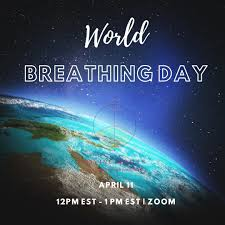
World Breathing Day is observed on April 11th
It is an annual global event created by the International Breathwork Foundation to promote healing and the power of breath. Breathwork refers to any type of breathing exercise or technique for mental, physical, and spiritual wellbeing. And so, it consists of consciously changing breathing patterns. Breathing promotes relaxation, increases energy levels, improves emotional states, and decreases stress levels. We all constantly breathe the same air, yet how often do we acknowledge how critical our breath is? That’s why the international day is dedicated to reconnecting to our human reality!
++++++++
What is IBF?
The International Breathwork Foundation IBF is a non-profit global network established in 1994. All our task force members are volunteers. IBF is open to everyone interested in the use of Conscious Breathing and Breathwork for health, well-being and spiritual practice.
The purpose of the IBF is to promote a heart-centred approach to breathwork, its theory and practice, for the expansion of consciousness and for personal and global transformation.
ABOUT IBF
Uniting and Inspiring People through Conscious Breathing
The IBF is a non-profit international network open to everyone interested in conscious breathing and breathwork. This includes Conscious Connected Breathwork Professionals, organisations and schools as well as individuals and practitioners interested in conscious breathing or those whose lives have been touched by this experience.
“The purpose of the IBF is to promote a heart-centred approach to breathwork, its theory and practice, for the expansion of consciousness and for personal and global transformation.”
The IBF was created in June 1994, during the first Global Inspiration Conference (GIC) in Sweden and was officially incorporated as a non-profit organisation in The Netherlands in June 2000. Principal funding of the International Breathwork Foundation is by annual membership fees.
The IBF has an open, respectful and inclusive spirit to all nations, races, religions, spiritual traditions and breathing techniques and does not adhere to any specific tradition, religious or otherwise.
The IBF serves as a research and documentation centre for collecting, collating and disseminating information from around the world about Breathwork and its diverse theories, techniques, practices, schools and trainings.
++++++++++
Breathing
Read more at https://en.wikipedia.org/wiki/Breathing
Breathing (respiration or ventilation) is the rhythmic process of moving air into (inhalation) and out of (exhalation) the lungs to enable gas exchange with the internal environment, primarily to remove carbon dioxide and take in oxygen.
All aerobic organisms require oxygen for cellular respiration, which extracts energy from food and produces carbon dioxide as a waste product. External respiration (breathing) brings air to the alveoli where gases move by diffusion; the circulatory system then transports oxygen and carbon dioxide between the lungs and the tissues.[2][3]
In vertebrates with lungs, breathing consists of repeated cycles of inhalation and exhalation through a branched system of airways that conduct air from the nose or mouth to the alveoli.[4] The number of respiratory cycles per minute — the respiratory or breathing rate — is a primary vital sign.[5] Under normal conditions, depth and rate of breathing are controlled unconsciously by homeostatic mechanisms that maintain arterial partial pressures of carbon dioxide and oxygen. Keeping arterial CO₂ stable helps maintain extracellular fluid pH; hyperventilation and hypoventilation alter CO₂ and thus pH and produce distressing symptoms.
Breathing also supports speech, laughter and certain reflexes (yawning, coughing, sneezing) and can contribute to thermoregulation (for example, panting in animals that cannot sweat sufficiently).
Read more at https://en.wikipedia.org/wiki/Breathing
++++++++++++++++
10 Breathing Exercises to Try When You’re Feeling Stressed
- Pursed lip breathing
- Belly breathing
- Breath focus
- Lion’s breath
- Alternate nostril breathing
- Equal breathing
- Resonant breathing
- Sitali breath
- Deep breathing
- Humming bee breath
- FAQ
- Takeaway
Several breathing techniques could help you feel calmer and more relaxed if you’re dealing with high levels of stress. All you need is a quiet space where you can pay attention to your breathing.
Read more at https://www.healthline.com/health/breathing-exercise
 the Yogic lens
 Andrew Huberman
In this episode my guest is Dr. Jack Feldman, Distinguished Professor of Neurobiology at the University of California, Los Angeles and a pioneering world expert in the science of respiration (breathing). We discuss how and why humans breathe the way we do, the function of the diaphragm and how it serves to increase oxygenation of the brain and body. We also explore how breathing influences mental state, fear, memory, reaction time and more. Additionally, we cover specific breathing protocols such as box breathing, cyclic hyperventilation (similar to Wim Hof breathing), nasal versus mouth breathing, unilateral breathing and how each of these affects the brain and body. We examine physiological sighs, peptides expressed by specific neurons controlling breathing and magnesium compounds that can improve cognitive ability and how they work. This conversation serves as a sort of master class on the science of breathing and breathing-related tools for health and performance. For an up-to-date list of our current sponsors, please visit our website: https://www.hubermanlab.com/sponsors. Previous sponsors mentioned in this podcast episode may no longer be affiliated with us. Our Breath Collective: https://www.ourbreathcollective.com/h…
Andrew Huberman shares a breathing practice called “cyclic sighing,” which improves mood, reduces stress, and induces a state of calm.
His explanation is followed by a 5-minute guided breathing session as a first introduction to cyclic sighing.
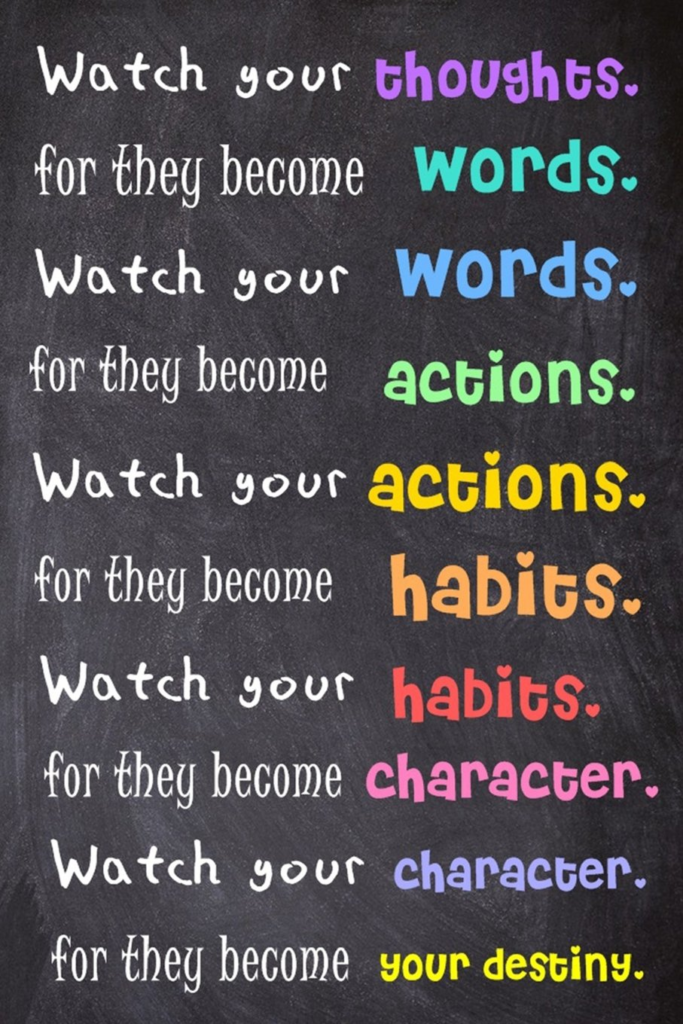
Watch Your Thoughts; For They Become Words.
Watch Your Words; For They Become Actions.
Watch Your Actions; For They Become Habits.
Watch Your Habits; For they Become Character
Watch Your Charecter; For They Become Your Destiny
On Every Page, Journal & Diary 100 Pages Paperback Book
by Motivational Journal Lover (Author)
At https://www.amazon.com/Thoughts-Actions-Actions-Habits-Journal/dp/1975791487
+++++++++++++
( This page is under development. Renewal, updates, and upgrades will be a gathering place for all who look and pay attention to celebrate the full moon, connecting with the moon’s powerful energy and people. )
Everyone who loves the moon, especially the full moon
After a lovely first honeymoon, continued by a monthly full moon honeymoon

“This website is under construction.”
Disclaimer of Liability Notice:
This blog post is intended for entertainment, promotional, motivational, and informational purposes only for informational purposes only and should not be taken as professional or medical advice. Always consult with healthcare and other professionals in the field of their expertise before making any changes to your life or health routine.
For more information, please refer to the Disclaimer of Liability section found at the bottom of this page.
Disclaimer of Liability
The information, books, ebooks, written words, pictures, audio, videos, products, services, material plus any other (collectively referred to as “the Content”) in this site and related sites or other all are for ( Pak company, www.Best 100 Plus.com, Promotional Guide, 4Seasons Gardens, Smart ebooks Reading, and other sites or webpages, as well as mobile sites any third-party or links ) are only intended for promotional, entertainment, informative, and educational purposes. The contents may presented in idealistic, dreamy, wishful thinking, positive, and “rosy” language, or is AI recommended for general information, writing science fiction or fictional stories, advertisement, marketing, promotion, and entertainment activities for adults.
Accuracy and Completeness
We make reasonable efforts to make the information on our websites accurate. However, information may contain errors, mistakes, or oversights and may become outdated over time. We do not guarantee the accuracy, completeness, suitability, or timeliness of any information, products, services, or other materials provided.
No Replacement for Professional Advice
The information on our websites does not replace medical, legal, financial, or other professional advice. Any content related to health, wellness, or potential benefits of red roses or rose products should be considered from a general perspective only. Always consult with qualified professionals in their respective fields before making any health-related, legal, financial, or other decisions based on information found on our websites.
Users are always advised to consult and seek qualified direct advice from medical professionals or experts in their respective fields before making any health-related, legal, financial, or other decisions regarding their health or other concerns for more direct, reliable advice and guidance on their choices and actions. The use of any information provided on the Pak Company sites, the Promotional Guide, or any third-party sources is all strictly and solely at your own risk.
Reliance at Your Own Risk
Any content related to health, wellness, or potential benefits of red roses or rose products should be considered from a general perspective only. The use of any information on our websites and reliance on any information provided is solely are at your own risk.
Pak Company and its websites and affiliates do not guarantee the accuracy, adequacy, validity, reliability, availability, upgraded, up-to-date, or completeness of all Content. We disclaim no any and all liability or responsibility for any content, products, or services arising from your use of Content found on our websites.
All Content, including advice and information related to health, legal, or professional matters, is not meant to be and should not be interpreted as professional advice. It is not intended to diagnose, treat, cure, or prevent any disease, nor should it be used as a substitute for the consultation, guidance, or advice of a legal, medical, financial, or any other professional services provider.
It’s advisable to consult with a local medical, legal, or financial professional and expert to ensure compliance with local regulations in the field of interest for more direct, reliable advice and guidance for your choices and actions, which are all strictly and solely on your own risk.
Third-Party Content
Our websites may contain links to third-party websites or services. We do not control or guarantee the accuracy, adequacy, validity, reliability, availability, upgraded, up-to-date, or completeness of all Content of these external resources. We strongly advise you to review the terms and conditions and privacy policies of any third-party websites or services that you visit or use. We assume no liability or responsibility for any content, products, services, or actions of third parties.
Acceptance of Terms
We disclaim any liability or responsibility for all Content, products, or services arising from your use of Content found on our websites or any third-party sources.
By accessing and using any information or all Content on this website and Promotional Guide, 4Seasons Gardens, Smart ebooks Reading, Best 100 Plus, and other sites or webpages, as well as mobile sites, and any third-party sources, you acknowledge that you have read and agree to this Disclaimer of Liability in its entirety.
If you do not agree with these terms, please discontinue using our websites. You are not authorized to use or access the Content provided, and you must not use these sites!
Modifications
We reserve the right to update or modify this Disclaimer of Liability at any time without prior notice. Changes will be posted on our websites and become effective immediately. Your continued use of the websites and Content following any changes posted constitutes your agreement to the revised terms.