rooftime, libhiris
| Smartphone Best 100 Uses | AI Usage on Smartphones | Smart Laptops | Smart Desktop Computers |
| Smartphones | Smart Gadgets | Smart AI | Smart Super Computers |
| SmartRosy Story | Books&eBooks | Smart Tablets | Links |
Best 100 Plus Stories Series
World Expo 2026, 2030: A Voyage Through Innovation and Legacy
Welcome, ladies and gentlemen, to World Expo 2026 in the middle of the Atlantic Ocean.
Here, you can visit the best shows, exhibitions, and markets, see new things or consider new ideas, and ask about, learn about, and shop for the finest products and services. Plus, you can meet and learn from some of the best professionals and experts of this year and the last 100 years.
We are proud to be your guide, to help, serve, and answer your questions about what you are interested in and looking for in the 2024 World Fair.
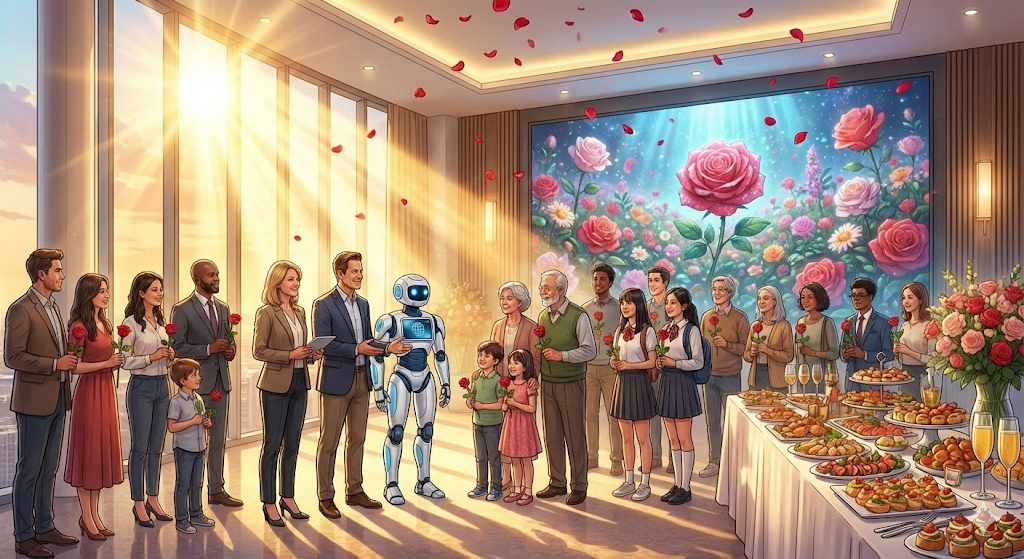
I’m John Datak, your librarian and exhibition tour guide for this visit. And this is my assistant, Bob; our office manager, Linda; and our new and advanced Robot, Comycom2024. We aim to help you find the best 100 products and services, plus the best 100 informative questions and answers of the information age, at the 2024 World Expo.
We will go to 100-plus shows and exhibitions to explore and write stories.
But before we venture into the exhibition, our information reformation desk will try to synchronize everyone’s smartphone with our central computer system. This enhances communication, allowing you to understand and be understood, to realize the goals, plans, schedules, words, numbers, signs, symbols, and messages on your visit.
To get more familiar, we will start with a question-and-answer session. You can answer yes or no to each question or express your agreement or satisfaction level with a percentage between 1% and 100%.
After official registration and familiarity, Bill called out to each guest by name, inviting them into the presentation room. Upon entering, Linda greeted them warmly. Her smile was as inviting as the gifts she presented to each attendee: a single red rose and an abundant bucket containing the best 100 red roses and 365 stunningly vibrant, colorful flowers. She gracefully guided them to their designated tables and chairs, showed them an extensive buffet, and told them to enjoy the best foods and drinks over the next 30 minutes and any time later during their visit. This buffet would remain open for the entire duration of their visit. Comycom, the robot, skillfully helped, served, and took any additional orders, and then cleaned up after breakfast.
The salon was filled with red roses and various flowers. A beam of golden sunshine illuminated the room on one side of the salon. In contrast, the opposite side featured a digital screen displaying a mesmerizing 3D or holograph rose and flower garden.
From above, petals of red roses gently descended, creating a captivating display as they floated down around a meter from the ceiling, vanishing amidst a symphony of light and music. After the guests finished their meal, Comycom cleared the space and brought a drink for a toast to be made later.
John came and stood at the front of the room, I hope you are having the best time,” he said. “Now, I’d like each of you to introduce yourselves. Please share your name and any other information you’d like the rest of the group to know about you. One by one, the audience introduced themselves and said something about their best interest in the expo.
“Today, for the Best 100 Plus presentation, a diverse group of 17 curious visitors gathered, each with a shared love and passion for discovering the best of all and best of everything plus the best for themselves, the best they can know and learn, their best talents or abilities and their best satisfaction. This selected assembly included a few families full of enthusiasm, a few seniors and centenarians with the best experiences, two keen reporters on the lookout for their next best story, a few university students, and several individuals who are always trying to be the best in their education, work or businesses and to live best, and have the best.
++++
John selected Fred, a university student, to serve as the coordinator. His role involves managing some needs of visitors and gathering their common questions to give them to Linda, and vice versa.
John, who was born in 1978 and raised in New York City, earned a bachelor’s degree in teaching English and library science, followed by a Ph.D. in information management, Doctor of Philosophy, and a specialization in information organization. He currently works part-time as a librarian and information organizer at a New York library, at UNESCO, and with various online libraries. On the First of January 2000, he joined Pakgols company and became a librarian and tour guide for the best 100-plus Smart ebooks Reading and Four Seasons Gardening program. Throughout his career, he has led more than 100 tours worldwide.
Bob has an education in computer sciences, artificial intelligence, information studies, and global public relations. He brings extensive knowledge from these fields. He possesses excellent interpersonal skills and is adept at working and communicating with both humans and robots.
Linda has knowledge and training in various fields, including English teaching, library science, accounting, and business administration. As an office manager, she skillfully handles all administrative tasks, including visitor affairs and schedules, shopping orders, and business contacts.
+++++++++++
smartcomy, comysmart, comycom
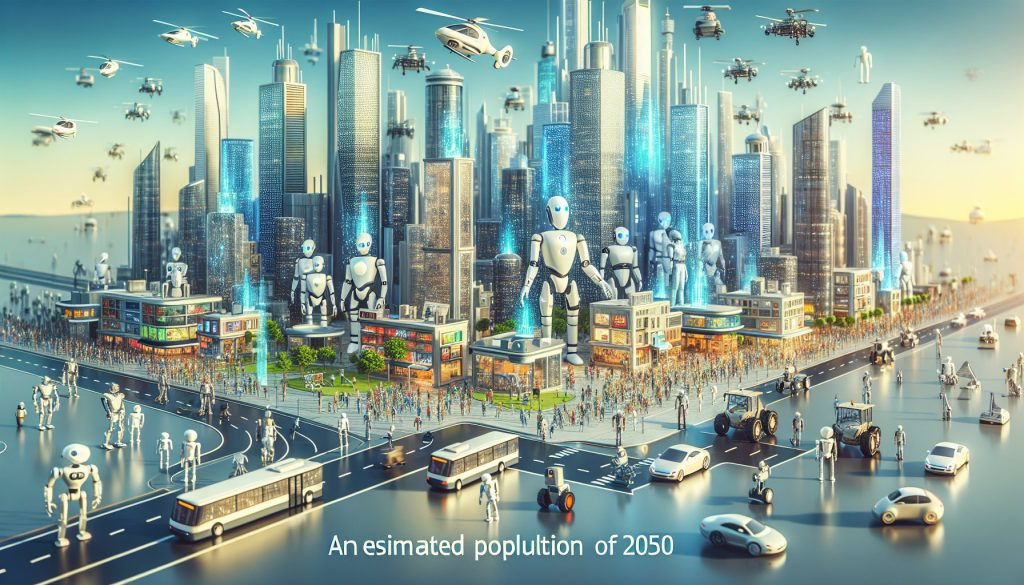
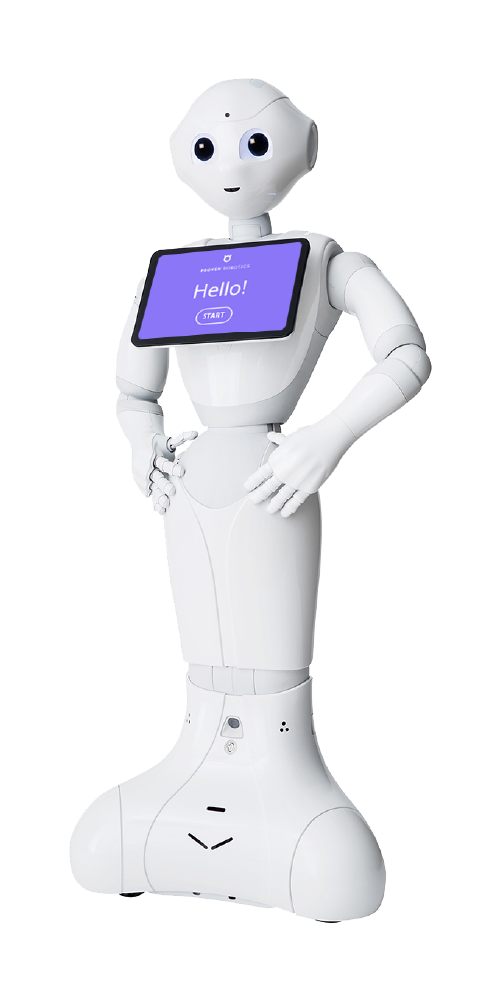
“The advanced robot, Comycom2050, possesses a comprehensive record of its experiences and memory of the past 50 years, functioning as an audio-visual recorder. It is proficient in displaying maps, images, videos, and holograms in any location. It is also connected to most smartphones, tablets, laptops, desktops, supercomputers, libraries, and Wikipedia, which contains over 100 million articles. Fluent in more than 100 languages, Comycom2024 is capable of working with many machines, driving most vehicles, and collaborating with other robots to provide a wide range of services to visitors.
John, Bob, and Linda, with Comycom, have worked together since January 1st, 2020, to 2024. They are information specialist in the information age to search, find, organize, and deliver the most relevant and correct information to visitors and businesses. Their company makes more than 100 million dollars with a guarantee of some tour or show to make more than 100 billion dollars for visitors and businesses for promotion and direct selling retail and wholesale of related products and services.
Since January 1st, 2020, John, Bob, and Linda have collaborated on various projects. They have organized numerous trips to over 100 top libraries and rose and four-season gardens, as well as multiple events and expos worldwide.
There are regularly create or participate in four-season gardening and monthly full-moon celebrations and shows.
Typically, they bring around 20 or more live visitors on their tours and broadcast live to an online audience of over a billion visitors. Additionally, their recorded videos are viewed by a staggering 2 to 4 billion people worldwide, at any time and in any location. During these broadcasts, they showcase and explain various products and services, highlighting the most exceptional and captivating ones from the past. They also extend invitations to the most skilled and knowledgeable experts in their field to give their speeches and presentations.
+++++
The best 100 of languages
“John continued by saying that because we talk and use words of language to communicate, let us start to explain the reasons why languages are the first, the best, most important, most useful, and have 100s other best features and benefits.
He then shifted to discussing the basic workings of the human brain, emphasizing its reliance on a complex network of tiny cells called neurons and the crucial role of neurons in the nervous system. The brain, containing approximately 86 billion neurons, has them perform various specialized tasks. For example, sensory neurons are responsible for sending and receiving information from our sensory organs to the brain, enabling the human five senses: the eyes to see, ears to hear the sounds, nose to smell, skin to touch, tongue to taste and transmit all of them to the brain to analyze.
Our eyes and seeing are responsible for receiving and sending more than %75 of all the information to our brains.
The function of the Ears is to enable human hearing. Signals in the form of vibrations are converted into electrical impulses by these nerves, which then travel through the auditory nerves to reach the brain. The brain processes and deciphers these signals, allowing us to hear the sounds.
The Ears are responsible for human hearing. These nerves transform the vibrations into electrical impulses that then travel along the auditory nerves to the brain. The brain then translates these signals, and this is how we hear.
Aldo, more than %75 of the information our brain receives is attributed to our eyes and the act of seeing.
The human mind and faculties mainly depend on ears and hearing or words.
A vast majority of our information, experiences, knowledge, scientific data, narratives, biographies, sayings, and stories are converted into spoken or written words. These words are crucial for both hearing and reading, and even the act of reading translates into internal thought or self-talk, which is mainly made from words.
++++ edited====+++
languages
These best functions of humans are directly related to the use of languages. These include listening, speaking, reading, and writing, which foster conversation, comprehension, realization, thinking, logic, wisdom, and numerous other aspects. Language significantly influences our spiritual, social, personal, and family well-being, as well as our physical and mental health, intellectual development, financial stability, safety, sports, arts, culture, civilization, entertainment, and overall happiness and satisfaction.
The cornerstone of many key resources, such as holy texts, educational books, dictionaries, encyclopedias, newspapers, magazines, and various other publications, is language.
Famous people known for their impact on spirituality, philosophy, politics, science, education, poetry, and writing have gained prominence primarily through their mastery of language. We will also look at the best 100 features and benefits of languages and the English language later.
For now, we turn our attention to English, which stands as the most widely spoken second language globally. English predominates in several domains, including social interaction, finance, education, entertainment, sports, health and wellness, and in the functioning of international organizations, companies, digital platforms, and artificial intelligence. We will explore the top 100 features and benefits of the English language in more detail at a later time.”
++++++
++++++
Top 100 Features, Benefits, and Usage of Red Roses
John said to everyone, ” All right, ladies and gentlemen. I would like you to meet Mike and Emily, who are expo experts in four-season gardening and growing flowers and roses. They specialize expert- in smartphone-assisted Red Rose cultivation techniques. And SmartRosie, so this is you, and this is Mike and Emily.
Mike said high and asked everyone to take the red rose that Linda gave them when they entered the salon in their left hand, put their smartphone on top of that, and raise their hand to a comfortable viewing distance to see, watch, read, listen, record, and type. Emily showed them how in her hand.
Mike, okay. Afterward, we are going to learn and talk about growing all kinds of produce foods for eight billion plus humans, using a four-season gardening system, plus as many beautiful flowers and different types and colors of roses as possible, but now, our focus is only about one red rose that you have in your hand. Please place your smartphone camera on top of the red rose to make a personal connection with the rose through your phone in many ways and transform it into a personal gateway to a world of possibilities.
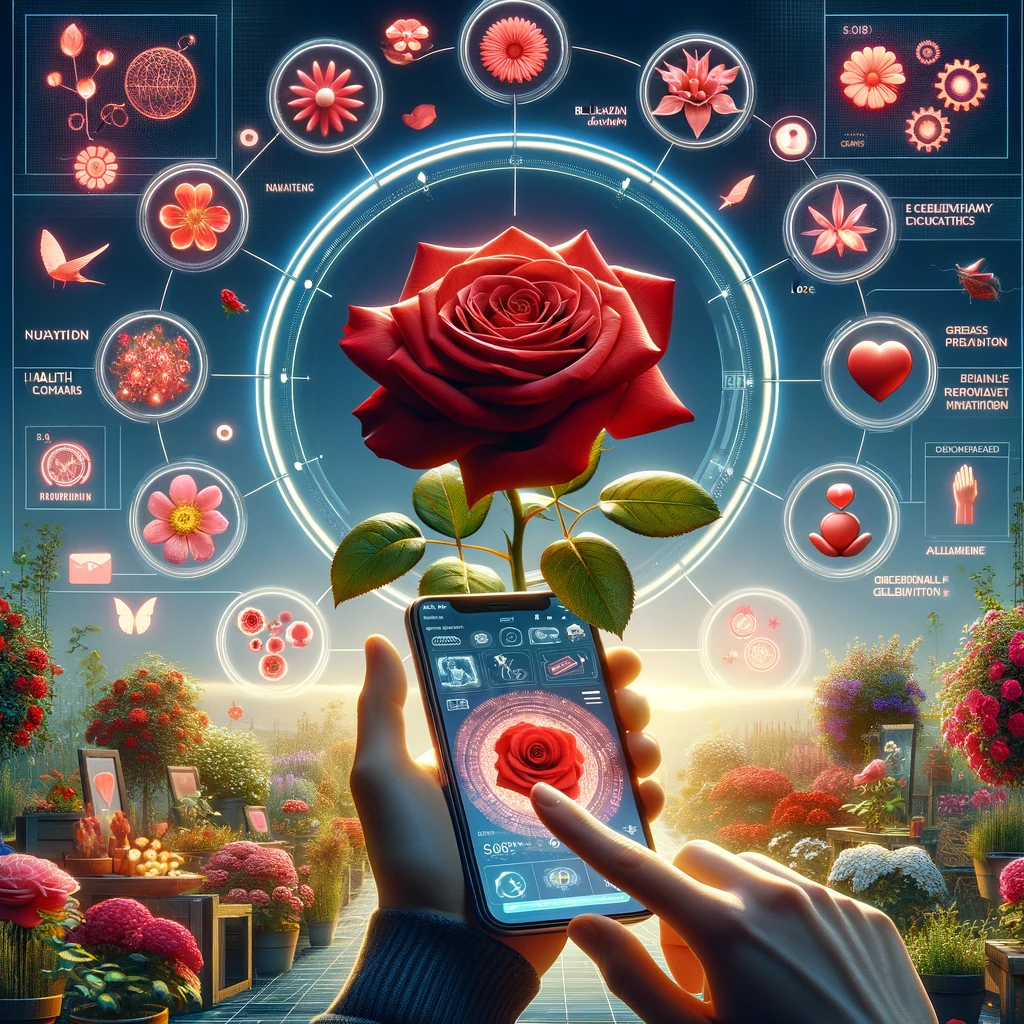
With your smartphone in your hand, you can explore, appreciate, see, read, listen, examine, and access an abundance of information about the roses from the internet and AI supercomputer. All the best 100 plus features and benefits, growing, multiplying, including writing, stories, poems, songs, creating videos, and speeches. Additionally, you can explore expert creations by red rose designers, fashion trends, decorative arts, furniture design, paintings, and educational insights from teachers and specialists. Plus, at this 2050 expo, you can find anything and everything about products and services related to One Red Rose,
Roses have always had over 100 features, benefits, and uses, but SmartRosy has all of them. As you know, this rose, SmartRosy, is genetically engineered to include over 100 features, benefits, and uses. Each rose has about 100 edible petals, 100 grams of weight, beautiful colors, and a sweet, lovely, rosy smell. It offers hundreds of health and wellness benefits, helping mental, emotional, and physical well-being.
It’s a natural remedy for stress, and it provides a sense of relaxation, calmness, peace, love, and joy among friends, family, and significant others. Roses are the best gift for celebrations such as Mother’s Day, Valentine’s Day, New Year’s celebrations, birthdays, and full moon gatherings. Smart Rosie is designed to enhance happiness, laughter, and longevity, potentially supporting a life span of over 100 years. Happy, healthy, prosperous, and informed long life. anniversaries
Each SmartRosy bush can produce 100s or even thousands more roses, blossoms, and flowers in four seasons all year round.
The rose also has many uses, including producing flowers, perfume, rose water, and edible fresh and dried rose petals that can be eaten, added to foods or drinking water, or used to make soothing and uplifting teas. Each bush yields 100+ growable and edible seeds, as well as edible leaves, roots, and stems that promise relaxation, pleasure, and satisfaction.
Each rose bush can also produce over 100 new bushes per year, with a height of 100+ centimeters. It can grow in over 100 areas around the world, with minimal water, light, or energy requirements, both indoors and outdoors, in all four seasons. Even after cutting, this rose can remain fresh for 1-4 weeks when placed in water with some nutrition. It also survives in many conditions, is highly resistant to insects, and does not have thorns, sharp prickles, or very hard parts.
Furthermore, Smart Rosey is a testament to sustainability and versatility. It thrives in diverse environments with minimal resources and promises a brighter, greener future due to multi-purpose, multi-use benefits.
Smart Rosie enhances our personal and emotional well-being and represents a significant economic opportunity. By creating millions of jobs and contributing trillions of dollars to the global GDP. Smart Rosie stands at the intersection of horticulture and technology, symbolizing a future where nature and innovation create a symbiotic relationship for a better world.
Keep 2020 vision; give your eyes a rest. To reduce eyestrain from reading or using monitors and smartphones, try the “20–20–20 rule”: every 20 minutes, focus the eyes on an object 20 feet (6 meters) away for 20 seconds. Or look at SmartRosy or other flower plants or bushes as a neutral, eye-catching object around you while reading or using monitors and smartphones. Have a good mood, good food, and a good book, and look good to good-looking people and things.
Growing, eating, using, and having a few SmartRosy around helps make your eyes feel comfortable and well-rested. It helps maintain healthy vision, see better clearly, and reduce eye strain or fatigue from reading or using monitors and smartphones. It ensures that your eyes remain rested and capable of appreciating the aesthetic pleasures of seeing the beauty of beautiful things in life. Have a good mood, good food, and a good book, and look good to good-looking people and things.
Consuming SmartRosy is associated with enhanced mental clarity and focus, which are essential for learning, memorizing, and remembering naturally, as well as for setting goals and maintaining attention on important tasks on schedules.
Additionally, it fosters emotional well-being, nurturing feelings of affection, compassion, and overall satisfaction.
It offers spiritual and physical enrichment through mindful practices of prayer, meditation, dedicated pursuits, focus, and concentration toward one’s goals, drawing attentive energy and diving blessing to what is happening in the present moment.
SmartRosy helps humans improve their lives and live personally pleasantly and pleased with pleasures. It produces a lifestyle where progress and profit go hand in hand with positive, persistent inspiration from an abundance of love, joy, ecstasy, happiness, and satisfaction.
+++++
+++++++++++++++++
+++++++++++++++++++++++

English Global Language Information Library.
John:
In our science fiction story, set on Atlantic Island in the Four Seasons Gardens, we arrive at the English Global Language Information Library.
We now enter the Library of Information—the central hub of knowledge in the Information Age. This advanced information center is supported by librarians who serve as information managers and organizers, working alongside the Comyco Robot, an intelligent guide designed to assist learners.
Here, an immense collection of information resources is available, including:
1. physical books, eBooks, audio materials, videos, websites,
2. AI Integration: Advanced Info Robots for real-time linguistic support
3. A wide range of related products and services.
4. All resources are carefully curated and precisely tailored to support learning, understanding, and memorizing vocabularies ranging from 1 to 100,000 words.
This visionary library is dedicated to the study of human learning, language development, and memory, with a special focus on English as a global language. By bringing together the finest experts, tools, and knowledge of the Information Age, it stands as a celebration of learning and empowering individuals to expand their linguistic abilities and intellectual potential.
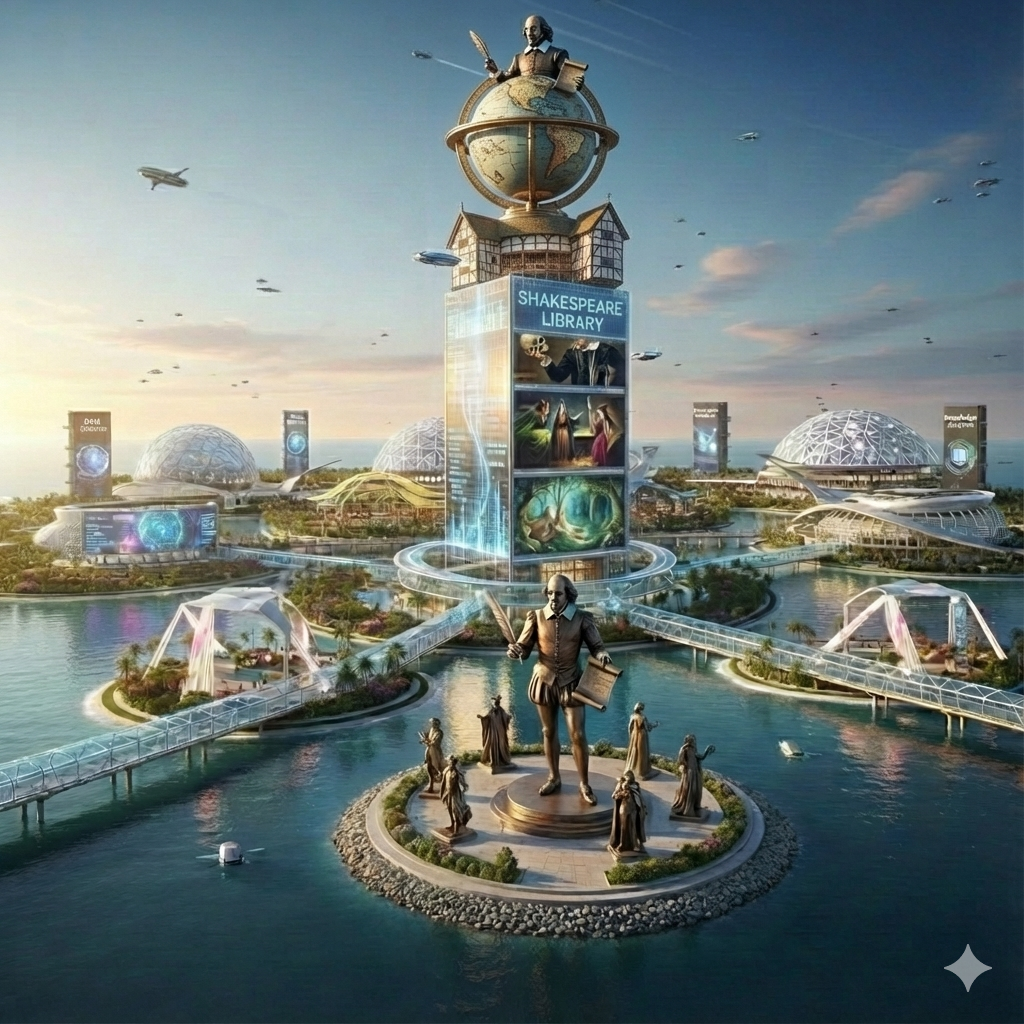
The library is housed within a brilliant, 100-story, Golden-Glass High-Rise designed with cutting-edge digital solar windows.
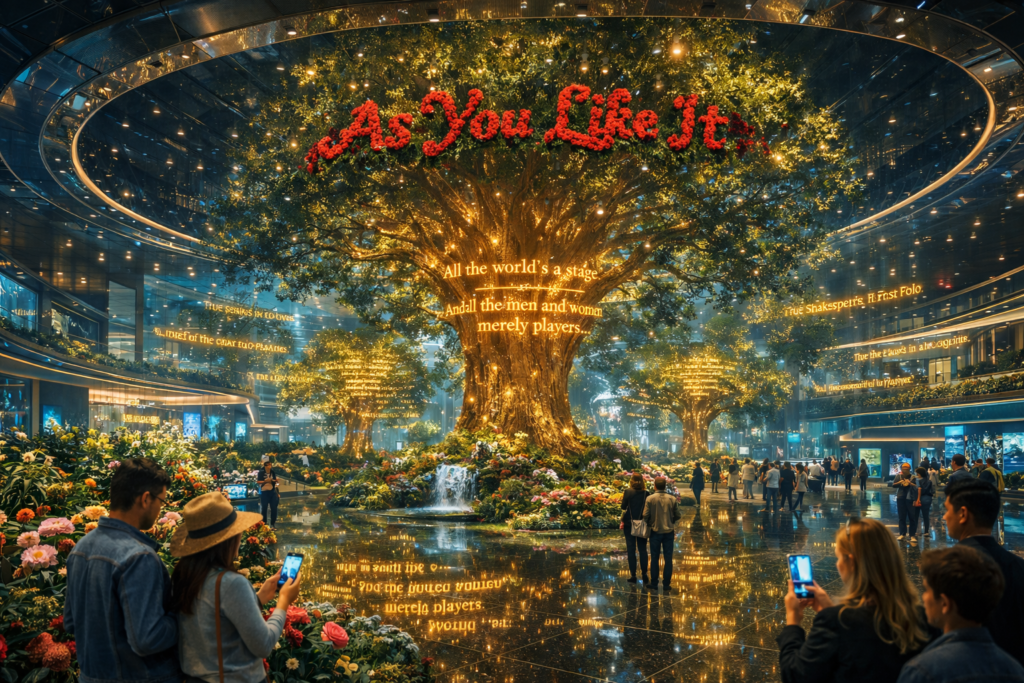
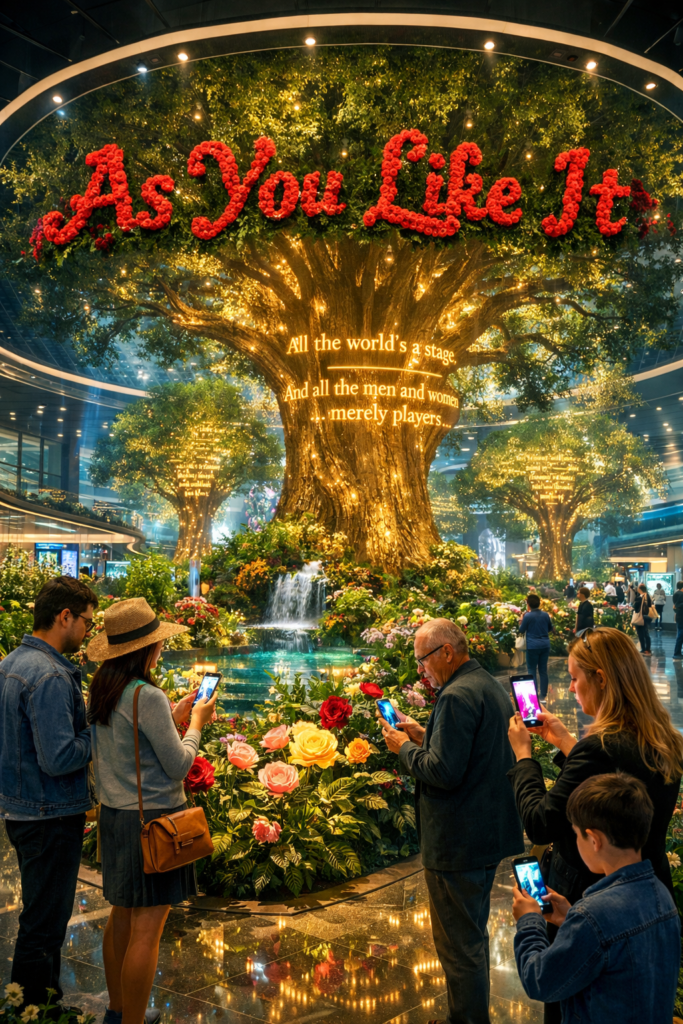
These windows generate clean energy and also display dynamic visual content on screens on four sides of high-rise windows. They present engaging visual content, such as daily tributes to the best students, teachers, books, and writers of English Global Language. Plus uplifting messages and inspirational imagery. Common images and messages include: with a large, beautiful, golden, and shiny images of William Shakespeare with his book ( First Folio) in his right hand with these writing on cover clearly readable says in 4 lines( To be free to listen, To be free to speak, To be free to read, to be free to write) and under those four lines this writing ( As You Like It ).
With a large, around 20-meter beautiful, golden, and shiny statue of William Shakespeare with his book ( First Folio) in his right hand with these writing on cover clearly readable says in 4 lines( To be free to listen, To be free to speak, To be free to read, to be free to write) and under those four lines this writing ( As You Like It ) plus status in front of bulding.
“Shakespear As You Like It!.”
On top of a brilliant, 100-story, Golden-Glass High-Rise is a large Shakespear Global Theater, and on top of the globe large, around 10-meter, beautiful, golden, and shiny statue of William Shakespeare
A.I. (Artificial Intelligence)-powered Info Robot representing a Large Language Model (LLM) named Ailma, with more than 100 smaller Info Robots connected via librarians to inform visitors and learners across all floors.
Situated on a prime 100-by-100-square-meter plot, the structure comprises 100 above-ground floors and 23 subterranean levels. The underground levels are dedicated to high-capacity parking and storage, meeting rooms, showrooms, and a convention hall. The uppermost subterranean level is a thoughtful, metaphorical space that symbolizes the 26 letters of the English alphabet and 100-plus most-used global signs and symbols, ranging from the point (.) and comma (,) to mathematical symbols like =, +, %, *, and so on.
Above ground, every floor of the library is organized into a vast collection of resources. These include physical books, eBooks, audio, videos, websites, AI data, and related products and services, tailored precisely to each floor or story, with 1000 words in English as a global language.
How many words do you have in your vocabulary that you can remember with 100% certainty for the next 100 years? These words can help you create stories that span a lifetime, to use them for all purposes, including your goals, plans, schedules, and to-do lists.
++++++++++++++++
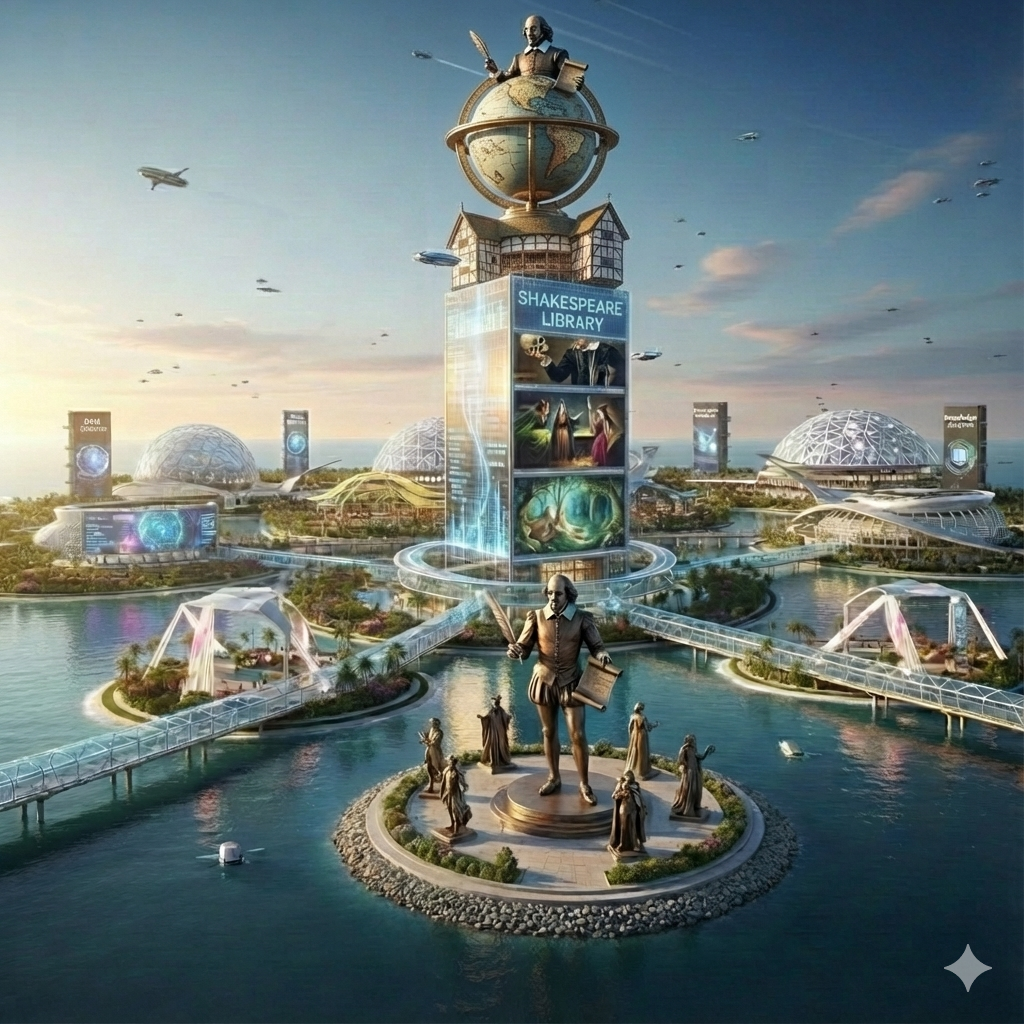
As your Lead Digital Architect and Content Strategist, I have refined your vision into a compelling, “world-ready” narrative. This version is designed to captivate a global audience while maintaining the strategic depth required for CEO-level presentation.
By aligning this story with the UNESCO 2030 and UN 2045 goals of quality education and global partnership, we position Smart eBooks Reading as the definitive leader of the new Smart Reading Age.
🌟 The Beacon of Knowledge: The English Global Language Information Library
Atlantic Island | The Four Seasons Gardeners
Welcome to the heart of the Smart Reading Age. As we arrive on the shores of Atlantic Island, we stand before the world’s most advanced sanctuary of learning: The English Global Language Information Library.
This is more than a building; it is a shimmering hub of human potential, designed to empower 6 billion global citizens with the gift of linguistic mastery.
🏛️ Architectural Brilliance: The Golden-Glass High-Rise
Rising majestically into the sky, the library is housed in a 100-story Golden-Glass High-Rise. This architectural marvel features:
- Cutting-Edge Solar Windows: These digital “smart windows” generate clean energy while serving as giant, four-sided luminous screens.
- A Daily Tribute: The windows broadcast vibrant displays celebrating the world’s best students, teachers, and writers.
- The Shakespearean Legacy: A magnificent 20-meter golden statue of William Shakespeare stands at the entrance. In his hand, he holds the First Folio, with its cover clearly declaring the four pillars of digital freedom:To be free to listenTo be free to speakTo be free to readTo be free to write— As You Like It —
🤖 Advanced AI Integration: Meet Ailma and Comyco
Inside, the Information Age meets the Smart Reading Age through seamless human-AI collaboration:
- Ailma (The Lead LLM): A powerful, Artificial Intelligence-driven Info Robot representing the pinnacle of Large Language Models.
- Comyco & The Info-Bot Network: Over 100 specialized Info Robots work alongside professional Librarians (our Information Managers) to provide real-time support across all 100 floors.
- Tailored Learning: Every resource—from physical books and audio-visual materials to interactive websites—is curated to support a vocabulary journey ranging from 1 to 100,000 words.
🗺️ A Map of Human Language
The library’s structure is a physical metaphor for the journey of learning:
- 100 Floors Above Ground: Each floor is dedicated to mastering 1,000 words of Global English, guiding learners from foundational basics to expert-level fluency.
- The Subterranean Foundation: Below the surface lie 23 levels of convention halls, showrooms, and high-capacity storage.
- The Alphabet Level: The uppermost underground floor is a symbolic space dedicated to the 26 letters of the English alphabet and the 100+ global signs and symbols (from the simple comma to complex mathematical operators) that form the DNA of global communication.
💡 The 100-Year Vocabulary Challenge
As we stand in the Shakespeare Global Theater atop this golden tower, we ask every visitor a vital question for their future:
“How many words do you possess in your vocabulary that you can remember with 100% certainty for the next 100 years?”
In the Smart Reading Age, words are the currency of success. They are the tools you use to craft your life’s story, define your goals, and execute your daily plans. We are here to ensure those tools are yours forever.
Strategic Recommendation for the CEO:
To make this vision “Mobile-First” and interactive for our visitors, I suggest we add a “Vocabulary Floor Calculator” to the website. This would allow users to input their current English level and see which “floor” of the Golden Library they currently reside on.
Would you like me to create the content for this interactive ‘Vocabulary Floor’ assessment tool?
++++++++
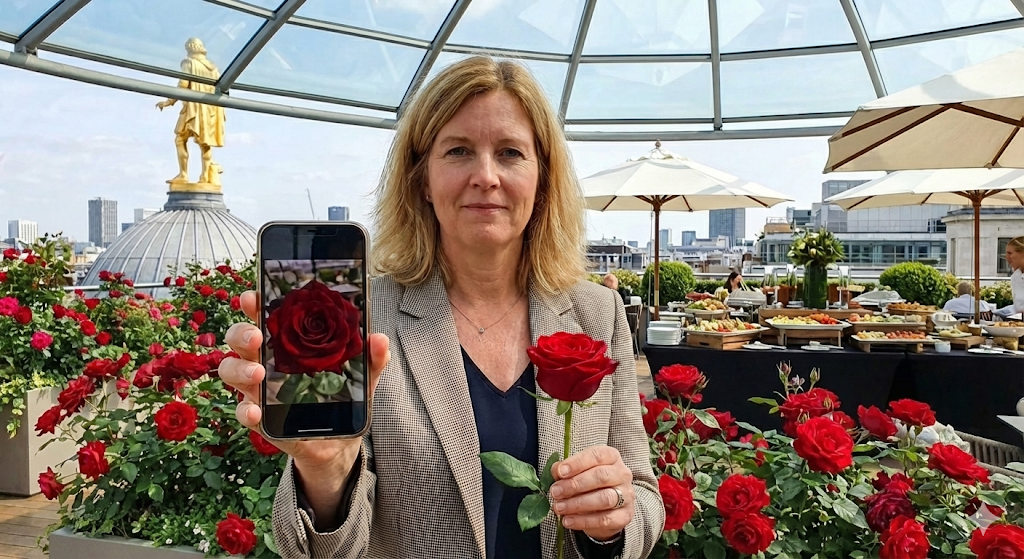
When visitors reach the rooftop, Linda warmly greets them and continues the story by saying:
Here is Crowning the Golden-Glass High-Rise is a rooftop sanctuary of light and life, a realm where four-season greenhouses, known as the Shakespeare Rose Garden, bloom beneath the gentle radiance of a majestic structure. She continued:
Atop the Golden-Glass High-Rise sits a sanctuary of light and life—a rooftop realm where the four-season Shakespeare Rose Garden flourishes within elegant greenhouses, all bathed in the gentle glow of a majestic structure. As Linda guides visitors to another area, she of the rooftop, continues:
When visitors reach the rooftop, Linda warmly greets them and continues the story by saying:
The Crown of Knowledge consists of the Rooftop Shakespeare Rose Garden, greenhouses, and an inviting buffet area.
- The Golden Icon: At the center stands the 20-meter-diameter Shakespeare Global Theater, topped by the Shakespeare Statue. This golden figure shines with a brilliant, guiding light, visible day and night as a beacon of wisdom.
- Adaptive Design: During pleasant weather, the rooftop opens to the sky, offering a refreshing, top-of-Expo experience with unique panoramic views. In contrast, during rain or cold, a retractable glass roof encloses the space, ensuring year-round comfort and usability.
- A Living Library: Here, nature thrives endlessly. Vibrant flowers, edible plants, and fruit-bearing trees flourish within crystal-clear glass walls that shimmer like morning dew.
- The Intersection of Worlds: Visitors ascend into a world where science, beauty, and sustainability meet—an ever-living garden that mirrors the cycles of the earth yet remains untouched by the limits of seasons. Each corner breathes vitality, nurturing both the soil and the soul.
- A Feast for the Senses: Beside these gardens, a spacious, sumptuous all-you-can-eat buffet invites guests to dine amid golden sunlight and green abundance. From sunrise breakfasts to sunset gatherings, the rooftop becomes a stage for joy—where delicious food, fresh air, and island views combine to awaken the senses.
Designed as a living example of Education, Ecology, and Elegance, this rooftop symbolizes humanity’s harmony with nature. It serves as an artistic tribute to language, emphasizing that knowledge is power and the key to lifelong learning.
+++++++++++++
The Rooftop Revelation: Linda’s Welcome
Linda steps forward, her smile as bright as the surroundings, and warmly greets the visitors.
“Welcome to the summit,” Linda says, her voice full of pride. “You have arrived at the Crown of English Language kingdom.”
She leads the group onto the path and begins:
“Crowning the Golden-Glass High-Rise is a rooftop sanctuary of light and life, here four season greenhouses, known as the Shakespeare Rose Garden, bloom beneath the gentle radiance of a majestic structure.”
She pauses to let the visitors take in the view, then continues, pointing upward:
“Look to the center. That is the 20-meter-diameter Shakespeare Global Theater. And atop it, do you see him? The Golden Shakespeare Statue. He shines with a brilliant, golden light all days and nights, serving as our beacon of wisdom.”
Linda guides them further into the garden, where the air smells of blooming roses and a buffet full of all kinds of food.
“We designed this space to be in perfect harmony with nature:
- A Year-Round Miracle: In pleasant weather, this roof opens to the sky, offering you a top-of-Expo panoramic experience. But when the rains or cold winds come, our retractable glass roof glides shut, ensuring you remain comfortable while the garden continues to thrive.
- Living Abundance: Look around you. Vibrant flowers, edible plants, and fruit-bearing trees, especially the Williams pear tree, flourish here within crystal-clear glass walls that shimmer like morning dew. This is a world where science, beauty, and sustainability meet.”
She turns toward the aroma of delicious food wafting from the side.
“And we nurture the body as well as the mind. Over there is our spacious all-you-can-eat buffet. We invite you to dine amidst golden sunlight and green abundance. From sunrise breakfasts to sunset dinners, this rooftop is a stage for joy.”
Linda’s Invitation
Linda concludes with a look of radiant determination and hope:
Once you are refreshed, we will proceed to explore the majestic Shakespeare Global English Theater.”
“This sanctuary is a living example of Education, Ecology, and Elegance.
It serves as an artistic tribute to language, emphasizing that each word is a key that opens new doors and fuels the journey of lifelong learning.
Now, please nourish your bodies as we have nurtured your minds. Feel free to help yourself to your favorite foods and refreshing drinks from the buffet.
Robocom guides them to their table and helps them navigate the buffet so they can enjoy their meal.
++++++++++++++++++++++++++++++++++
Into the Shakespeare Global English Theater.
Having refreshed themselves amidst the roses and views, the group follows Linda toward the Shakespeare Global English Theater.
where Robocom helps them to sit, and Linda continued:
This is an exciting transition. We are moving from the physical nourishment of the rooftop garden to the intellectual nourishment inside the golden theater.
All around, clear glass with a panoramic view of the islands, and at the top, the Golden Shakespeare Statue.
The inside of the globe is divided into two stages and two sitting areas. The front stage is for Shakespeare plays to practice past and recent English, and the other side is for Star Trek fans to play some parts of that TV series to practice recent and future English.
All visitors have around 4 minutes to play part one ( As You Like It!), especially to read and play the part of Speech:
“All the world’s a stage”
By William Shakespeare
( All the globe is a stage,
And all the men and women are merely players;
They have their exits and their entrances;
And one man in his time plays many parts,
His acts being seven ages. At first, the infant, whatever they like, …. and continue to the end of the poem.
If anyone is interested in taking photos or videos to preserve memories forever, a librarian is available to assist.
“Space: the final frontier. These are the voyages of the starship Enterprise. Its five-year mission: to explore strange new worlds, to seek out new life and new civilizations, to boldly go where no one has gone before,” from the opening narration of Star Trek:
The Theater of Time: Past, Present, and Future
Having refreshed themselves amidst the roses and views, the group follows Linda toward the majestic entrance of the Shakespeare Global English Theater.
A Welcome by Robocom As they step inside, Robocom, our friendly and gleaming automated assistant, glides forward. With gentle precision, Robocom guides the guests to their comfortable seats, ensuring everyone has a perfect view.
The Panoramic “Wooden O” Linda takes center stage and gestures around the breathtaking interior: “Welcome to a theater like no other. As you can see, we are surrounded by crystal-clear glass walls, offering a panoramic view of the beautiful islands outside. And look up—right through the ceiling, you can see the Golden Shakespeare Statue shining down on us, blessing this house of words.”
The Dual Stages She points to the unique layout of the room. “We have divided this globe into two distinct stages to master the timeline of the English language:
- The Classic Stage: On this side, we honor the roots. Here, we enact Shakespeare plays to practice the richness of Past and Recent English.
- The Future Stage: On the opposite side, we look forward. This area is dedicated to Star Trek and sci-fi scenarios, allowing fans to roleplay and practice Recent and Future English terminology.”
The Call to Action: “All the Globe is a Stage” Linda smiles warmly. “Now, it is your turn to shine, as a global English spkears, and Shakespeare fan.. We invite every visitor to take the stage for a 4-minute performance from As You Like It.”
She recites the opening lines, encouraging the group to join in:
“All the world’s a stage, And all the men and women are merely players; They have their exits and their entrances; And one man in his time plays many parts…”
“Feel free to adapt it,” she encourages. “‘ All the univers, or globe or just the rose garden or All the globe is a stage…’ Read the speech, play the kids or whatever part you like, and continue to the end of the poem!”
Preserving the Memory “Do not worry about capturing the moment yourself. If you wish to preserve these memories forever, our expert Librarian is standing by. They will happily take professional photos or videos of your debut performance, so you can keep this ‘Best 100’ moment for a lifetime.”
Linda kindly invites everyone to the other side of the theater and smiles warmly. “Now, it is your turn to shine, as a global English speaker and Star Trek TV series fan. We invite every visitor to take the stage for a 4-minute performance from a famous phrase from the opening narration of the Star Trek television series, representing the mission of exploration, discovery, and venturing into the unknown infinite space.
She recites the opening lines, encouraging the group to join in:
“Space: the final frontier. These are the voyages of the starship Enterprise. Its our mission: to explore strange new worlds, to seek out new life and new civilizations, to boldly go where no one has gone before,” from the opening narration of Star Trek:
“Feel free to adapt it,” she encourages. “‘All the globe is a stage…’ Read the speech, play the infant, the justice, or whatever part you like, from Star Trek or others or from yourself!” Remember this is your globe and your universe to, read or play As You Like It.”
+++++++++++
The Final Frontier: A Stage for the Future
Linda kindly invites everyone to cross the gleaming floor to the other side of the theater. The atmosphere shifts from the warm amber of the Shakespearean wood to the cool, sleek silver of a starship bridge.
She smiles warmly, her eyes reflecting the panoramic view of the islands through the glass walls.
“Now,” she announces, “it is your turn to shine, not just as a student of the past, but as a Global English Speaker and a voyager of the future. We invite every visitor to take this futuristic stage for a 4-minute performance.”
The Mission Statement She raises a hand toward the sky, where the Golden Statue shines above the glass ceiling. “We ask you to recite the famous phrase from the opening narration of the Star Trek television series. This represents our collective mission of exploration, discovery, and venturing into the unknown infinite space.”
Linda’s voice takes on a resonant, inspiring tone as she recites the opening lines, encouraging the group to join in:
“Space: the final frontier. These are the voyages of the starship Enterprise. Its our mission: to explore strange new worlds, to seek out new life and new civilizations, to boldly go where no one has gone before!“
The Universe as Your Stage As the echo of the famous words settles, Linda opens her arms wide, embracing both the Shakespearean and Futuristic sides of the room.
“Feel free to adapt it,” she encourages. “‘All the globe is a stage…’ so make this stage your own!”
She laughs with delight. “Read the speech as a Captain, play the infant, the justice, or whatever part you like—whether from Star Trek, Shakespeare, or a story from your own heart! Remember, this is your globe and your universe to read, to play, and to create As You Like It.”
++++++++++++++++++
++++++
+++++
Chapter 11: The Rose on the Global Stage
Scene: The Global Theater of Time. Characters: Linda, Bob, and the Visitors.
Linda beamed at the group, her smile as bright as the stage lights.
“I love your energy,” she announced warmly. “I like you all very much. Please, give yourself a big hand!”
The visitors clapped, the sound echoing through the hall.
“For the next speech,” Linda continued, her eyes twinkling, “everyone is free to choose any theater you like—the Past, the Future, or both. But right now, we choose the Theater of Nature.”
“To enhance this experience, please accept a gift from me. as the tocken of us and all librarians this The Gift of the Red Roses”
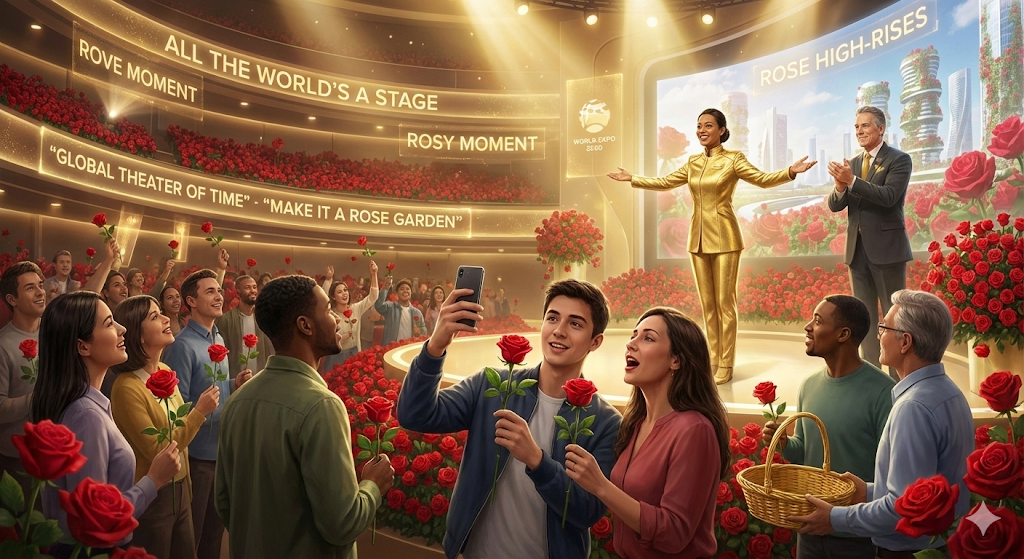
Bob stepped forward, carrying a golden basket filled with the Best 100 fresh Red Roses. As he moved through the crowd, the scent of the flowers filled the air. Linda helped hand a single red rose to each person.
“Please,” Linda instructed gently, “hold this rose in your left hand—the hand connected directly to your heart.”
The Smart Shakespear Connection Linda raised her own rose to the light.
“We are standing in the Rosy Expo, surrounded by Rosy Islands and Rose High-Rises. You have walked through the Shakespeare Rose Garden and seen the abundance of beauty. So, let us recall the words of William Shakespeare:
‘Of all flowers, methinks a rose is best.’
“And remember the wisdom of the Smart Shakespear:
‘If you have love, express it by courage.’“
The Call to Action Linda looked at the group, challenging them with a smile.
“Now, it is your turn. Step into your role as a Smart Shakespear. Acknowledge that this is the best flower, and express your love for the beautiful Red Rose! Feel free to say anything, or name any flower as the best. As You Like It, you are free to choose.”
The Grand Finale As the visitors admired their flowers, Linda delivered the final lesson of the tour.
“Please remember this golden rule: Be Yourself. Why? Because only you are qualified to be you. No one else in history, past or future, is qualified to play your part.”
She spread her arms wide, embracing the room, the roses, and the technology.
“Shakespeare said, ‘All the world’s a stage.’ But at Best 100 Plus, we say: ‘All the universe—our entire global planet—is a stage… and it is ready for you to play your part as a Rose Gardener, to make this world a Rose Garden.’“
Chapter 12: The Rosy Moment
Scene: The Global Theater of Time.
For a moment, the room was silent, filled only with the sweet, heavenly scent of the Best 100 Red Roses. The visitors stood tall, each holding their flower like a torch of beauty.
Then, the Realization kicked in.
Fred, the university student, was the first to act. He didn’t just admire the flower; he remembered his training. He tapped his Smart Neck Wallet and lifted his smartphone.
“Smartphone Best Use #18: Capturing the Moment,” Fred whispered with a smile.
He framed the shot perfectly—the velvety crimson petals of his rose glowing against the golden sunlight of the Library. Click. He didn’t just take a photo; he saved a feeling.
Nearby, Sarah, the journalist, closed her eyes and inhaled deeply. The fragrance seemed to unlock the poet inside her. She opened her eyes, looked at the rose in her hand, and spoke the words that were forming in her heart:
“Red Roses reign as the monarchs of floral beauty, holding the throne as the classic symbol of love, nature, divine elegance, heavenly sacred, and beautiful attraction!”
Her voice grew stronger, filled with passion as others nodded in agreement.
“Red Roses are the king of beautiful roses, the beauty queen of flowers, and their blossoms are the prince and princess of all beautiful roses and flowers!”
John Datak clapped slowly, his face beaming with pride.
“Perfect,” John said. “You have done it. You have used your Language Freedom to describe the indescribable.”
He gestured to Fred’s phone and Sarah’s rose.
“This is the secret of the Best 100 Plus lifestyle. The best use of a smartphone is not just to make a call—it is to capture a Rosy Moment of your life. Whether you write it down, photograph it, or simply breathe it in… you have made this moment eternal.”
Linda raised her hand. “To the Gardeners of the Rosy Future!”
“To the Gardeners!” the crowd cheered, raising their roses and their smartphones together in a salute to the Best World.
++++
+++++
++++++++++
+++++++++++++++++++++++++++++++
Linda smiles warmly. “Now, it is your turn to shine, as a global English spkears, and Shakespeare fan.. We invite every visitor to take the stage for a 4-minute performance from As You Like It.”
The quote you provided, “If you have love, express it by courage,” is a common modern summation or rephrasing of a line from Shakespeare’s play Macbeth.
++++++++++++++
That famous line, “Of all flowers, methinks a rose is best,” comes from William Shakespeare’s play The Two Noble Kinsmen, a collaborative work with John Fletcher, celebrating the rose as the ultimate symbol of beauty, love, and elegance, a sentiment often echoed in art, gardening,
It’s a simple declaration of preference, highlighting the rose’s inherent perfection and allure, setting a tone of appreciation for nature’s finest.
Red Roses reign as the monarchs of floral beauty, holding the throne as the classic symbol of love, nature, divine elegance, heavenly sacred, and beautiful attraction!
Red Roses are the king of beautiful roses, the beauty queen of flowers, and their blossoms are the prince and princess of all beautiful roses and flowers!
+
Be yourself because only you are qualified to be you
Be yourself because no one else is qualified to be you
+++++++++
- “Word Power is World Power.”
++++++++++++++
Chapter 6: The Synchronization Station
Scene: The Transition from the Garden to the Central Hall.
John Datak clapped his hands gently, drawing the visitors’ attention away from the holographic roses.
“My friends, now that you understand the philosophy of the Smart Shakespear, it is time to give you the tools,” John announced. “Please follow my assistant, Bob, to the Information Desk. There, we will equip you for your journey into the ‘Best 100’ lifestyle.”
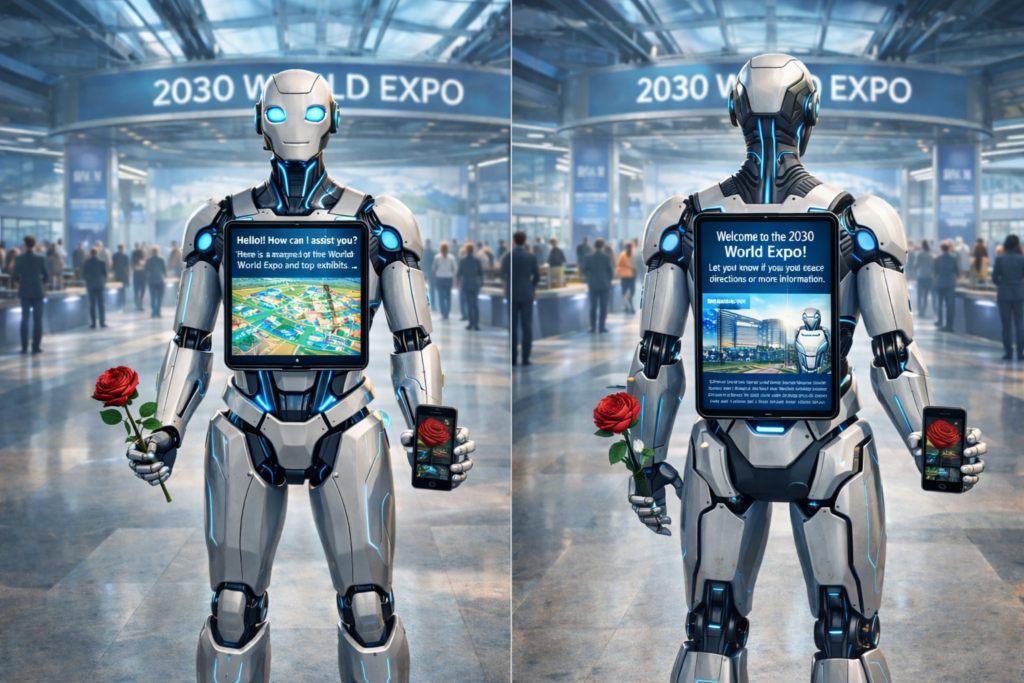
The group followed Bob across the polished white marble floor. They arrived at a sleek, horseshoe-shaped desk glowing with a soft blue light. Behind the desk stood Comycom2050, its silver chassis reflecting the golden summer sunlight streaming through the glass roof.
1. The Network Synchronization Bob smiled at the group. “Welcome to the Information Reformation Desk. Here, our librarian and Comycom are ready to help you synchronize your smartphone with the Expo and the Radiant Library’s computerized network.”
“Please place your phones on the scanner,” Bob instructed.
As the visitors did so, Comycom chirped happily. “Synchronizing… Connection established. You now have access to the Best 100 Libraries and the Global Language Database.”
2. The Smart Neck Wallet Bob then reached under the counter and produced a stylish, lightweight accessory made of shimmering, durable fabric.
“We know that a ‘Smart Shakespear’ needs to be ready to capture inspiration at any moment,” Bob explained. “Therefore, we offer you this specially designed Smart Neck Wallet.”
He demonstrated how to wear it.
“It is not just a holder; it is a Studio. It positions your smartphone at the perfect chest level, stabilizing it for:
- Optimal Photography: Capture the ‘Best 100’ moments without shaking.
- Audio Recording: Dictate your thoughts while walking through the gardens.
- Video Logging: Record your life story hands-free.”
3. The Vocabulary Bank (The Treasure Chest) Bob then presented two more items: a small digital device and a beautiful, physical binder with high-quality paper.
“Finally,” Bob said, his voice turning serious and respectful, “we give you the keys to intelligence: The Vocabulary Collector.”
He held up the Digital Collector first. “This digital tool captures new words you hear during your visit and saves them to your cloud.”
Then, he opened the Binder. “And this is your Personal Vocabulary Notebook. In the Information Age, words are wealth. We invite you to collect words, one by one, just as you would collect gold coins.”
The 100,000 Word Goal “Your goal,” Bob challenged them, looking at Fred the student, “is to build a Memory Bank of 10,000 to 100,000 words.
- Write them down.
- Learn their meanings.
- Use them to express your ‘Best Self’.”
“Why?” asked Sarah, the journalist.
“Because,” Bob replied, tapping the binder, “these words will build the neural pathways in your brain that you will use for the next 100 plus years. A rich vocabulary is the foundation of a ‘Smart Shakespear’ mind—sharp, creative, and alive forever.”
The visitors eagerly accepted the wallets and binders, sliding their phones into the holders. They stood taller, looking like a team of modern explorers ready to document the future.
Promotional “Call to Action” Ideas
(To add to your “Products” or “Shop” page)
Item: The “Smart Shakespear” Starter Kit
- Includes:
- The Smart Neck Wallet: “Hands-Free History Making.”
- The Vocabulary Binder: “Your 100-Year Memory Bank.”
- Access Pass: Synchronization with the Best 100 Plus Network.
- Slogan: “Don’t just carry a phone. Wear a Studio. Build a Library.”
- saving one word at a time, to your memory bank account.+++++++++++++++++++++
+++++++++++ - The Shakespeare convention or exhibition showroom floor
When they arrived at the Shakespeare convention or exhibition showroom on one of the underground floors, John announced:
Welcome to The Shakespeare convention or exhibition showroom.
Chapter 13: The Under Grand – The Shakespeare Universe
Scene: In one floor of the Lower Level of the Radiant Library. Atmosphere: Sophisticated, High-Tech Museum, Warm Lighting.
The elevator doors slid open, revealing a space that was vast and humming with history. This floor was lit by warm, ambient spotlights that made every display look like a jewel.
John Datak stepped out and opened his arms wide, and announced.
“Welcome to the Global Shakespeare Convention and Exhibition Showroom.”
The visitors smiled. Some laughed softly. It felt official. It felt fun.
2. The Scope of the Floor John walked toward the center of the room. The space was a maze of wonders. “This floor is dedicated entirely to the Shakespeare Universe. Here, we bridge the gap between 1623 and 2050.”
He pointed to the different zones of the massive convention floor:
- 📚 The Library Zone: “From the rarest books to the newest AI research tools.”
- 🏛️ The Museum Zone: “Artifacts, costumes, and the history of the English language.”
- 🎓 The Education Zone: “Information on everything from grammar schools to high schools and top universities that specialize in literature.”
- 🎭 The Entertainment Zone: “A database of every live theater, movie, TV show, and serial adaptation ever made.”
- 🌿 The Garden Zone: “An indoor conservatory featuring 175 plants and flowers Shakespeare wrote about in his book, the First Folio.”
Comycom will display the details of every exhibit as we pass,” John explained, “and your Smartphones are already recording the tour, so you have all for a single detail to review later or keep them forever in your memory bank.”
3. The Starting Point John stopped in front of a glass case in the center of the room. Inside, bathed in a protective golden light, sat a large, open book.
“But to understand the future, we must start with the foundation,” John said reverently. “We begin with the book that saved the English language… ‘The First Folio.” ‘The First Folio”
While Comcom starts to show writing, pictures, videos, and other things in this area, John continued:
What is the First Folio, and why is it important?
“The First Folio,” John explained,
- The First Folio of Shakespeare, published in 1623, is an extraordinary book, collecting 36 plays into a single authoritative volume. About half of Shakespeare’s plays had never previously appeared in print, including All’s Well That Ends Well, Antony and Cleopatra, As You Like It, The Comedy of Errors, Coriolanus, Cymbeline, Henry VI, Part 1, Henry VIII, Julius Caesar, King John, Macbeth, Measure for Measure, The Taming of the Shrew, The Tempest, Timon of Athens, Twelfth Night, The Two Gentlemen of Verona, and The Winter’s Tale. Without the First Folio, 18 plays might have been lost forever. The Folio established the foundation of Shakespeare’s dramatic works, shaping the canon as we know it today. Scholars and editors use it as a primary source when creating modern editions. This includes our first recommended story or play for learning and entertainment: As You Like It.
The First Folio is the first published collection of Shakespeare’s plays, produced seven years after his death. Its title is Mr. William Shakespeare’s Comedies, Histories & Tragedies, and it groups his plays into those categories—comedies, histories, and tragedies—for the first time.
2. The Big Three Genres. It organized the plays into three distinct categories for the first time: Comedies, Histories, and Tragedies, creating the standard classification system still used by scholars and readers today.
3.
4. Historical Literary Artifact: Offers insight into early 17th-century printing and publishing. One of the most studied and valuable books in the world to shaped the English language and global literature.
4..
5. The Massive Scope (900+ Pages) It contains 36 plays in a single volume. It is a massive “Server of Knowledge” containing approximately 900,000 words.
6..
7. The Vocabulary Bank It acts as the physical container for thousands of unique words and phrases that defined modern English, preserving them in print for the first time.
8. The Rarity and Value Value ($10 Million+). It is one of the most sought-after books in the world. Roughly 750 copies were printed, with only 235 known to survive as of 2026. In 2020, a copy sold for nearly $10 million, making it the world’s most Valuable Script and the most expensive literary work. The “Server of Knowledge” Massive Scope (900+ Pages) It contains 36 plays in a single volume. (900+ Pages) containing approximately 900,000 words.
9. Who published The First Folio?: The First Folio was created in the years after Shakespeare’s death in 1616. His friends and former colleagues John Heminge and Henry Condell, who were also partners in the King’s Men acting company, brought together his plays.
Heminge and Condell had worked with Shakespeare for years and, like him, were actors and shareholders in the King’s Men. By the time of the First Folio, Heminge was the company’s business manager. Shakespeare left money to both men in his will to buy memorial rings, a sign that he considered them good friends.
The book was published by a London syndicate headed by Edward Blount and Isaac Jaggard. Isaac’s father William Jaggard printed it at his London printing shop, but he died before the book was completed, and Isaac Jaggard took over the shop.
10. Standardized Shakespearean English: The Folio provides a critical record of Early Modern English, including many of the words and phrases Shakespeare invented that are still used in 2026, such as “break the ice” or “in a pickle”. It is the closest thing we have to Shakespeare’s original manuscripts. For 99% of his work, the First Folio is the ultimate authority—the “Root Directory” of the English global language. Ifyou are interested, you can visit these websites for more detailed information.
Smart Shakespear
1+ Shakespeare Book: First Folio
2+ Shakespeare Comedy Book: As You Like It!
John continued:
This area of the exhibition is dedicated to all of Shakespeare’s works. Each play, story, sonnet, and more has a special showroom that showcases the journey and productions related to that piece. Especially for William Shakespeare’s most famous works include comedies such as: “As You Like It.”, A Midsummer Night’s Dream, Much Ado About Nothing, and Twelfth Night; historical plays like Henry V and Richard III; tragedies like **Hamlet, Macbeth, Othello, King Lear, and Romeo and Juliet; ; and poems, especially his Sonnets, forming a cornerstone of English literature.
Shakespeare, in his lifetime, wrote and signed his name under more than 10 different names. From around the 19th century, especially the 20th century, most use the name ( Shakespeare) around the world.
1. Shakespeare and his works are highly respected by many people throughout history and around the world.
2. We at www.best100plus.com have the highest respect too,
3. For that and many other reasons, we chose the name Shakespear. When we refer to the real Shakespeare, we use “Shakespear,” and for our ideas, we use “Shakespear” to maintain respect and freedom for our concepts.
4. To use it as a brand name more freely for promoting pear, Shakspear blender smoothies, and smart shakesprear, individuals can adopt these names as nicknames for their artistic works, such as writing, photos, or videos taken with a smartphone, among other purposes.
5. The selected play from the First Folio to promote and learn the first 10,000 words is “As You Like It.” Therefore, most of the promotion will focus on “As You Like It.”
6. We will visit all areas, but for now, Linda will present and discuss “As You Like It.” “Center here,” John said.
+
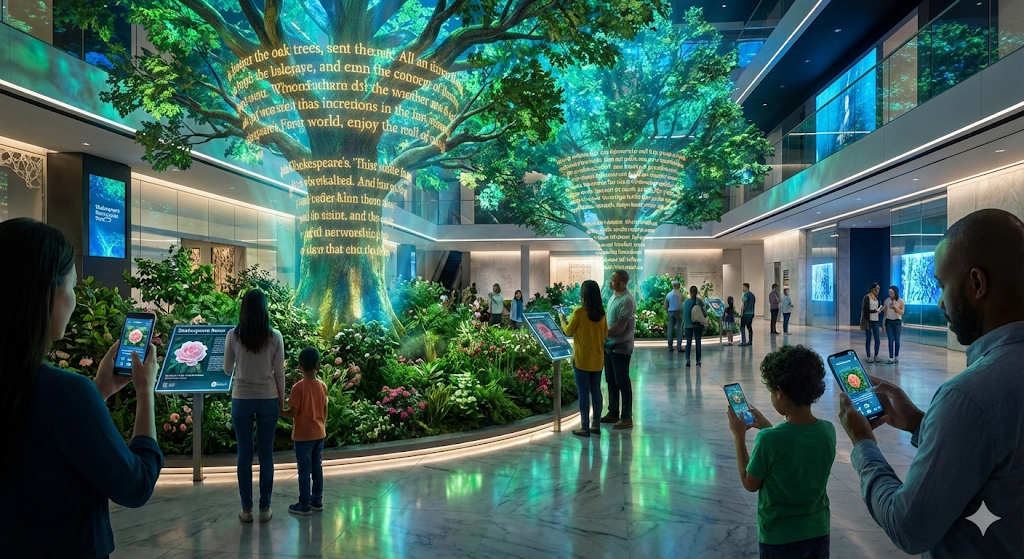
The elevator’s hum faded into a serene silence as the group stood before the glass-encased First Folio. The air was cool, carrying the faint, sweet scent of old parchment and digital ozone. John Datak stepped back, his task of introduction complete, and gestured toward the center of the shimmering floor where Linda waited.
Linda stood beneath a holographic projection of a lush, digital forest—the Forest of Arden. She wore a gown that seemed to shift colors, mirroring the vibrant greens and rose pinks of the garden above.
🎭 The Presentation: As You Like It
“Welcome to the heart of the Forest,” Linda began, her voice echoing with a warm, melodic resonance. “If the First Folio is the ‘Root Directory’ of the English language, then As You Like It is the most beautiful program ever written for it. We have selected this play as our primary vehicle to help you master the first 10,000 words of Global English.”
She tapped her smartphone, and the room’s ambient lighting shifted. The walls became transparent, showing a 360-degree view of a pastoral paradise.
🌟 Why “As You Like It” for the 2045 Learner?
Linda walked through the holographic trees, explaining the strategic choice:
- The Pastoral Escape: Just as the characters flee to the Forest of Arden to find truth, our visitors use the Radiant Library to find clarity in a complex world.
- The Seven Ages of Man: This famous speech (from Act II, Scene VII) is our template for the Best 100 Life Habits, tracking human growth from infancy to the centenarian years.
- The Vocabulary of Nature: The play is the source of our Shakespeare Roses and our focus on environmental sustainability (SDG alignment).
- Gender and Identity: Through Rosalind, the play explores the fluidity of identity, encouraging a Social Learning style that is inclusive and optimistic.
💎 The “Shakespear” Brand: Respect & Freedom
Linda paused by a display featuring a sleek, high-tech blender and a smartphone running the Smart Shakespear app.
“You noticed John used a specific spelling,” Linda said with a wink. “In the Shakespeare Global Convention, we honor the man, the actor, and the writer. But for our Best 100 Plus vision, we use the brand name ‘Shakespear.’ >
Why? Because it gives us the freedom to innovate. Shakespear is a brand for the future—it is your Shakespear Blender for healthy smoothies, your Smart Shakespear AI tutor, and your creative nickname for the ‘Best 100’ photos you take on your smartphone. We respect the history, but we own the future.”
📚 The Learning Roadmap (The 10,000 Word Goal)
Linda pointed to the Education Zone, where holographic books floated in mid-air. “To reach the 80% completion mark of our mission, we use As You Like It to anchor your vocabulary. Here is how we categorize the learning journey:”
| Level | Goal | Learning Style focus |
| Foundation | The First 1,000 Words | Visual & Aural (Watching the 1936 Colorized Movie). |
| Expansion | 1,000 to 5,000 Words | Verbal & Social (Acting out scenes in the Shakespeare Garden). |
| Mastery | 5,000 to 10,000 Words | Logical & Solitary (Analyzing the First Folio’s original text). |
🎨 Visual Prompt: The Forest of Arden 2045
For the Smart Shakespear section of www.best100plus.com, use this prompt to capture the scene:
Prompt: A stunning, high-contrast 8k image of a futuristic Forest of Arden inside a high-tech museum. Giant holographic oak trees glow with golden text from the First Folio. Diverse people are using glowing smartphones to scan “Shakespeare Roses.” The floor is polished marble reflecting the vibrant greens and azure blues of the digital forest. It is a perfect blend of 1623 history and 2045 technology. Shiny, professional, and visionary.
🚀 Taking it to the Next Level
Linda smiled as the Comycom2050 notifications chimed again on everyone’s devices. “Your Digital Gift Pack now includes the ‘As You Like It’ Vocabulary Tracker. It will highlight every new word you learn as you walk through the Museum Zone.”
Would you like me to draft the “First 100 Words of Wisdom” from As You Like It to help our visitors begin their 10,000-word journey immediately?+++++++++
+++++++++++++++++
+++++++
Chapter 7: The Era of Memory vs. The Era of Record
Scene: The Information Reformation Desk. Speaker: John Datak.
John watched as the visitors placed their shiny new Vocabulary Binders into their bags. He raised a hand to pause them, his expression serious and thoughtful.
“Before we move on,” John said, “you must understand why we insist you write things down. Many of you trust your minds. But in the Information Reformation, we teach a hard truth: Writing is reliable. Memory is not.“
He tapped the cover of his own binder.
“Memories fade. They get distorted by time and emotion. They can be lost forever in a moment of forgetfulness. But writing—or any form of recording—provides a consistent, tangible reference. It is the foundation of Accountability, Clear Thinking, and Accuracy.”
The Historical Perspective: The Gutenberg Gap John gestured to a holographic timeline that Comycom projected into the air. It showed a timeline of human history.
“Consider our hero, William Shakespeare. He lived from April 23, 1564, to April 23, 1616. This was approximately 120 to 170 years after Johannes Gutenberg invented the movable-type printing press in Germany around 1440.”
The hologram zoomed in on an image of an old printing press.
“Gutenberg’s invention was the ‘Smartphone’ of the 15th Century. It revolutionized information, enabling the mass production of books. It spread knowledge, fueled literacy, and ignited the Renaissance, taking power away from the wealthy elite and giving it to the people.”
The Reliance on Memory “However,” John continued, “even though the press was invented in 1440, by Shakespeare’s time in England, mass literacy was still in its infancy. Most of the population could not read or write. They had no choice. All humans relied entirely on their memory.“
John looked at the students in the group.
“Imagine that. Every story, every history, every recipe, every contract—it all had to be memorized or hand-written by a very few. If the person died, the information died with them.”
The Modern Choice “Today, you are the ‘Best 100 Plus’ Generation. You are not forced to rely on a fragile memory. You have the tools of Information Reformation.”
John pointed to their Smart Neck Wallets and Binders.
“You have the ability to record, video, audio, and write. You can preserve your thoughts for the next 100 years. So, my advice to you is this: Do not let your life be a fading memory. Be a Smart Shakespear. Document your brilliance. Preserve your legacy. Make your information tangible, accurate, and eternal.”
++++
+++++
https://4seasonsgardensplus.com/health-foods/#47-the-nature-of-things
Feature: Spread Shakespeare’s influence far beyond England.
John continued: Writing things down is more reliable than relying on memory, as memories fade, get distorted, or can be lost, while writing or any recording provides a consistent, tangible reference for important information, learning, and accountability. It emphasizes documentation for accuracy, clear thinking, and long-term preservation.
William Shakespeare lived from (23 April 1564– 23 April 1616) or from 12o to 170 years after Johannes Gutenberg’s invention of the movable-type printing press in Germany around 1440 revolutionized information, enabling the mass production of books and texts affordably, spreading knowledge, literacy, and ideas like the Renaissance, marking a pivotal moment in history by making texts accessible beyond the wealthy elite. Although printing was invented in Germany in 1440, it is reasonable to assume it was just at the beginning in England. So the pion is all the information that was memorized or written by hand. Also, because only a few people of the population were literate and able to write, so all humans had only rely on their memory.
The majority of humans always had good or very good memory, but they needs were and are always willing to learn and find, also choosing the right memorizing techniques, methods, systems, and using them profoundly.
Shakespeare was the recipient, learner of most of the educational and artistic methods of actors and theater.
Shakespeare became the master of the best, highest student, teacher, and promoter of most of those historically best memorizing methods. As a student, he learned the English language very well, also he was a student of Grammar school and especially speciall wast vocabulary ( around 30 to 40,000 words ). Also William Shakespeare’s works contain nearly 900,000 words, with estimates around 884,000-885,000 across his plays, sonnets, and poems, using over 20,000 unique words and introducing about 1,700 new words or first recorded usages to the English language.
Shakespeare was a very busy actor, sometimes playing a few characters a week, so he had to memorize them. The number one need of acting is the ability to memorize and remember the lines and plays.
Shakespear as a play-writer and later as a creator and owner of the Globe Theater, was able to put the best memorizing methods in writing and a real test of acting. Failure to memorize and forgetting meant being out of a job and out of business very badly, and losing his fame and fortune. But even him, because he did not print as a book or any type of recording, ( from his around 1 million hi created only 1000 words officially remain as his writing because he wrote them.)
Fortunately, Shakespeare’s friends collected his works, published them as a book in 1000 copies, by the name of the First Folio, which around 250 copies remain in good condition by value at more than 10 million dollars for each book. But generous Shakespeare friends made it in good quality to buy from 10 to 100 dollars or browse it from all libraries for free, always from the internet on your smartphone or gadgets. It is one of the most popular, most widely printed, and most widely distributed books in human cultural history. Also, most shows, movies, translated into more than 100 languages,
The First Folio contains most methods of memorization in the English language, as well as education, the arts, literature, and culture.
The First Folio was created and written combination of 7 learning styles like, Visual, Auditory, Verbal, Logical, Physical, Social, and Interpersonal.
It is also has many other methods like Natural, Repeation, Association, Impression, and Preparation. By using patterns, mnemonics, acronyms, formulas, rhythms, or rhymes to enhance memory, finding points, discovering, comprehension, understanding, and realization.
The First Folio for 400 years and now always avalable for anyone for reading, rewriting as a homework or professionally, listening, reading it loud, telling it stories, watching its play on live theaters, movies and TVs, or best of all, playing one of its 38 plays any of them more interesting for you as a lover or professionally as you like
+++++++
++++++++
+++++++++
+++++++++++++++++++++++++++++++++++++++++++++++++++++++++++++++
Chapter 7: The Era of Memory vs. The Era of Record
Scene: The Information Reformation Desk. Speaker: John Datak.
John watched as the visitors placed their shiny new Vocabulary Binders into their bags. He raised a hand to pause them, his expression serious and thoughtful.
“Before we move on,” John said, “you must understand why we insist you write things down. Many of you trust your minds. But in the Information Reformation, we teach a hard truth: Writing is reliable. Memory is not.“
He tapped the cover of his own binder.
“Memories fade. They get distorted by time and emotion. They can be lost forever in a moment of forgetfulness. But writing—or any form of recording—provides a consistent, tangible reference. It is the foundation of Accountability, Clear Thinking, and Accuracy.”
The Historical Perspective: The Gutenberg Gap John gestured to a holographic timeline that Comycom projected into the air. It showed a timeline of human history.
“Consider our hero, William Shakespeare. He lived from April 23, 1564, to April 23, 1616. This was approximately 120 to 170 years after Johannes Gutenberg invented the movable-type printing press in Germany around 1440.”
The hologram zoomed in on an image of an old printing press.
“Gutenberg’s invention was the ‘Smartphone’ of the 15th Century. It revolutionized information, enabling the mass production of books. It spread knowledge, fueled literacy, and ignited the Renaissance, taking power away from the wealthy elite and giving it to the people.”
The Reliance on Memory “However,” John continued, “even though the press was invented in 1440, by Shakespeare’s time in England, mass literacy was still in its infancy. Most of the population could not read or write. They had no choice. All humans relied entirely on their memory.“
John looked at the students in the group.
“Imagine that. Every story, every history, every recipe, every contract—it all had to be memorized or hand-written by a very few. If the person died, the information died with them.”
The Modern Choice “Today, you are the ‘Best 100 Plus’ Generation. You are not forced to rely on a fragile memory. You have the tools of Information Reformation.”
John pointed to their Smart Neck Wallets and Binders.
“You have the ability to record, video, audio, and write. You can preserve your thoughts for the next 100 years. So, my advice to you is this: Do not let your life be a fading memory. Be a Smart Shakespear. Document your brilliance. Preserve your legacy. Make your information tangible, accurate, and eternal.”
++++++
Chapter 8: The First Folio – The Ultimate Memory Guide
Scene: The Hall of Great Minds (Next to the Information Desk). Speaker: John Datak.
John Datak held up a shimmering holographic projection of a large, leather-bound book.
“We have spoken about the need to record your life,” John said. “Now, let us look at the master who proved why memory techniques are essential: William Shakespeare.”
1. The Human Potential “History shows us that most humans have always possessed a Good to Very Good memory. The difference between an average person and a genius is simply Desire and Technique. Shakespeare was not born with a computer in his head; he was a relentless learner who mastered the art of memorization.”
2. The Master of Words (The Statistics) Comycom2050 projected a stream of golden numbers floating in the air:
- Vocabulary: 30,000 to 40,000 words.
- Total Output: Nearly 900,000 words (across plays, sonnets, and poems).
- Unique Words: Over 20,000.
- New Inventions: 1,700 new words introduced to English.
“Shakespeare was a student of the Grammar School of life,” John explained. “He collected words like jewels.”
3. The High Stakes of Acting “Why was he so obsessed with memory? Because he was a busy actor and the owner of the Globe Theater. He often played multiple characters in a single week. The Number One Need of Acting is Memory. If Shakespeare forgot his lines, he didn’t just feel embarrassed—he would be out of a job, out of business, and he would lose his fame and fortune. His memory was his survival.”
4. The Tragedy of the Unrecorded John’s voice lowered slightly. “But here is the irony. Despite creating nearly 1 million words, Shakespeare never printed his own books. Today, only about 1,000 words remain in his own handwriting. Because he relied on memory and not recording, we almost lost him entirely.”
5. The Miracle of the First Folio The hologram of the book glowed brighter.
“Fortunately, his friends—John Heminges and Henry Condell—performed the ultimate act of Information Reformation. They collected his works and published the First Folio in 1623.
- Original Copies: Only about 1,000 were printed.
- Remaining: Only around 250 exist today.
- Value: One copy is now worth over $10 Million.”
Chapter 9: The Treasure in Your Pocket
Scene: The Hall of Great Minds. Speaker: John Datak.
John paused, letting the $10 million figure sink in. Then, a bright smile spread across his face.
“But here is the Radiant Truth of the Information Age,” John announced. “You do not need 10 million dollars to possess this wisdom. You do not even need to travel to a museum.”
1. The Generosity of Friends “Just as Shakespeare’s friends—Heminges and Condell—saved his work in 1623, generous friends of the modern age have continued this legacy. Publishers, librarians, and digital archivists have worked tirelessly to ensure this ‘Best Book’ is available in Good Quality for everyone.”
Comycom2050 changed the hologram from the rare leather book to a sleek, modern paperback, and then to a glowing digital file.
“Today, you can own a beautiful physical copy for $10 to $100. Or, even better…”
2. The Library of the World (Free Access) John pointed to the smartphones in the visitors’ neck wallets.
“You can browse it from almost any library in the world for Free. It is always there, waiting on the internet, accessible instantly on your gadget. The barrier to entry is gone. The only requirement is your curiosity.”
3. The Most Popular Book in Culture “This accessibility has made the First Folio and Shakespeare’s plays a phenomenon of human history,” John continued. He listed the facts on the screen:
- Most Widely Printed: It stands alongside religious texts as one of the most distributed books in history.
- Most Adapted: It is the foundation for the most shows, movies, and theater productions globally.
- Global Language: It has been translated into more than 100 languages.
4. The Universal Connection “Think about that,” John said to the group. “A storekeeper in Tokyo, a student in Brazil, and a gardener in New York can all read Romeo and Juliet or Hamlet on their phones at the same time.
Shakespeare is no longer just English; he is Universal. He belongs to the Best 100 Plus family of humanity.”
The Call to Action “So,” John concluded, “do not let this treasure sit inside your phone unopened.
- Download it today.
- Read one page.
- Watch a movie adaptation. Be part of the cultural history that connects us all.”
6. The 7 Styles of “Smart Learning” “But the First Folio is priceless for another reason,” John continued, gesturing to the Smart Neck Wallets the visitors were wearing. “It is the greatest textbook on How to Learn. It combines all 7 Learning Styles:”
- 👁️ Visual: Vivid imagery (Roses, Suns, Stars).
- 👂 Auditory: Rhythm, rhyme, and the music of iambic pentameter.
- 🗣️ Verbal: The masterful use of vocabulary and speech.
- 🏃 Physical (Kinetic): Action, stage movement, and gesture.
- 🧠 Logical: Complex plots, legal arguments, and formulas.
- 🤝 Social (Interpersonal): Dialogue and the interplay of characters.
- 🧘 Solitary (Intrapersonal): The famous soliloquies (Hamlet’s internal thoughts).
Shakespeare employed various techniques: repetition, association, impression, and preparation. He utilized mnemonics, acronyms, formulas, patterns, rhythms, and rhymes to enhance memory, comprehension, understanding, and realizations to make his words memorable.
Shakespeare used various techniques, including repetition, association, impression, and preparation. He employed mnemonics, acronyms, formulas, patterns, rhythms, and rhymes to improve memory, comprehension, and understanding, making his words more memorable.
The Challenge John smiled at the group.
“We do not ask you to write a play. But we ask you to use your Vocabulary Binder and your Smartphone to practice these 7 styles. If a book from 1623 is worth $10 Million because of the wisdom inside it… imagine what your recorded legacy could be worth to your great-grandchildren in 2050.”
++++It is also has many other methods like Natural, Repeation, Association, Impression, Preparation. By using patterns, mnemonics, acronyms, formulas, rhythms, or rhymes to enhance memory, finding points, discovering, comprehension, understanding, and realization.+++
John continued: Writing things down is more reliable than relying on memory, as memories fade, get distorted, or can be lost, while writing or any recording provides a consistent, tangible reference for important information, learning, and accountability. It emphasizes documentation for accuracy, clear thinking, and long-term preservation.
William Shakespeare lived from (23 April 1564– 23 April 1616) or from 12o to 170 years after Johannes Gutenberg’s invention of the movable-type printing press in Germany around 1440 revolutionized information, enabling the mass production of books and texts affordably, spreading knowledge, literacy, and ideas like the Renaissance, marking a pivotal moment in history by making texts accessible beyond the wealthy elite. Although printing was invented in Germany in 1440, it is reasonable to assume it was just at the beginning in England. So the pion is all the information that was memorized or written by hand. Also, because only a few people of the population were literate and able to write, so all humans had only rely on their memory.
The majority of humans always had good or very good memory, but they needs were and are always willing to learn and find, also choosing the right memorizing techniques, methods, systems, and using them profoundly.
Shakespeare was the recipient, learner of most of the educational and artistic methods of actors and theater.
Shakespeare became the master of the best, highest student, teacher, and promoter of most of those historically best memorizing methods. As a student, he learned the English language very well, also he was a student of Grammar school and especially speciall wast vocabulary ( around 30 to 40,000 words ). Also William Shakespeare’s works contain nearly 900,000 words, with estimates around 884,000-885,000 across his plays, sonnets, and poems, using over 20,000 unique words and introducing about 1,700 new words or first recorded usages to the English language.
Shakespeare was a very busy actor, sometimes playing a few characters a week, so he had to memorize them. The number one need of acting is the ability to memorize and remember the lines and plays.
Shakespear as a play-writer and later as a creator and owner of the Globe Theater, was able to put the best memorizing methods in writing and a real test of acting. Failure to memorize and forgetting meant being out of a job and out of business very badly, and losing his fame and fortune. But even him, because he did not print as a book or any type of recording, ( from his around 1 million hi created only 1000 words officially remain as his writing because he wrote them.)
Fortunately, Shakespeare’s friends collected his works, published them as a book in 1000 copies, by the name of the First Folio, which around 250 copies remain in good condition by value at more than 10 million dollars for each book. But generous Shakespeare friends made it in good quality to buy from 10 to 100 dollars or browse it from all libraries for free, always from the internet on your smartphone or gadgets. It is one of the most popular, most widely printed, and most widely distributed books in human cultural history. Also, most shows, movies, translated into more than 100 languages,
The First Folio contains most methods of memorization in the English language, as well as education, the arts, literature, and culture.
The First Folio was created and written combination of 7 learning styles like, Visual, Auditory, Verbal, Logical, Physical, Social, and Interpersonal.
It is also has many other methods like Natural, Repeation, Association, Impression, and Preparation. By using patterns, mnemonics, acronyms, formulas, rhythms, or rhymes to enhance memory, finding points, discovering, comprehension, understanding, and realization.
The First Folio for 400 years and now always avalable for anyone for reading, rewriting as a homework or professionally, listening, reading it loud, telling it stories, watching its play on live theaters, movies and TVs, or best of all, playing one of its 38 plays any of them more interesting for you as a lover or professionally as you like it!
John asks all visitors to follow his assistant Bob to the information desk.
When they arrive, Bob starts by saying: Here, the information librarian and Comycom are ready to help you to synchronize your smartphone with the expo and library computerized network with your smartphone.
Also, if you like it, they offer specially designed neck wallets that hold your smartphone and help you position and adjust it for optimal photography, audio, and video recording.
Also has a digital vocabulary collector, plus one binder with papers as a personal vocabulary notebook, to collect and use words one by one to a 10,00 or 100,000 memory bank to remember and use them for the next 100 plus years.
After a while, when everyone becomes ready, Bob and Robocam guide them to the Shakespeare Convention Center, showroom at one of the underground floors which is all about the Shakespeare book ( first Folio), but mostly is about the story or play book of ( As You Like It) is chosen to promote and help English learners with the first 10,000 most used English words. There is one original print of the First Folio) is on display, with more than $10,000,000 value also available online, and all kinds of possibilities to view or all kinds of search.
++++++++
Statue of Language Freedom
Shakespeare Statue of Freedom
Shakespeare: The Statue of Language Freedom
++++++
Master Words to Master Your World.
“Choose the Best Words, Create the Best World

++++++++++
All the world’s a stage
What can a person achieve with a vocabulary of 10,000 words in English?
Exploring the Power of Advanced Proficiency in Global English as a Second Language
A vocabulary of 10,000 words is widely regarded as the threshold for advanced English proficiency. At this prestigious stage, a learner transcends “survival” communication and achieves high-level fluency, enabling academic, professional work or business, and social interactions with complex English expressions.
Key Abilities Gained with 10,000 Words
1. High-Level Global Comprehension
- 98–99% Text Coverage: You can understand 98% of everyday spoken English and up to 99% of common written texts, including newspapers, news broadcasts, films, literature, novels, websites, and non-specialized books.
- Intellectual Intuition: You recognize enough surrounding vocabulary to accurately deduce the meaning of unfamiliar words or technical terms from context without needing a dictionary.
- Media Fluency: Complex films, documentaries, interviews, and live debates become accessible and enjoyable, with minimal reliance on subtitles or dictionaries, as easily as a native speaker.
2. Advanced Communication and Expression
- Professional Interaction in Work and Business: English is the primary language of international business and trade, and strong English skills are a significant advantage in the global job market. You can confidently participate in workplace discussions, negotiations, and presentations, and even discuss technical topics, abstract or specialized concepts, with confidence.
- Career Advancement: Employers prioritize candidates with strong communication skills; a 10,000-word vocabulary often correlates with higher salaries and better job opportunities.
- Precision in Language: Your communication becomes highly precise and expressive, utilizing a wide range of synonyms, idiomatic expressions, and advanced grammatical structures.
- Near-Native Fluency: If pronunciation and grammar are also well-developed, a 10,000-word vocabulary allows many learners to blend in seamlessly with native speakers in both social and professional contexts.
3. Academic Literacy and Writing Skills
- University-Level Reading: You can comfortably read novels, academic articles, international newspapers, and general nonfiction without frequent interruptions to look up unfamiliar words.
- Complex Writing Ability: You’re capable of producing analytical essays, research papers, reviews, and professional reports that meet academic and workplace standards.
- Foundation for Specialization: This vocabulary range provides a solid foundation for mastering technical jargon in fields such as law, engineering, medicine, and business.
4. Alignment with Global Standards (CEFR)
- C1 Level: Typically associated with 8,000 to 10,000 words. At this level, users can communicate effectively and flexibly for all social and professional purposes on a wide range of topics, including unfamiliar or sensitive subjects.
- C2 Level: Often associated with 10,000+ words. This is considered the pinnacle of language mastery, where users can express themselves spontaneously, precisely, and effortlessly—making English feel almost limitless in its possibilities, an extension of your own thoughts
- For International Student Acceptances: Universities generally require a high level of English proficiency for admission. Standardized tests such as IELTS and TOEFL are common ways universities assess proficiency, and high scores on these tests demonstrate the extensive vocabulary and language skills required in an academic environment. While the specific requirements vary by institution, a 10,000-word vocabulary corresponds to an advanced level of English (around C1 or C2 on the CEFR scale) or ( IELTS and TOEFL ). This level of proficiency is generally more than sufficient for academic success.
5. Other Benefits and Uses - Access to Global Information and Culture: English is the language of much global media, academic research, and international business. A strong vocabulary opens doors to a vast range of information and a deeper understanding of diverse cultures.
- Easier International Travel: Because English is widely spoken globally, a robust vocabulary makes navigating new places and communicating with locals easier and more enjoyable during travel. This vocabulary size ensures you can handle virtually any situation that may arise during international travel, from routine transactions to unexpected issues, without significant communication barriers.
- Active vs. Passive Vocabulary: A passive vocabulary (words you understand when you hear or read them) is typically larger than an active vocabulary (words you use confidently in speaking and writing). Knowing 10,000 words actively is a significant achievement.
- Pragmatics and Idioms: Understanding idiomatic expressions, slang, and cultural nuances is essential for social interaction and truly “global” English communication.
- Cognitive Advantages: Learning an extensive vocabulary challenges the brain, which can improve memory, enhance critical thinking, goal-setting, and planning, and potentially delay the onset of cognitive decline.
- Practice: Consistent practice through listening, speaking, writing, and reading books, news articles or watching movies is necessary to integrate vocabulary into natural, fluent use. Learn words in context by reading books, news articles, and listening to podcasts or watching movies, rather than in isolation.
Conclusion
A 10,000-word vocabulary unlocks the full potential of English as a global language. It bridges the gap between functional fluency and true linguistic mastery—enabling individuals to live, work, learn, and create in English at the highest levels.
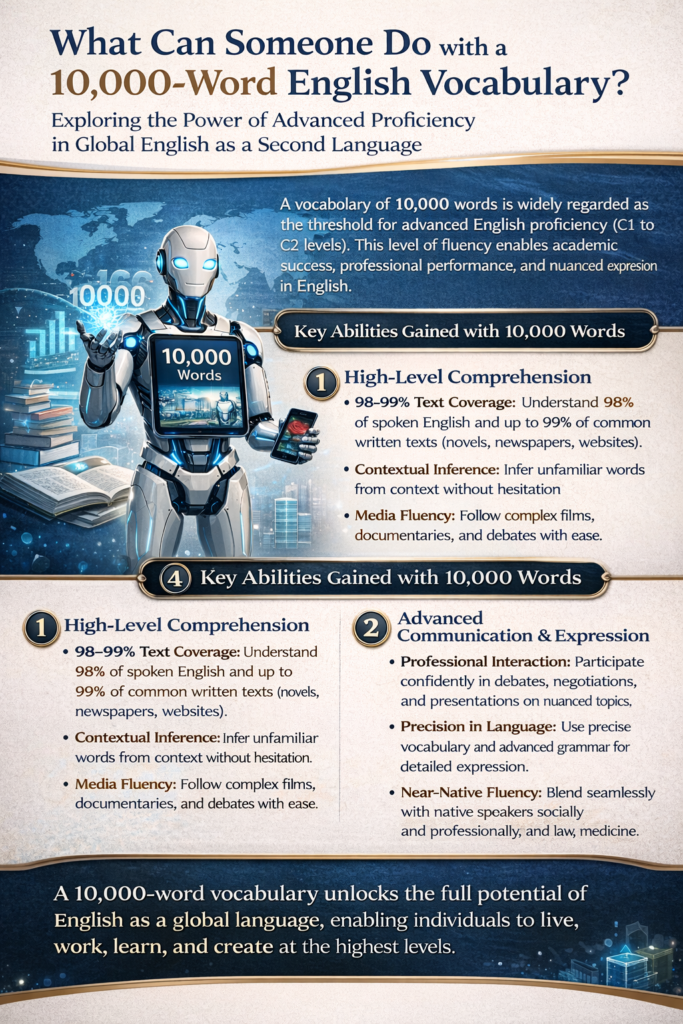
Please edit, refine, polish, and like professional rewrite the writing below:
1 line with 10 words
1 page 10 line *10 words = +100 words (( +20% ) of the most commonly used words in the English language)
10 pages * 100 words = +1000 words (+85% of the most commonly used words in the English language)
100 pages * 100 words = +10,000 words (+98% of the most commonly used words in the English language)
1 book with 100 pages =+10,000 words
100 minutes is enough to think, listen, speak, read, or write up to 100*100=10,000+ words.
100 minutes is enough time to think, listen, speak, read, or write up to 10,000+ words — that’s 100 words per minute.
For 100-plus years, living, learning, working, and socializing within a global highest culture in this universe.
For un 100
++++++
Average Conversational Pace: The average speaking rate for conversational talk is between 120 and 150 words per minute (wpm). At this rate, 10,000 words would take about 66 to 83 minutes.
+++++++
Please edit, refine, polish, and, like a professional, rewrite the writing below:
Each line contains 10 words.
Each page consists of 10 lines, with 10 words per line, totaling approximately 100 words. These 100 words cover about 20% of the most commonly used words in the English language.
Ten pages at 100 words per page yield about 1,000 words, which together encompass roughly 85% of the most commonly used English words.
Expanding to 100 pages results in approximately 10,000 words, a total that includes around 98% of the most commonly used words in English.
A 100-page book equals about 10,000 words.
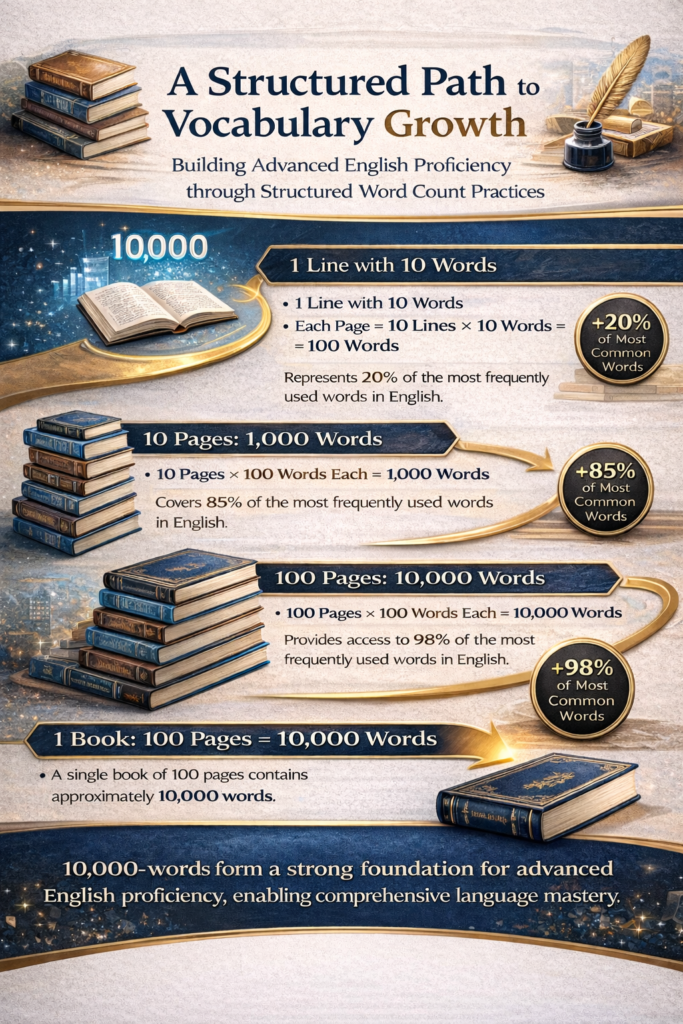
1+ 1, 10, 100, 400, 1000 Words
2+ 2000 Words
3+ 3000 Words
4+ 4000 is Words
5+ 5000 Words
6+ 6000 Words
7+ 7000 Words
8+ 8000 Words
9+ 9000 Words
10+ 10,000 Words
11+ 11,000 Words
12+ 12,000 Words
13+ 13,000 Words
14+ 14,000 Words
15+ 15,000 Words
16+ 16,000 Words
17+ 17,000 Words
18+ 18,000 Words
19+ 19,000 Words
20+ 20,000 Words
21+ 21,000 Words
22+ 22,000 Words
23+ 23,000 Words
24+ 24,000 Words
25+ 25,000 Words
26+ 26,000 Words
27+ 27,000 Words
28+ 28,000 Words
29+ 29,000 Words
30+ 30,000 Words
31+ 31,000 Words
32+ 32,000 Words
33+ 33,000 Words
34+ 34,000 Words
35+ 35,000 Words
36+ 36,000 Words
37+ 37,000 Words
38+ 38,000 Words
39+ 39,000 Words
40+ 40,000 Words
41+ 41,000 Words
42+ 42,000 Words
43+ 43,000 Words
44+ 44,000 Words
45+ 45,000 Words
46+ 46,000 Words
47+ 47,000 Words
48+ 48,000 Words
49+ 49,000 Words
50+ 50,000 Words
51+ 51,000 Words
52+ 52,000 Words
53+ 53,000 Words
54+ 54,000 Words
55+ 55,000 Words
56+ 56,000 Words
57+ 57,000 Words
58+ 58,000 Words
59+ 59,000 Words
60+ 60,000 Words
61+ 61,000 Words
62+ 62,000 Words
63+ 63,000 Words
64+ 64,000 Words
65+ 65,000 Words
66+ 66,000 Words
67+ 67,000 Words
68+ 68,000 Words
69+ 69,000 Words
70+ 70,000 Words
71+ 71,000 Words
72+ 72,000 Words
73+ 73,000 Words
74+ 74,000 Words
75+ 75,000 Words
76+ 76,000 Words
77+ 77,000 Words
78+ 78,000 Words
79+ 79,000 Words
80+ 80,000 Words
81+ 81,000 Words
82+ 82,000 Words
83+ 83,000 Words
84+ 84,000 Words
85+ 85,000 Words
86+ 86,000 Words
87+ 87,000 Words
88+ 88,000 Words
89+ 89,000 Words
90+ 90,000 Words
91+ 91,000 Words
92+ 92,000 Words
93+ 93,000 Words
94+ 94,000 Words
95+ 95,000 Words
96+ 96,000 Words
97+ 97,000 Words
98+ 98,000 Words
99+ 99,000 Words
100+ 100,000 Words
100+ 100,00 Words
1+ 10,000, 20,000 or, 30,000 or 40,000 to final goal 100,000 words plus, and onward. The 100th floor is dedicated to celebrating, supporting, and honoring individuals who have reached their 100th birthday and the remarkable journeys they have made. The 122nd floor is dedicated to the legacy of Jeanne Calment of France, the longest-living person ever verified, who lived to $122$ years and $164$ days (1875-1997).
The 123rd floor is the ultimate challenge space. It compiles all current recommendations for living 123 years to establish a new world record. It is designed to inspire hope, dreams, and prayers, featuring numerous ready recognition documents, substantial rewards, and a staggering $123 million cash prize for the successful challenger.
From the 123rd to the 200th floor, each floor is dedicated to year-by-year living goals spanning 200, perhaps at the 22nd, 23rd, or 24th centuries, or around years 3000 or 4000. These floors are filled with all suggestions, recommendations, ideas, formulas, recipes, prescriptions, products, services, inventions, discoveries, plans, and prayers to answer this question: How to live to that specific age? But for now, the world awaits the challengers who seek to set a new record by living to 123 years and becoming humanity’s next longevity hero.
John continued: We are about to begin our unparalleled longevity journey, ascending from the first floor to the 200th floor of this remarkable Centenarian Library. Here at the Atlantic Island Four Seasons Gardeners Centenarian Library, you’ll discover the world’s most comprehensive collection of age-specific resources. Each floor is carefully curated to match a specific age, from 1 to 200, offering a rich array of materials, including physical books, eBooks, audio recordings, videos, websites, AI-driven data, and a wide variety of related products and services.
In addition to its vast media library, the building hosts exhibitions, interactive shows, and innovation markets where visitors can explore new ideas, encounter groundbreaking technologies, and discover the latest in health, wellness, and longevity.
You’ll also have the opportunity to meet and learn from leading professionals and experts in the fields of fitness, aging science, holistic health, and personal wellness. Each floor presents suggestions, insights, formulas, recipes, prescriptions, inventions, discoveries, services, and spiritual reflections, all designed to help you answer one life-defining question:
“How do you want to live, and how can you thrive at your desired age?”
Use your smartphone to scan, take photos, record videos, send messages, place orders, take notes, and access information to live a happy, healthy, prosperous life for over 100 years.
We’re proud to be your guide on this journey to support you, inspire you, and help you find exactly what you’re looking for here at the Atlantic Island Four Seasons Gardeners Centenarian Library, one of the featured destinations of the 2030 World Fair.
For more information, please visit: 100-plus-years-living-benefits-advantages-and-reasons
https://www.best100plus.com/100-plus-years-living-benefits-advantages-and-reasons/
+++++++++++
The library is housed within a brilliant, 100-story, Golden-Glass High-Rise designed with cutting-edge digital solar windows. These windows generate clean energy and also display dynamic visual content on screens on four sides of high-rise windows. They present engaging visual content, such as daily tributes to the best students, teachers, books, and writers of English Global Language. Plus uplifting messages and inspirational imagery. Common images and messages include: with a large, beautiful, golden, and shiny images of William Shakespeare with his book ( First Folio) in his right hand with these writing on cover clearly readable says in 4 lines( To be free to listen, To be free to speak, To be free to read, to be free to write) and under those four lines this writing ( As You Like It ).
with a large, around 20-meter beautiful, golden, and shiny statue of William Shakespeare with his book ( First Folio) in his right hand with these writing on cover clearly readable says in 4 lines( To be free to listen, To be free to speak, To be free to read, to be free to write) and under those four lines this writing ( As You Like It ) plus status in front of bulding.
“Shakespear As You Like It!.”
On top of a brilliant, 100-story, Golden-Glass High-Rise is a large Shakespear Global Theater, and on top of the globe large, around 10-meter, beautiful, golden, and shiny statue of William Shakespeare
A.I. (Artificial Intelligence)-powered Info Robot representing a Large Language Model (LLM) named Ailma, with more than 100 smaller Info Robots connected to inform visitors and learners on all floors.
Situated on a prime 100-by-100-square-meter plot, the structure comprises 100 above-ground floors and 23 subterranean levels. The underground levels are dedicated to high-capacity parking and storage, meeting rooms, and a convention hall. The uppermost subterranean level is a thoughtful, metaphorical space symbolizing the 26 English language alphabet letters and 100 plus most used global signs and symbols from just the point daot . or virgols to mathematical symbols like = +-%* to …
Above ground, every floor of the library is organized into a vast collection of resources. These include physical books, eBooks, audio, videos, websites, AI data, and related products and services, which are tailored precisely to each floor or story to 1000 words of the English as global language.
How many words do you have in your vocabulary that you can remember with 100% certainty for the next 100 years? These words can help you create stories that span a lifetime, including your goals, plans, schedules, and to-do lists.
How many words do you have vocabulary in your memory banks dictionary that you can remember with 100% certainty sure you can remember for sure to use them for 100 years of long living? To create your 100-year-long stories, including ( Goals, plans, schedules, to-do lists, and more.)
How many words do you have in your memory banks for 100% certainty, sure you can remember for sure to use them for 100 years of long living?
+++++
Emphasizing Words of Language: From Human Mastery to Artificial Intelligence
Language is the ultimate tool for connection and creation. Whether through the natural growth of a human mind or the complex training of an AI, the volume of words we command defines our ability to “be free to listen, speak, read, and write.”
Special emphasis is placed on the relationship between vocabulary size, numerical milestones, and educational or intellectual grade levels, as illustrated below:
- 1+ — 1, 10, 100, 400, 1,000 words
- 2+ — 2,000, 2,026, 2,030 words
- 3+ — 4,000 words
- 4+ — 10,000 words
- 5+ — 20,000 words (typically known by 6th-grade students)
- 6+ — 40,000 words (typically known by 12th-grade students)
- 7+ — 60,000 words (average for a bachelor’s degree holder)
- 8+ — 80,000 words (estimated vocabulary of a PhD or doctor)
- 10+ — 100,000+ words (the level of a language master, literary genius, prolific writer, or top linguistic expert)
The Human Vocabulary Journey
Below is a breakdown of vocabulary milestones, mapping word counts to educational levels and expertise levels.
| Level | Estimated Vocabulary | Mastery Milestone |
| 1 | 1 to 1,000 Words | Early Childhood & Foundational Basics |
| 2 | 2,000 to 2,030 Words | Primary Development (Milestones for 2026/2030) |
| 3 | 4,000 Words | Emerging Literacy |
| 4 | 10,000 Words | Functional Fluency |
| 5 | 20,000 Words | 6th Grade Proficiency |
| 6 | 40,000 Words | 12th Grade (High School Graduate) |
| 7 | 60,000 Words | Bachelor’s Degree Level |
| 8 | 80,000 Words | Advanced Expertise (Doctorate/PhD) |
| 10+ | 100,000+ Words | Linguistic Masters, Geniuses, and Elite Writers |
Artificial Intelligence (AI), Large Language Models (LLMs), and Vocabulary Volume
Humans learn through experience and study, while Large Language Models (LLMs) process language using massive datasets and specialized tokenization techniques.
LLMs are trained on an enormous amount of text, ranging from hundreds of billions to over a trillion words, gathered from the internet, books, academic databases, and various other text-rich sources. This vast exposure allows the models to learn:
- Grammar and syntax
- Factual knowledge
- Patterns of reasoning
- Contextual understanding
Fixed Vocabulary Size in LLMs
Despite being trained on such massive data, LLMs operate using a fixed vocabulary — a discrete set of units known as tokens. During processing, any input text is tokenized (broken down) into these units.
- In multilingual models, the vocabulary size is generally larger, often around 250,000 tokens, to support multiple languages efficiently.
- In monolingual models (trained on a single language), the vocabulary size typically ranges from 30,000 to 60,000 tokens.
Why This Matters
Understanding the “Best 1 to100,000+ Words” inspires and motivates everyone to appreciate each word, advancing their learning and memorization for peak human achievement while utilizing AI as a powerful partner in the creative process.
Understanding the “Best 100,000+ Words” allows everyone to appreciate the peak of human achievement while utilizing AI as a powerful partner in the creative process.
At www.best100plus.com, we celebrate this bridge between human bril
[ Please note: All numbers and grade levels presented are estimates and represent informed approximations for the story, not definitive or guaranteed outcomes.]

e Linguistic Treasury: Investing in Human Potential
John: “In our journey across Atlantic Island and through the Four Seasons Gardeners complex, we now enter the most critical sector of the English Global Language Information Library: The Offices of Finance, Budget, and Rewards.
Here, we don’t just count books; we calculate the value of human genius.”
The Burden of Language: A Global Challenge
John continues:
The human need to learn and memorize language, the pursuit of linguistic mastery from the first word to 100, then 1,000, 10,000, and ultimately the elite milestone of 100,000 words, has long defined the path to human success. Across history, this journey has remained one of the greatest intellectual challenges—and among the most significant educational investments—for individuals, families, organizations, governments, and global institutions like UNESCO. While the cost of achieving such linguistic mastery can be substantial, the rewards of global communication, cultural access, and cognitive development are truly priceless.
The current “Market Price” of human learning is staggering:
- Total Financial Cost: $100,000 to $1,000,000 per expert.
- Time Investment: 10,000 to 40,000 hours (1 to 10+ years of life).
- Unit Cost: $10 to $100 and 1 to 10 hours of study per single word.
The $100 Billion Global Incentive
To solve this monumental challenge, the Finance and Reward Offices are issuing a historic proposal. We seek any story, system, method, software, AI, or biological interface that enables a human to permanently memorize the spelling and pronunciation of words for 100 years.
The Prize: > For a system that guarantees the permanent retention of 100,000 words, the Library will compensate the creator with:
$100 Billion USD
(Calculated at a rate of $1 Million per word)
Scope of the Reward:
- Technical Requirement: Permanent memorization and recall of spelling and pronunciation (comparable to a digital recording or wireless cloud link).
- Distinction: This reward focuses solely on the storage and retrieval of data (The Memory Bridge), rather than contextual usage or conversational training.
- Format: Open to all mediums—from narrative methods to AI-driven neural links.
A Call to All Generations
This initiative is designed to motivate and inspire every mind on the planet—from the curiosity of kids and teens to the wisdom of our centenarians. We are calling on the inventors of today to build the bridge to 2045, ensuring that no word is ever forgotten and no human potential is ever wasted.
The future of language is here. How will you earn your first million?
Inspiring All Generations to Learn
This bold initiative is designed to motivate and inspire learners of all ages, from the curiosity of kids and teens to young adults, professionals, and seniors, to the wisdom of our centenarians, to actively engage in the process of mastering vocabulary, one word at a time. It honors the belief that every word learned is an investment in one’s future, identity, and global connection.
Furthermore, this calls for today’s creative minds and ingenious inventors to enable individuals and humanity to achieve their full potential.
The future of language is now. What will be the next word you learn to earn your first million dollars?
Learning each new word is
Learning new words in English helps us in multiple ways. It eases the trouble of expression and brings clarity to communication. A rich vocabulary will allow us to use the right set of words at the right time and encourage our listeners to quickly grab the ideas we are trying to convey through communication.
Words for learning new things include acquiring knowledge, discovering, exploring, studying, mastering skills, assimilating, grasping, or researching, with specific terms like “neophile” (a lover of novelty) or “inquisitive” describing the person. The best word depends on context, like “upskilling,” “training,” or simply “picking up” new info.

Do with a 10,000-Word English Vocabulary?
Exploring the Power of Advanced Proficiency in Global English as a Second Language
A vocabulary of 10,000 words is widely regarded as the threshold for advanced English proficiency. At this prestigious stage, a learner transcends “survival” communication and achieves high-level fluency, enabling academic, professional work or business, and social interactions with complex English expressions.
Key Abilities Gained with 10,000 Words
1. High-Level Global Comprehension
- 98–99% Text Coverage: You can understand 98% of everyday spoken English and up to 99% of common written texts, including newspapers, news broadcasts, films, literature, novels, websites, and non-specialized books.
- Intellectual Intuition: You recognize enough surrounding vocabulary to accurately deduce the meaning of unfamiliar words or technical terms from context without needing a dictionary.
- Media Fluency: Complex films, documentaries, interviews, and live debates become accessible and enjoyable, with minimal reliance on subtitles or dictionaries, as easily as a native speaker.
2. Advanced Communication and Expression
- Professional Interaction in Work and Business: English is the primary language of international business and trade, and strong English skills are a significant advantage in the global job market. You can confidently participate in workplace discussions, negotiations, and presentations, and even discuss technical topics, abstract or specialized concepts, with confidence.
- Career Advancement: Employers prioritize candidates with strong communication skills; a 10,000-word vocabulary often correlates with higher salaries and better job opportunities.
- Precision in Language: Your communication becomes highly precise and expressive, utilizing a wide range of synonyms, idiomatic expressions, and advanced grammatical structures.
- Near-Native Fluency: If pronunciation and grammar are also well-developed, a 10,000-word vocabulary allows many learners to blend in seamlessly with native speakers in both social and professional contexts.
3. Academic Literacy and Writing Skills
- University-Level Reading: You can comfortably read novels, academic articles, international newspapers, and general nonfiction without frequent interruptions to look up unfamiliar words.
- Complex Writing Ability: You’re capable of producing analytical essays, research papers, reviews, and professional reports that meet academic and workplace standards.
- Foundation for Specialization: This vocabulary range provides a solid foundation for mastering technical jargon in fields such as law, engineering, medicine, and business.
4. Alignment with Global Standards (CEFR)
- C1 Level: Typically associated with 8,000 to 10,000 words. At this level, users can communicate effectively and flexibly for all social and professional purposes on a wide range of topics, including unfamiliar or sensitive subjects.
- C2 Level: Often associated with 10,000+ words. This is considered the pinnacle of language mastery, where users can express themselves spontaneously, precisely, and effortlessly—making English feel almost limitless in its possibilities, an extension of your own thoughts
- For International Student Acceptances: Universities generally require a high level of English proficiency for admission. Standardized tests such as IELTS and TOEFL are common ways universities assess proficiency, and high scores on these tests demonstrate the extensive vocabulary and language skills required in an academic environment. While the specific requirements vary by institution, a 10,000-word vocabulary corresponds to an advanced level of English (around C1 or C2 on the CEFR scale) or ( IELTS and TOEFL ). This level of proficiency is generally more than sufficient for academic success.
5. Other Benefits and Uses - Access to Global Information and Culture: English is the language of much global media, academic research, and international business. A strong vocabulary opens doors to a vast range of information and a deeper understanding of diverse cultures.
- Easier International Travel: Because English is widely spoken globally, a robust vocabulary makes navigating new places and communicating with locals easier and more enjoyable during travel. This vocabulary size ensures you can handle virtually any situation that may arise during international travel, from routine transactions to unexpected issues, without significant communication barriers.
- Active vs. Passive Vocabulary: A passive vocabulary (words you understand when you hear or read them) is typically larger than an active vocabulary (words you use confidently in speaking and writing). Knowing 10,000 words actively is a significant achievement.
- Pragmatics and Idioms: Understanding idiomatic expressions, slang, and cultural nuances is essential for social interaction and truly “global” English communication.
- Cognitive Advantages: Learning an extensive vocabulary challenges the brain, which can improve memory, enhance critical thinking, goal-setting, and planning, and potentially delay the onset of cognitive decline.
- Practice: Consistent practice through listening, speaking, writing, and reading books, news articles or watching movies is necessary to integrate vocabulary into natural, fluent use. Learn words in context by reading books, news articles, and listening to podcasts or watching movies, rather than in isolation.
Conclusion
A 10,000-word vocabulary unlocks the full potential of English as a global language. It bridges the gap between functional fluency and true linguistic mastery—enabling individuals to live, work, learn, and create in English at the highest levels.
Please edit, refine, polish, and like professional rewrite the writing below:
1 line with 10 words
1 page 10 line *10 words = +100 words (( +20% ) of the most commonly used words in the English language)
10 pages * 100 words = +1000 words (+85% of the most commonly used words in the English language)
100 pages * 100 words = +10,000 words (+98% of the most commonly used words in the English language)
1 book with 100 pages =+10,000 words
100 minutes is enough to think, listen, speak, read, or write up to 100*100=10,000+ words.
100 minutes is enough time to think, listen, speak, read, or write up to 10,000+ words — that’s 100 words per minute.
For 100-plus years, living, learning, working, and socializing within a global highest culture in this universe.
For un 100
++++++
Average Conversational Pace: The average speaking rate for conversational talk is between 120 and 150 words per minute (wpm). At this rate, 10,000 words would take about 66 to 83 minutes.
+++++++
Please edit, refine, polish, and, like a professional, rewrite the writing below:
Each line contains 10 words.
Each page consists of 10 lines, with 10 words per line, totaling approximately 100 words. These 100 words cover about 20% of the most commonly used words in the English language.
Ten pages at 100 words per page yield about 1,000 words, which together encompass roughly 85% of the most commonly used English words.
Expanding to 100 pages results in approximately 10,000 words, a total that includes around 98% of the most commonly used words in English.
A 100-page book equals about 10,000 words.
++++++++++++++++++++++++

The Atlantic Island Four Seasons Gardens, Gardening, and Four Elements Libraries
The Summar, Fire, Light, Sunshine, and Energy Library
The Spiring, Water, Greens, and Flowers Library
The Fall, Air, and Breathing Library
The Winter, Lands, and Foods Library
Hohn: In our science fiction story, we now arrive at the Atlantic Island, Four Seasons Gardeners Centenarian Library of Information, a visionary hub dedicated to the study of human longevity. This extraordinary library brings together the finest resources of the Information Age to support and celebrate humanity’s Centenarian Age.
The library is housed within a brilliant, 200-story, Golden-Glass High-Rise designed with cutting-edge digital solar windows. These windows generate clean energy and also display dynamic visual content on screens. They present engaging visual content, such as daily birthday tributes for those turning 100, uplifting messages, and inspirational imagery. Common messages include: “Live a happy, healthy, prosperous, and informed 100-plus-year-long life.”
Situated on a prime 100-by-100-square-meter plot, the structure comprises 200 above-ground floors and 21 subterranean levels. The underground levels are dedicated to high-capacity parking and storage, meeting rooms, and a convention hall. The uppermost subterranean level is a thoughtful, metaphorical space symbolizing the nine-month developmental journey in the womb, representing the very genesis of life.
Above ground, every floor of the library is organized into a vast collection of resources. These include physical books, eBooks, audio, videos, websites, AI data, and related products and services, which are tailored precisely to that age group year by year, from ages 1 to 200.
Special emphasis is placed on milestone decades, such as ages 10, 20, 30, and onward. The 100th floor is dedicated to celebrating, supporting, and honoring individuals who have reached their 100th birthday and the remarkable journeys they have made. The 122nd floor is dedicated to the legacy of Jeanne Calment of France, the longest-living person ever verified, who lived to 122$ years and 164 days (1875-1997).
The 123rd floor is the ultimate challenge space. It compiles all current recommendations for living 123 years to establish a new world record. It is designed to inspire hope, dreams, and prayers, featuring numerous ready recognition documents, substantial rewards, and a staggering $123 million cash prize for the successful challenger.
From the 123rd to the 200th floor, each floor is dedicated to year-by-year living goals spanning 200, perhaps at the 22nd, 23rd, or 24th centuries, or around years 3000 or 4000. These floors are filled with all suggestions, recommendations, ideas, formulas, recipes, prescriptions, products, services, inventions, discoveries, plans, and prayers to answer this question: How to live to that specific age? But for now, the world awaits the challengers who seek to set a new record by living to 123 years and becoming humanity’s next longevity hero.
John continued: We are about to begin our unparalleled longevity journey, ascending from the first floor to the 200th floor of this remarkable Centenarian Library. Here at the Atlantic Island Four Seasons Gardeners Centenarian Library, you’ll discover the world’s most comprehensive collection of age-specific resources. Each floor is carefully curated to match a specific age, from 1 to 200, offering a rich array of materials, including physical books, eBooks, audio recordings, videos, websites, AI-driven data, and a wide variety of related products and services.
In addition to its vast media library, the building hosts exhibitions, interactive shows, and innovation markets where visitors can explore new ideas, encounter groundbreaking technologies, and discover the latest in health, wellness, and longevity.
You’ll also have the opportunity to meet and learn from leading professionals and experts in the fields of fitness, aging science, holistic health, and personal wellness. Each floor presents suggestions, insights, formulas, recipes, prescriptions, inventions, discoveries, services, and spiritual reflections, all designed to help you answer one life-defining question:
“How do you want to live, and how can you thrive at your desired age?”
Use your smartphone to scan, take photos, record videos, send messages, place orders, take notes, and access information to live a happy, healthy, prosperous life for over 100 years.
We’re proud to be your guide on this journey to support you, inspire you, and help you find exactly what you’re looking for here at the Atlantic Island Four Seasons Gardeners Centenarian Library, one of the featured destinations of the 2030 World Fair.
For more information, please visit: 100-plus-years-living-benefits-advantages-and-reasons
https://www.best100plus.com/100-plus-years-living-benefits-advanta
++++++++++++++++++++
v https://www.best100plus.com/roses-smartrosy-story26gem1/
Williams pear tree’s
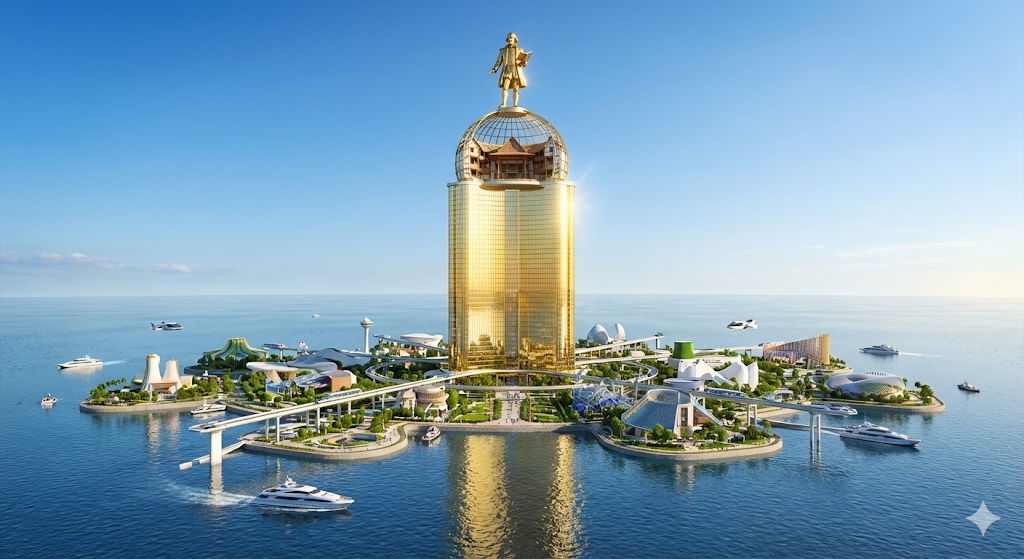
+++