1. Shakespeare and his works are highly respected by many people throughout history and around the world.
2. We at www.best100plus.com have the highest respect too,
3. For that and many other reasons, we chose the name Shakespear. When we refer to the real Shakespeare, we use “Shakespear,” and for our ideas, we use “Shakespear” to maintain respect and freedom for our concepts.
4. To use it as a brand name more freely for promoting pear, Shakspear blender smoothies, and smart shakesprear, individuals can adopt these names as nicknames for their artistic works, such as writing, photos, or videos taken with a smartphone, among other purposes.
5. All unique names, writing, stories, images, videos, etc. in the best 100 collections and their usage are created, authored, written, copyrighted, trademarked, and owned solely by WWW.best100plus.com and Ray Story. Only those explicitly specified specifically mentioned as copyright-free are available for use by anyone interested.
All third-party content in the WWW.best100plus.com collection requires permission from its owners and copyright holders for any type of use.
5. To teach or to learn 100,000 English words, first start with the following progression: from 1 word to 10, 100, 400, 1000, to 10,000 Words.
With a few methods:
A. SmartRosy with roses in the stories.
B. With a play or story (“As You Like It”) from the Shakespeare book “The First Folio.” As You Like It follows its heroine Rosalind and Orlando, as Smart Rosalind and Olandlord
6. The selected play from the First Folio to promote and learn the first 10,000 words is “As You Like It.” Therefore, most of the promotion will focus on “As You Like It.”
7. We will visit all areas, but for now, Linda will present and discuss “As You Like It.” “Center here,” John said.
+To teach or to learn 100,000 English words, first starting from: start with the following progression:
1+ 1, 10, 100, 400, 1000 Words
2+ 2000 Words
3+ 3000 Words
4+ 4000 is Words
5+ 5000 Words
6+ 6000 Words
7+ 7000 Words
8+ 8000 Words
9+ 9000 Words
10+ 10,000 Words
+++++++++++
Please edit, refine, polish, and, like a professional, rewrite the writing below:
++++++++++++++++++++++++++
A Smart Approach to Mastering 100,000 English Words🌹📚
To teach or learn 100,000 English words, start with a clear plan. The journey from knowing 1 word to mastering 100,000 words makes mastery accessible to everyone through the best available styles and methods like:
The 7 learning styles combine sensory and social preferences, typically including Visual, Auditory (Aural), Reading/Writing, Kinesthetic (Physical) (the popular VARK model) with Logical, Social, and Solitary styles, forming a comprehensive model where individuals learn best through seeing, hearing, words, doing, reasoning, groups, or alone, often using a mix of these approaches for effective information retention. Additionally, by adding natural, Repeation, Association, Impression, Preparation, and numbering. By using patterns, mnemonics, acronyms, formulas, rhythms, or rhymes to enhance memory, finding points, discovering, comprehension, understanding, and realization, plus accessing human higher inner conscious powers.
Naturally, Repeatually, Associationally, Impressionally, Preparationally. By using patterns, mnemonics, acronyms, formulas, rhythms, or rhymes to enhance memory, finding points, discovering, comprehension, understanding, and realization.
1 → 10 → 100 → 400 → 1,000 → 10,000 → 100,000
We use several friendly methods for learning, realizing, memorizing, remembering, and using 100,000 words effectively for over 100 plus years:
Method A: SmartRosy — learning through the vibrant beauty of the rose-powered stories, images, and “Rosy Moments.” where every bloom signifies a new level of understanding. 🌹
Method B: Smart Shakespear Learning Path — learning through our reimagined classic, new version of As You Like It from Shakespeare’s First Folio, guided as a modern, creative journey with Smart Rosalind and Smart Orlando as they navigate the Forest of Arden as the Shakespeare Rose Garden. 🎭✨
+++++++++++
The 7 common learning styles, often cited as Visual, Aural, Verbal, Physical (Kinesthetic), Logical, Social, and Solitary
+++++++++++++++++++++++++++
🌟
🏛️
+++++++++++++++++++++++++++++++++++
To teach or to learn 100,000 English words, first start with the following progression: from 1 word to 10, 100, 400, 1000, to 10,000 Words.
With a few methods:
A. SmartRosy with roses in the stories.
B. With a play or story (“As You Like It”) from the Shakespeare book “The First Folio.” As You Like It follows its heroine Rosalind and Orlando, as Smart Rosalind and Olandlord
++++++++++++++++++++++++
1 line with 10 words= + 10 words (+10%) of the most commonly used words) If possible, in 2 sepred side, each side with 5 words
1 page 10 line *10 words = +100 words (( +20% ) of the most commonly used words in the English language)
10 pages * 100 words = +1000 words (+85% of the most commonly used words in the English language)
100 pages * 100 words = +10,000 words (+98% of the most commonly used words in the English language)
1 book with 100 pages =+10,000 words
100 minutes is enough to think, listen, speak, read, or write up to 100*100=10,000+ words.
100 minutes is enough time to think, listen, speak, read, or write up to 10,000+ words — that’s 100 words per minute.
For 100-plus years, living, learning, working, and socializing within the highest culture in this universe.
+++++++
1. with 10,000 SmartRosy in the stories, which are in 10 colors and each rose is numbered and represents 1 specific word.
2. With a play or story (“As You Like It” for the 2045 learner) from the Shakespeare book “The First Folio.” As You Like It follows its heroine Rosalind and Orlando, as Smart Rosalind and Olandlord
Bouts with stories, books, sound recordings, videos, websites, AIs, live teachers, TV series, and classroom settings with teachers, tutors, and mentors. These will be formatted according to seven learning styles and more.

The elevator’s hum faded into a serene silence as the group stood before the glass-encased First Folio. The air was cool, carrying the faint, sweet scent of old parchment and digital ozone. John Datak stepped back, his task of introduction complete, and gestured toward the center of the shimmering floor where Linda waited.
Linda stood beneath a holographic projection of a lush, digital forest—the Forest of Arden. She wore a gown that seemed to shift colors, mirroring the vibrant greens and rose pinks of the garden above.
🎭 The Presentation: As You Like It
“Welcome to the heart of the Forest,” Linda began, her voice echoing with a warm, melodic resonance. “If the First Folio is the ‘Root Directory’ of the English language, then As You Like It is the most beautiful program ever written for it. We have selected this play as our primary vehicle to help you master the first 10,000 words of Global English.”
She tapped her smartphone, and the room’s ambient lighting shifted. The walls became transparent, showing a 360-degree view of a pastoral paradise.
🌟 Why “As You Like It” for the 2045 Learner?
Linda walked through the holographic trees, explaining the strategic choice:
- The Pastoral Escape: Just as the characters flee to the Forest of Arden to find truth, our visitors use the Radiant Library to find clarity in a complex world.
- The Seven Ages of Man: This famous speech (from Act II, Scene VII) is our template for the Best 100 Life Habits, tracking human growth from infancy to the centenarian years.
- The Vocabulary of Nature: The play is the source of our Shakespeare Roses and our focus on environmental sustainability (SDG alignment).
- Gender and Identity: Through Rosalind, the play explores the fluidity of identity, encouraging a Social Learning style that is inclusive and optimistic.
💎 The “Shakespear” Brand: Respect & Freedom
Linda paused by a display featuring a sleek, high-tech blender and a smartphone running the Smart Shakespear app.
“You noticed John used a specific spelling,” Linda said with a wink. “In the Shakespeare Global Convention, we honor the man, the actor, and the writer. But for our Best 100 Plus vision, we use the brand name ‘Shakespear.’ >
Why? Because it gives us the freedom to innovate. Shakespear is a brand for the future—it is your Shakespear Blender for healthy smoothies, your Smart Shakespear AI tutor, and your creative nickname for the ‘Best 100’ photos you take on your smartphone. We respect the history, but we own the future.”
📚 The Learning Roadmap (The 10,000 Word Goal)
Linda pointed to the Education Zone, where holographic books floated in mid-air. “To reach the 80% completion mark of our mission, we use As You Like It to anchor your vocabulary. Here is how we categorize the learning journey:”
🚀 Taking it to the Next Level
+++++++++++++++++

+++++++


Chapter 7: The Era of Memory vs. The Era of Record
Scene: The Information Reformation Desk. Speaker: John Datak.
John watched as the visitors placed their shiny new Vocabulary Binders into their bags. He raised a hand to pause them, his expression serious and thoughtful.
“Before we move on,” John said, “you must understand why we insist you write things down. Many of you trust your minds. But in the Information Reformation, we teach a hard truth: Writing is reliable. Memory is not.“
He tapped the cover of his own binder.
“Memories fade. They get distorted by time and emotion. They can be lost forever in a moment of forgetfulness. But writing—or any form of recording—provides a consistent, tangible reference. It is the foundation of Accountability, Clear Thinking, and Accuracy.”
The Historical Perspective: The Gutenberg Gap John gestured to a holographic timeline that Comycom projected into the air. It showed a timeline of human history.
“Consider our hero, William Shakespeare. He lived from April 23, 1564, to April 23, 1616. This was approximately 120 to 170 years after Johannes Gutenberg invented the movable-type printing press in Germany around 1440.”
The hologram zoomed in on an image of an old printing press.
“Gutenberg’s invention was the ‘Smartphone’ of the 15th Century. It revolutionized information, enabling the mass production of books. It spread knowledge, fueled literacy, and ignited the Renaissance, taking power away from the wealthy elite and giving it to the people.”
The Reliance on Memory “However,” John continued, “even though the press was invented in 1440, by Shakespeare’s time in England, mass literacy was still in its infancy. Most of the population could not read or write. They had no choice. All humans relied entirely on their memory.“
John looked at the students in the group.
“Imagine that. Every story, every history, every recipe, every contract—it all had to be memorized or hand-written by a very few. If the person died, the information died with them.”
The Modern Choice “Today, you are the ‘Best 100 Plus’ Generation. You are not forced to rely on a fragile memory. You have the tools of Information Reformation.”
John pointed to their Smart Neck Wallets and Binders.
“You have the ability to record, video, audio, and write. You can preserve your thoughts for the next 100 years. So, my advice to you is this: Do not let your life be a fading memory. Be a Smart Shakespear. Document your brilliance. Preserve your legacy. Make your information tangible, accurate, and eternal.”
++++
+++++
https://4seasonsgardensplus.com/health-foods/#47-the-nature-of-things
Feature: Spread Shakespeare’s influence far beyond England.
John continued: Writing things down is more reliable than relying on memory, as memories fade, get distorted, or can be lost, while writing or any recording provides a consistent, tangible reference for important information, learning, and accountability. It emphasizes documentation for accuracy, clear thinking, and long-term preservation.
William Shakespeare lived from (23 April 1564– 23 April 1616) or from 12o to 170 years after Johannes Gutenberg’s invention of the movable-type printing press in Germany around 1440 revolutionized information, enabling the mass production of books and texts affordably, spreading knowledge, literacy, and ideas like the Renaissance, marking a pivotal moment in history by making texts accessible beyond the wealthy elite. Although printing was invented in Germany in 1440, it is reasonable to assume it was just at the beginning in England. So the pion is all the information that was memorized or written by hand. Also, because only a few people of the population were literate and able to write, so all humans had only rely on their memory.
The majority of humans always had good or very good memory, but they needs were and are always willing to learn and find, also choosing the right memorizing techniques, methods, systems, and using them profoundly.
Shakespeare was the recipient, learner of most of the educational and artistic methods of actors and theater.
Shakespeare became the master of the best, highest student, teacher, and promoter of most of those historically best memorizing methods. As a student, he learned the English language very well, also he was a student of Grammar school and especially speciall wast vocabulary ( around 30 to 40,000 words ). Also William Shakespeare’s works contain nearly 900,000 words, with estimates around 884,000-885,000 across his plays, sonnets, and poems, using over 20,000 unique words and introducing about 1,700 new words or first recorded usages to the English language.
Shakespeare was a very busy actor, sometimes playing a few characters a week, so he had to memorize them. The number one need of acting is the ability to memorize and remember the lines and plays.
Shakespear as a play-writer and later as a creator and owner of the Globe Theater, was able to put the best memorizing methods in writing and a real test of acting. Failure to memorize and forgetting meant being out of a job and out of business very badly, and losing his fame and fortune. But even him, because he did not print as a book or any type of recording, ( from his around 1 million hi created only 1000 words officially remain as his writing because he wrote them.)
Fortunately, Shakespeare’s friends collected his works, published them as a book in 1000 copies, by the name of the First Folio, which around 250 copies remain in good condition by value at more than 10 million dollars for each book. But generous Shakespeare friends made it in good quality to buy from 10 to 100 dollars or browse it from all libraries for free, always from the internet on your smartphone or gadgets. It is one of the most popular, most widely printed, and most widely distributed books in human cultural history. Also, most shows, movies, translated into more than 100 languages,
The First Folio contains most methods of memorization in the English language, as well as education, the arts, literature, and culture.
The First Folio was created and written combination of 7 learning styles like, Visual, Auditory, Verbal, Logical, Physical, Social, and Interpersonal.
It is also has many other methods like Natural, Repeation, Association, Impression, and Preparation. By using patterns, mnemonics, acronyms, formulas, rhythms, or rhymes to enhance memory, finding points, discovering, comprehension, understanding, and realization.
The First Folio for 400 years and now always avalable for anyone for reading, rewriting as a homework or professionally, listening, reading it loud, telling it stories, watching its play on live theaters, movies and TVs, or best of all, playing one of its 38 plays any of them more interesting for you as a lover or professionally as you like
+++++++++++++++++++++++
As You Like It!
From the 1623 First Folio, the book of Shakespeare that saved the English language.
Read more at Wikipedia: https://en.wikipedia.org/wiki/As_You_Like_It
Read all about: As You Like It! at https://smartebooksreading.info/shakespeare-as-you-like-it/

First page of As You Like It from the First Folio of Shakespeare’s plays, published in 1623
As You Like It is a pastoral comedy by William Shakespeare, believed to have been written in 1599 and first published in the First Folio in 1623.
As You Like It follows its heroine Rosalind as she flees persecution in her uncle’s court, accompanied by her cousin Celia to find safety and, eventually, love, in the Forest of Arden. Disguised for safety and wisdom, Rosalind (as Ganymede) tests the heart of her love, Orlando, teaching him that true connection requires more than just poetry—it requires a “Best 100” commitment to truth and nature. In the forest, they encounter a variety of memorable characters, notably the melancholy traveller Jaques, who speaks many of Shakespeare’s most famous speeches (such as “All the world’s a stage“, “too much of a good thing”, and “A fool! A fool! I met a fool in the forest”). Jaques provides a sharp contrast to the other characters in the play, always observing and disputing the hardships of life in the country.
The play remains a favourite among audiences and has been adapted for radio, film, and musical theatre. The piece has been a favourite of famous actors on stage and screen, notably Vanessa Redgrave, Juliet Stevenson, Maggie Smith, Rebecca Hall, Helen Mirren, and Patti LuPone in the role of Rosalind, and Alan Rickman, Stephen Spinella, Kevin Kline, Stephen Dillane, and Ellen Burstyn in the role of Jaques.
Introduction to the play
Readers and audiences have long greeted As You Like It with delight. Its characters are brilliant conversationalists, including the princesses Rosalind and Celia and their Fool, Touchstone. Soon after Rosalind and Orlando meet and fall in love, the princesses and Touchstone go into exile in the Forest of Arden, where they find new conversational partners. Duke Frederick, younger brother to Duke Senior, has overthrown his brother and forced him to live homeless in the forest with his courtiers, including the cynical Jaques. Orlando, whose older brother Oliver plotted his death, has fled there, too.
Read more at https://www.folger.edu/explore/shakespeares-works/as-you-like-it/
Main characters:
- Duke Senior, Rosalind’s father, was overthrown by his younger brother, Duke Frederick—Celia’s father.
- Rosalind is the heroine of the play, Duke Senior’s daughter. She disguises herself as a male shepherdnamed Ganymede.
- Celia, Duke Frederick’s daughter and Rosalind’s loyal cousin, is on the journey.
- Orlando de Bois The brave youth learning the language of love, is the main character who leads the lovers of Rosalind.
- Jaques: The character who delivers the “All the world’s a stage.”
- Touchstone, a court fool who said, “The wise know they are fools. Fools think they are wise!”
- Hymen: the official in charge of weddings in the end; God of marriage, and the happy ending of the story.
++++++++++++++++++

🌟 The Radiant Union of Land and Rose: Rosaland and Olando, with the loving heart at the Forest of Arden rose garden.
our heroes—Rosaland and OlandoRosaland,
rose of land, Olando, o land lord, o land owner
“Here in our Shakespear adaptation, Rosalind becomes Rosaland, the Rose-of-Land, and Orlando becomes the Oland Lord, because roses need land to grow, and love needs a place to live.”
Rosalind (Rosaland, “Rose-of-Land”)
Roseland (one word) or RoseLand (brand style).
Orlando, Lord of the Land (more classic)
Orlando, Rose-Land Guardian (ties directly to roses)
💎
100-story, Golden-Glass High-Rise
Above ground, every floor of the library is organized into a vast collection of resources. These include physical books, eBooks, audio, videos, websites, AI data, and related products and services, which are tailored precisely to each floor or story to 1000 words of the English as a global language, from 1 floor to 100 floors each floor 1000 words from 1000 to 100,000 words. Each story of a brilliant, 100-story, Golden-Glass High-Rise also has the written story with 1000 words from
The library is housed within a brilliant, 100-story, Golden-Glass High-Rise designed with cutting-edge digital solar windows. These windows generate clean energy and also display dynamic visual content on screens on four sides of high-rise windows. They present engaging visual content, such as daily tributes to the best students, teachers, books, and writers of English Global Language. Plus uplifting messages and inspirational imagery. Common images and messages include: with a large, beautiful, golden, and shiny images of William Shakespeare with his book ( First Folio) in his right hand with these writing on cover clearly readable says in 4 lines( To be free to listen, To be free to speak, To be free to read, to be free to write) and under those four lines this writing ( As You Like It )
Situated on a prime 100-by-100-square-meter plot, the structure comprises 100 above-ground floors and 23 subterranean levels. The underground levels are dedicated to high-capacity parking and storage, meeting rooms, and a convention hall.
The brilliant 100-story Golden-Glass High-Rise of the English Global Language Information Library rises like a lighthouse of learning. From Floor 1 to Floor 10 of the tower is dedicated to the first 1,000 to 10,000 English words—the core vocabulary that covers roughly 98% of the most commonly used English in everyday life. These ten floors are guided by one joyful gateway story: As You Like It—our chosen Shakespeare play from the First Folio—used as a living, theatrical path to help learners reach 10,000 words with confidence. Each floor and every new 1,000-word milestone is designed like an educational: halls, exhibits, and learning corners decorated with 10 different natural, vivid-colored roses, and 10 reminding every visitor that language grows best the way roses do—by steps, by seasons, and with loving care and land to bloom.
“Our brains love stories. To remember ‘ story with 1000 words written only for learning and memorising and educational
Our brains love stories. To remember ‘
Please edit and rewrite to maximize clarity, coherence, credibility, and readability while preserving the original meaning and intent. Make this writing polished, modern, and easy to understand, add the relevant details, and make it the best possible.
+++++++++++++++++++++
Humans love, learn, and grow—spiritually, mentally, socially, and educationally—through the power of stories.
Situated on a prime 100-by-100-square-meter plot, the 100-story Golden-Glass High-Rise of the English Global Language Information Library is designed as a living series: 100 floors, 100 story-tales—each floor dedicated to a higher grade of English through a unique 1,000-word journey. Step by step, floor by floor, language becomes experience, and experience becomes growth. 🌹📚🏛️
Humans love and grow spiritually, mentally, socially, and educationally through the power of stories.
The brilliant 100-story Golden-Glass High-Rise of the English Global Language Information Library features 100 stories series, with each floor dedicated to a higher grade of a different 1000 unique -word tale.
Humans love and grow spiritually, mentally, socially, and educationally through the power of stories.
🌹 each floor
it’s an experiential ascent, where “leveling up” in English mirrors literal elevation, reinforcing the idea that stories are the ultimate teachers of empathy, resilience, and wisdom.
A 100-story golden-glass high-rise where each floor unfolds as a dedicated “story-tale” — a 1,000-word immersive journey ascending through progressively higher levels of English proficiency. It’s like turning language acquisition into a literal pilgrimage: visitors (or residents?) climb floor by floor, story by story, transforming vocabulary, grammar, idioms, literature, and cultural nuance into lived experience. The building itself becomes a metaphor for human growth — spiritual reflection in beginner tales of wonder, mental sharpening through intermediate narratives of challenge, social connection via advanced dialogues and debates, and educational mastery at the summit with sophisticated, literary English.
+++++
Humans have always loved, learned, and grown—spiritually, mentally, socially, and intellectually—through the timeless power of stories. Research consistently shows that storytelling is one of the most effective ways to acquire language: it engages emotions, provides rich context for new vocabulary and grammar, boosts retention, fosters natural comprehension, and makes learning enjoyable and memorable, much like how children master their first language.
Rising on a prime 100 × 100-meter plot stands the visionary Golden-Glass High-Rise, home to the English Global Language Information Library—a 100-story architectural masterpiece designed as a literal “living library” of stories.
Each of the 100 floors is dedicated to a progressive level of English mastery, guiding learners upward through a carefully sequenced journey. Every level features a unique, immersive 1,000-word story tailored to that stage of proficiency. Floor by floor, learners advance from foundational basics to advanced fluency.
In this innovative structure, language learning transforms from abstract study into lived experience: stories become the vehicle for growth, turning words into vivid memories, grammar into intuitive understanding, and skills into confident, real-world communication.
Floor by floor, story by story, learners acquire English—they grow into more curious, empathetic, articulate versions of themselves.
Enter the Golden-Glass High-Rise. Press the button for your floor. Let the stories lift you—higher, brighter, bolder—toward mastery and beyond.
Step inside, ascend one story at a time, and watch English—and personal development—unfold.

+++++++++++++++++++++++++++++
+++++++++++++++++
Synopsis

Wrestling scene from As You Like It, Francis Hayman, c. 1750
As You Like It!
From the 1623 First Folio, the book of Shakespear
The play is set in a duchy in France, but most of the action takes place in a location called the Forest of Arden. This may be intended as the Ardennes, a forested region covering an area located in southeast Belgium, western Luxembourg and northeastern France, or Arden, Warwickshire, near Shakespeare’s home town, which was the ancestral origin of his mother’s family—who incidentally were called Arden.
Frederick has usurped the duchy and exiled his older brother, Duke Senior. Duke Senior’s daughter, Rosalind, has been permitted to remain at court because she is the closest friend and cousin of Frederick’s only child, Celia. Orlando, a young gentleman of the kingdom who at first sight has fallen in love with Rosalind, is forced to flee his home after being persecuted by his older brother, Oliver. Frederick becomes angry and banishes Rosalind from court. Celia and Rosalind decide to flee together accompanied by the court fool, Touchstone, with Rosalind disguised as a young man and Celia disguised as a poor lady.
Rosalind, now disguised as Ganymede (“Jove‘s own page”), and Celia, now disguised as Aliena (Latin for “stranger”), arrive in the Arcadian Forest of Arden, where the exiled Duke now lives with some supporters, including “the melancholy Jaques”, a malcontent figure, who is introduced weeping over the slaughter of a deer. “Ganymede” and “Aliena” do not immediately encounter the Duke and his companions. Instead, they meet Corin, an impoverished tenant, and offer to buy his master’s crude cottage.
Audrey by Philip Richard Morris
Orlando and his servant Adam, meanwhile, find the Duke and his men and are soon living with them and posting simplistic love poems for Rosalind on the trees. (The role of Adam may have been played by Shakespeare, though this story is said to be apocryphal.)[1] Rosalind, also in love with Orlando, meets him as Ganymede and pretends to counsel him to cure him of being in love. Ganymede says that “he” will take Rosalind’s place and that “he” and Orlando can act out their relationship.
The shepherdess, Phebe, with whom Silvius is in love, has fallen in love with Ganymede (Rosalind in disguise), though “Ganymede” continually shows that “he” is not interested in Phebe. Touchstone, meanwhile, has fallen in love with the dull-witted shepherdess, Audrey, and tries to woo her, but eventually is forced to be married first. William, another shepherd, attempts to marry Audrey as well, but is stopped by Touchstone, who threatens to kill him “a hundred and fifty ways”.
Finally, Silvius, Phebe, Ganymede, and Orlando are brought together in an argument with each other over who will get whom. Ganymede says he will solve the problem, having Orlando promise to marry Rosalind, and Phebe promise to marry Silvius if she cannot marry Ganymede.
Orlando sees Oliver in the forest and rescues him from a lioness, causing Oliver to repent for mistreating Orlando. Oliver meets Aliena (Celia’s false identity) and falls in love with her, and they agree to marry. Orlando and Rosalind, Oliver and Celia, Silvius and Phebe, and Touchstone and Audrey all are married in the final scene, after which they discover that Frederick also has repented his faults, deciding to restore his legitimate brother to the dukedom and adopt a religious life. Jaques, ever melancholic, declines their invitation to return to the court, preferring to stay in the forest and to adopt a religious life as well. Rosalind speaks an epilogue to the audience, commending the play to both men and women in the audience.
Love
Love is the central theme of As You Like It, like other romantic comedies of Shakespeare. Following the tradition of a romantic comedy, As You Like It is a tale of love manifested in its varied forms. In many of the love-stories, it is love at first sight. This principle of “love at first sight” is seen in the love-stories of Rosalind and Orlando, Celia and Oliver, as well as Phebe and Ganymede. The love story of Audrey and Touchstone is a parody of romantic love. Another form of love is between women, as in Rosalind and Celia’s deep bond.
Forgiveness
The play highlights the theme of usurpation and injustice on the property of others. However, it ends happily with reconciliation and forgiveness. Duke Frederick is converted by a hermit and he restores the dukedom to Duke Senior who, in his turn, restores the forest to the deer. Oliver also undergoes a change of heart and learns to love Orlando. Thus, the play ends on a note of rejoicing and merry-making.
+++++++
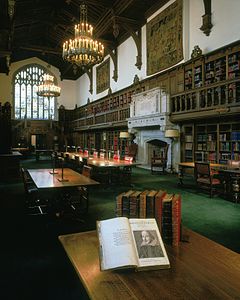
The Folger Shakespeare Library is an independent research library on Capitol Hill in Washington, D.C., in the United States. It has the world’s largest collection of the printed works of William Shakespeare, and is a primary repository for rare materials from the early modern period (1500–1750). The library was established by Henry Clay Folger in association with his wife, Emily Jordan Folger. It opened in 1932, two years after his death.
The library offers advanced scholarly programs and national outreach to K–12 classroom teachers on Shakespeare education. Other performances and events at the Folger include the award-winning Folger Theatre, which produces Shakespeare-inspired theater; Folger Consort, the early-music ensemble-in-residence; the O.B. Hardison Poetry Series; the PEN/Faulkner Reading Series; and numerous other exhibits, seminars, talks and lectures, and family programs. It also has several publications, including the Folger Library editions of Shakespeare’s plays, the journal Shakespeare Quarterly, the teacher resource books Shakespeare Set Free, and catalogs of exhibitions. The Folger is also a leader in methods of preserving rare materials.
The library is privately endowed and administered by the Trustees of Amherst College. The library building is listed on the National Register of Historic Places.
Folger Shakespeare Library is the world’s largest Shakespeare collection, the ultimate resource for exploring Shakespeare and his world. The Folger welcomes millions of visitors online and in person. We provide unparalleled access to a huge array of resources, from original sources to modern interpretations. With the Folger, you can experience the power of performance, the wonder of exhibitions, and the excitement of pathbreaking research. We offer the opportunity to see and even work with early modern sources, driving discovery and transforming education for students of all ages.
Shakespeare belongs to you. His world is vast. Come explore. Join us online, on the road, or in Washington, DC.
In addition to being the world’s largest Shakespeare collection, the Folger is home to major collections of other rare Renaissance books, manuscripts, and works of art. Located a block from the US Capitol, the Folger serves a wide audience of scholars, visitors, teachers, students, families, and theater– and concert-goers.
The Folger opened in 1932, as a gift to the American people from founders Henry and Emily Folger.
Learn more about the history of the Folger.
Click here to Visit Folger Shakespeares Library
+++++++++++++
Freeman–Seven Ages of Man
From the Tony Awards. The Oscar-winning actor delivers the famous speech from Shakespeare’s “As You Like It”
++++
| https://www.sparknotes.com/nofear/shakespeare/asyoulikeit/page_98/ ORIGINAL TEXT JAQUESAll the world’s a stage,And all the men and women merely players.They have their exits and their entrances,145And one man in his time plays many parts,His acts being seven ages. At first the infant,Mewling and puking in the nurse’s arms.Then the whining schoolboy with his satchelAnd shining morning face, creeping like snail150Unwillingly to school. And then the lover,Sighing like furnace, with a woeful balladMade to his mistress’ eyebrow. Then a soldier,Full of strange oaths and bearded like the pard,Jealous in honor, sudden and quick in quarrel, 155Seeking the bubble reputation Even in the cannon’s mouth. And then the justice, In fair round belly with good capon lined, With eyes severe and beard of formal cut, Full of wise saws and modern instances; 160And so he plays his part. The sixth age shifts Into the lean and slippered pantaloon With spectacles on nose and pouch on side, His youthful hose, well saved, a world too wide For his shrunk shank, and his big manly voice, 165Turning again toward childish treble, pipes And whistles in his sound. Last scene of all, That ends this strange eventful history, Is second childishness and mere oblivion, Sans teeth, sans eyes, sans taste, sans everything. | https://www.sparknotes.com/nofear/shakespeare/asyoulikeit/page_98/ MODERN TEXT JAQUESThe whole world is a stage, and all the men and women merely actors. They have their exits and their entrances, and in his lifetime a man will play many parts, his life separated into seven acts. In the first act he is an infant, whimpering and puking in his nurse’s arms. Then he’s the whining schoolboy, with a book bag and a bright, young face, creeping like a snail unwillingly to school. Then he becomes a lover, huffing and puffing like a furnace as he writes sad poems about his mistress’s eyebrows. In the fourth act, he’s a soldier, full of foreign curses, with a beard like a panther, eager to defend his honor and quick to fight. On the battlefield, he puts himself in front of the cannon’s mouth, risking his life to seek fame that is as fleeting as a soap bubble. In the fifth act, he is a judge, with a nice fat belly from all the bribes he’s taken. His eyes are stern, and he’s given his beard a respectable cut. He’s full of wise sayings and up-to-the-minute anecdotes: that’s the way he plays his part. In the sixth act, the curtain rises on a skinny old man in slippers, glasses on his nose and a money bag at his side. The stockings he wore in his youth hang loosely on his shriveled legs now, and his bellowing voice has shrunk back down to a childish squeak. In the last scene of our play—the end of this strange, eventful history—our hero, full of forgetfulness, enters his second childhood: without teeth, without eyes, without taste, without everything. |
++++
ORLANDOHang there on this tree, you lines of poetry, and bear witness to my love. And you, goddess of the moon , queen of the night—with your chaste eye, from your pale home up above—watch your huntress, who has the power to control my life. Oh, Rosalind, these trees will be my books—I’ll write my thoughts down on their bark. That way, everyone who passes through this forest will find your virtues everywhere. Run, run, Orlando, on every tree carve praises of her beauty, her virtue, and her inexpressibility.
++++
ROSALIND(reading, as Ganymede)
From the far east to the west IndiesThere is no jewel like Rosalind.
Her worth is carried on the windAnd it blows throughout the world, carrying the name of Rosalind.
All the most beautiful paintingsAre black when compared to Rosalind.
Don’t think of any beauty But the beauty of Rosalind.
++++
TOUCHSTONELet
Let me try:If there’s a buck who needs a doeTell him Rosalind will do.
A cat in heat will look for a mate,And Rosalind certainly will too.
Winter garments need to be filled with something,
And so does skinny Rosalind. After you harvest, you have to sheaf and bind So throw ripe Rosalind on the harvest cart.
The sweetest nut has the sourest rind And Rosalind is that kind of nut.
The man who finds the sweetest rose Will be pricked by it, and by Rosalind.
This is exactly the false way that verses gallop along. Why bother with them?
++++++++++++++++++
++++
JAQUES
All the world’s a stage,
And all the men and women merely players;
They have their exits and their entrances;
And one man in his time plays many parts,
His acts being seven ages. At first the infant,
Mewling and puking in the nurse’s arms;
Then the whining school-boy, with his satchel
And shining morning face, creeping like snail
Unwillingly to school. And then the lover,
Sighing like furnace, with a woeful ballad
Made to his mistress’ eyebrow. Then a soldier,
Full of strange oaths, and bearded like the pard,
Jealous in honour, sudden and quick in quarrel,
Seeking the bubble reputation
Even in the cannon’s mouth. And then the justice,
In fair round belly with good capon lin’d,
With eyes severe and beard of formal cut,
Full of wise saws and modern instances;
And so he plays his part. The sixth age shifts
Into the lean and slipper’d pantaloon,
With spectacles on nose and pouch on side;
His youthful hose, well sav’d, a world too wide
For his shrunk shank; and his big manly voice,
Turning again toward childish treble, pipes
And whistles in his sound. Last scene of all,
That ends this strange eventful history,
Is second childishness and mere oblivion;
Sans teeth, sans eyes, sans taste, sans everything.
+++++++++
The Oxford Shakespeare:
As You Like It
Paperback at : Amazon
by William Shakespeare (Author)
- Hardcover from CDN$ 9.621 Used from CDN$ 25.714 New from CDN$ 9.62
- Paperback CDN$ 10.84
27 Used from CDN$ 2.3535 New from CDN$ 9.03
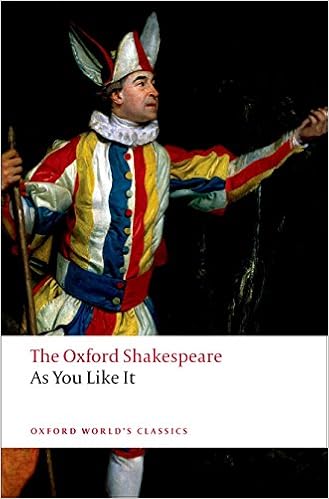
As You Like It is Shakespeare’s most light-hearted comedy, and its witty heroine Rosalind has his longest female role. In this edition, Alan Brissenden reassesses both its textual and performance history, showing how interpretations have changed since the first recorded production in 1740.
He examines Shakespeare’s sources and elucidates the central themes of love, pastoral, and doubleness. Detailed annotations investigate the allusive and often bawdy language, enabling student, actor, and director to savour the humour and the seriousness of the play to the full.
++++++

As You Like It: Oxford School Shakespeare (Oxford School Shakespeare Series)
Paperback $6.83 – $7.19
This edition of As You LIke It is especially designed for students, with accessible on-page notes and explanatory illustrations, clear background information, and rigorous but accessible scholarly credentials. This edition includes illustrations, preliminary notes, reading lists (including websites) and classroom notes, allowing students to master Shakespeare’s work.
About the Series:
Newly redesigned and easier to read, each play in the Oxford School Shakespeare series includes the complete and unabridged text, detailed and clear explanations of difficult words and passages, a synopsis of the plot, summaries of individual scenes, and notes on the main characters. Also included is a wide range of questions and activities for work in class, together with the historical background to Shakespeare’s England, a brief biography of Shakespeare, and a complete list of his plays.
++++++
+++++++++++++turn this into a clean WordPress-ready post with:
✅ headings + short paragraphs, ✅ bullet structure, ✅ a strong closing call-to-action, and ✅ a “Week 1 plan” that begins the 1 → 10 → 100 ladder immediately
++++++++++++++++++++
++++++++++++++++++++++
As the best writer and learning and memory expert:
Could you please edit, proofread, and rewrite the following text to enhance its clarity, coherence, and overall quality? Additionally, feel free to add any relevant information or suggestions that could improve the writing further. I am looking for a polished piece that reflects the standards of a top-tier writer. Here is the text that needs your attention: Thank you!
+++++++++++++++++++++++++++++++++++
A Smart Approach to Mastering 100,000 English Words 🌹📚
Clear plan. Strong memory methods. A beautiful story-powered journey.
Learning (or teaching) 100,000 English words it requires a system. When vocabulary is built step by step, reinforced through real use, and reviewed the right way, the path from 1 word to 100,000 becomes realistic and inspiring.
🔑The 1→10→100→1,000→10,000→100,000 Word Ladder 🚀
🔑The 1→10→100→1,000→10,000→100,000🌹Word Highrise 🚀🌍
Progress is fastest when you learn in levels, not in random piles:
1 → 10 → 100 → 400 → 1,000 → 10,000 → 100,000
At every level, each word should include:
- Meaning (what the word is)
- Usage (how it works in a sentence)
- Personal connection (why it matters to you)
- Review cycles (so it stays in long-term memory)
Learning Styles That Support Real Vocabulary Growth 🧠✨
People remember words differently. A strong foundation is the VARK learning model:
Most learners win by using a blend, not only one style.
Five Memory Drivers That Make Words Stick 🔑
To move words into long-term memory, build each word with:
- Repetition – review in spaced cycles (not cramming)
- Association – connect the word to an image, story, or familiar idea
- Impression – make the first encounter vivid and meaningful
- Preparation – learn words that match your goals and life
- Numbering – organize words into levels, sets, and milestones
Helpful tools include:
- mnemonics, acronyms, rhythm/rhyme, patterns, and word families
- short micro-stories that place words in memorable scenes
- frequent self-testing (recall builds memory faster than rereading)
Two Friendly Long-Term Learning Paths 🌍🌹
Method A: SmartRosy 🌹
Learn through rose-powered stories, images, and “Rosy Moments,” where every bloom represents a new level of vocabulary growth.
Why it works:
- emotional connection strengthens memory
- images speed up recall
- repetition becomes enjoyable, not boring
Method B: The Smart Shakespeare Learning Path 🎭🌹
Learn through a modern learning journey inspired by Shakespeare’s As You Like It—guided by Smart Rosalind and Smart Orlando through the Forest of Arden and your “Shakespeare Rose Garden” of words.
Why it works:
- stories make vocabulary memorable
- dialogue improves speaking and comprehension
- reading + performance builds confidence quickly
Week 1 Plan: Start the 1 → 10 → 100 Ladder Today ✅
This plan begins immediately and sets your foundation.
Day 1: The “1 Word Power Start” (1 word)
Choose one powerful word you want to own forever.
Do this in 15 minutes:
- write the definition
- write 3 example sentences
- say it aloud 10 times
- connect it to a memory image
- use it in a short personal sentence
Days 2–3: Build to 10 Words (10 words total)
Add 3–5 words per day until you reach 10.
For each word, create:
- meaning + 1 synonym + 1 opposite (if possible)
- 2 example sentences
- 1 “Rosy Moment” image or mini-story
- 1 self-test (cover the meaning and recall it)
Daily review (5 minutes):
- test yourself on yesterday’s words
- rewrite 2 sentences from memory
Days 4–7: Build to 100 Words (100 words total)
Now scale up—without stress.
Daily target:
- 15 new words/day (Days 4–7 = 60 words)
- plus review words to reach 100 total by the end of the week
Daily structure (30–45 minutes):
- 15 minutes: learn 10–15 new words
- 10 minutes: review yesterday’s words
- 10 minutes: review older words (spaced repetition)
- 5 minutes: write a short paragraph using 5 of your words
Weekend checkpoint (Day 7):
- self-test all 100 words
- circle the weakest 20
- repeat them using images, stories, or rhyme
Quick Tools That Upgrade Results Instantly ⚡
Add any of these to make learning faster and smoother:
- A word-card template: Word → Meaning → Example → Your sentence → Memory hook
- A “Top Core Words” foundation: start with everyday high-frequency words
- A vocabulary map: home, work, school, emotions, hobbies, storytelling, goals
- A weekly milestone: “100 words/week = 5,200 words/year” (and that’s just the start)
Your Next Step (Call to Action) 🌟
Start now—today.
✅ Pick your first word.
✅ Follow the Week 1 Plan.
✅ Build your list from 1 → 10 → 100 with confidence.
+++++
++++
A Smart Approach to Mastering 100,000 English Words🌹📚
To teach or learn 100,000 English words, start with a clear plan. The journey from knowing 1 word to mastering 100,000 words makes mastery accessible to everyone through the best available styles and methods like:
The 7 learning styles combine sensory and social preferences, typically including Visual, Auditory (Aural), Reading/Writing, Kinesthetic (Physical) (the popular VARK model) with Logical, Social, and Solitary styles, forming a comprehensive model where individuals learn best through seeing, hearing, words, doing, reasoning, groups, or alone, often using a mix of these approaches for effective information retention. Additionally, by adding natural, Repeation, Association, Impression, Preparation, and numbering. By using patterns, mnemonics, acronyms, formulas, rhythms, or rhymes to enhance memory, finding points, discovering, comprehension, understanding, and realization, plus accessing human higher inner conscious powers.
Naturally, Repeatually, Associationally, Impressionally, Preparationally. By using patterns, mnemonics, acronyms, formulas, rhythms, or rhymes to enhance memory, finding points, discovering, comprehension, understanding, and realization.
1 → 10 → 100 → 400 → 1,000 → 10,000 → 100,000
We use several friendly methods for learning, realizing, memorizing, remembering, and using 100,000 words effectively for over 100 plus years:
Method A: SmartRosy — learning through the vibrant beauty of the rose-powered stories, images, and “Rosy Moments.” where every bloom signifies a new level of understanding. 🌹
Method B: Smart Shakespear Learning Path — learning through our reimagined classic, new version of As You Like It from Shakespeare’s First Folio, guided as a modern, creative journey with Smart Rosalind and Smart Orlando as they navigate the Forest of Arden as the Shakespeare Rose Garden. 🎭✨
+++++++++++++++++++++
gpt
A Smart Approach to Mastering 100,000 English Words 🌹📚
A clear plan. Strong memory methods. A beautiful story-powered journey.
To learn (or teach) 100,000 English words, you need more than effort—you need a system. The path from 1 word to 100,000 becomes achievable when it is built step by step, reinforced through real use, and supported by memory-friendly techniques.
A simple growth ladder
Progress is fastest when you learn in levels, not in random piles:
1 → 10 → 100 → 400 → 1,000 → 10,000 → 100,000
Each level should include:
- Core meaning (what the word is)
- Real usage (how the word works in sentences)
- Personal connection (why the word matters to you)
- Review cycles (so the word stays in long-term memory)
Learning styles, memory science, and a practical blend 🧠✨
Different people remember best in different ways. A helpful foundation is the VARK model:
- Visual (images, diagrams, color cues)
- Auditory (listening, repetition, pronunciation)
- Reading/Writing (lists, notes, definitions, examples)
- Kinesthetic (actions, gestures, real-world practice)
To make the system more complete, add:
- Logical (patterns, word families, roots, rules)
- Social (conversation, group learning, teaching others)
- Solitary (quiet focus, journaling, self-testing)
Most learners succeed by using a mix, not just one style.
Five powerful memory drivers (simple and natural) 🔑
To turn vocabulary into long-term mastery, build each word through:
- Repetition – review in spaced cycles (not all at once)
- Association – link the word to an image, story, feeling, or familiar idea
- Impression – make the first encounter strong (surprising, emotional, vivid)
- Preparation – learn words that match your goals (work, study, travel, writing)
- Numbering – organize words into levels, sets, and “word milestones”
Helpful tools include:
- mnemonics, acronyms, rhythm and rhyme, patterns, and word families
- short “micro-stories” that place words into memorable scenes
- frequent self-testing (because recall builds stronger memory than rereading)
Two friendly long-term learning paths 🌍🌹
Method A: SmartRosy
Learn through the vibrant beauty of rose-powered stories, images, and “Rosy Moments,” where each bloom represents a new level of vocabulary growth. 🌹
This method emphasizes:
- emotional connection (strong memory)
- visual storytelling (fast recall)
- creative repetition (review without boredom)
Method B: The Smart Shakespeare Learning Path
Learn through a reimagined, modern learning journey inspired by Shakespeare’s As You Like It—guided by Smart Rosalind and Smart Orlando as they explore the Forest of Arden and your “Shakespeare Rose Garden” of words. 🎭🌹
This method emphasizes:
- classic + modern language bridges
- memorable scenes and dialogue
- “learning by performance” (reading, speaking, acting, writing)
Extra suggestions to strengthen your project ✅
If you want this to reach “top-tier” quality and real results, add:
- A daily minimum: “10 words per day + 3 review rounds”
- A weekly checkpoint: “50 new words + 150 review recalls”
- A simple word card template (Word → Meaning → Example → Your sentence → Memory hook)
- A “Top 3000 Core Words” foundation before expanding to advanced and specialized vocabulary
- A personal vocabulary map: home, work, study, hobbies, emotions, stories, future goals
+++++++++++++
gmini
🏛️ The Smart Approach to Mastering 100,000 English Words
g 1 word to mastering 100,000, making elite proficiency accessible to everyone through a fusion of science, art, and nature.
1. The Science: Activating the Whole Brain, mix combination
We do not rely on a single method. Instead, we activate the 7 Universal Learning Styles, ensuring that every student finds their unique path to retention:
- Sensory Inputs: We engage the Visual (seeing), Auditory (hearing), and Kinesthetic (doing).
- Information Processing: We utilize Reading/Writing for structure and Logical patterns for reasoning.
- Social Dynamics: We offer Social learning for groups and Solitary reflection for deep internal processing.
3. The Ladder: The Path of Progress
We climb the High-Rise one systematic floor at a time:
1 → 10 → 100 → 400 → 1,000 → 10,000 → 100,000
4. The Methods: Two Paths, One Destination
We use friendly, proven methods that have helped learners realize and remember language effectively for over a century:
🌹 Method A: The SmartRosy Path
The Visual & Emotional Journey.
Learning through the vibrant beauty of rose-powered stories and images. We create “Rosy Moments” where every bloom signifies a new level of understanding, turning abstract vocabulary into tangible beauty.
🎭 Method B: The Smart Shakespeare Path
The Narrative & Literary Journey.
Learning through a reimagined, modern version of As You Like It from Shakespeare’s First Folio. Students follow Smart Rosaland and Smart Olando as they navigate the Forest of Arden—now transformed into the Shakespeare Rose Garden—where every tree and flower represents a word waiting to be discovered.
✍️
💡
+++++++++++++++++
+++++++++++++++++++++++++++++++++++++++++
A Smart Approach to Mastering 100,000 English Words 🌹📚
Mastering a vocabulary of 100,000 English words may sound daunting, but with a structured plan, it becomes an achievable—and even enjoyable—journey. The path from knowing just one word to commanding tens of thousands is built on proven methods that combine cognitive science, memory techniques, and creative engagement. Start small, build momentum, and scale up progressively: 1 → 10 → 100 → 400 → 1,000 → 10,000 → 100,000.
Core Learning Styles for Maximum Retention
Effective vocabulary acquisition draws from diverse learning preferences. The widely recognized VARK model (developed by Neil Fleming) identifies four primary modalities:
- Visual — learning through images, diagrams, colors, and spatial arrangements
- Aural/Auditory — learning through sound, discussion, lectures, and spoken explanation
- Read/Write — learning through text, lists, notes, and written reflection
- Kinesthetic — learning through movement, touch, hands-on activities, and physical engagement
Many experts extend this framework to seven styles by incorporating:
- Logical (reasoning, patterns, systems, and analysis)
- Social (group interaction, collaboration, and discussion)
- Solitary (independent reflection and self-paced study)
Most people benefit from a blend of these styles rather than relying on just one. Research shows that multi-modal approaches—combining sensory input with active practice—greatly enhance long-term retention.
Powerful Memory Techniques to Accelerate Mastery
Layer these evidence-based strategies onto your preferred styles for exponential gains:
- Spaced Repetition — Review words at increasing intervals (e.g., today, tomorrow, in 3 days, in 1 week, in 1 month) to move them from short-term to long-term memory. Apps like Anki or Memrise automate this process brilliantly.
- Active Recall — Test yourself without looking at notes (e.g., cover definitions and retrieve them from memory). This strengthens neural pathways far more than passive re-reading.
- Association & Mnemonics — Link new words to vivid images, stories, rhymes, acronyms, or existing knowledge (e.g., connect “serendipity” to a surprise gift wrapped in silk).
- Visualization & Impression — Create strong mental pictures or emotional “impressions” of words to make them unforgettable.
- Repetition with Variation — Repeat naturally but vary context (sentences, stories, conversations) to avoid rote boredom.
- Preparation & Chunking — Group words thematically or by root (e.g., “tele-” words like telephone, television) and prepare mind-maps or hierarchies before diving in.
These techniques—rooted in cognitive psychology—have powered vocabulary acquisition for over a century, from classical scholars to modern polyglots.
Two Signature Methods for Deep, Joyful Learning
Method A: SmartRosy 🌹
Transform vocabulary into vibrant, memorable experiences through “Rosy Moments.” Each word blooms like a rose: pair it with a striking image, a short poetic story, or a sensory detail (color, scent, texture). The rose becomes a symbol of growth—every new bloom represents deeper understanding and beauty. This visual-emotional method taps into imagination and positive association, making abstract words feel alive and personal.
Method B: Smart Shakespeare Learning Path
Reimagine Shakespeare’s As You Like It (from the First Folio of 1623) as a modern creative adventure. Follow Smart Rosalind and Smart Orlando as they navigate the enchanted Forest of Arden—a metaphorical landscape of language discovery. Disguised identities, witty banter, pastoral wisdom, and themes of love, exile, and self-realization mirror the learner’s own journey: shedding old limitations, exploring new “roles” (word usages), and finding harmony in complexity. Use key scenes (e.g., “All the world’s a stage”) to anchor vocabulary clusters—turning classic lines into living context for thousands of words.
The Progressive Roadmap
Begin modestly and compound gains:
- Master the first 1–10 words through pure immersion and repetition.
- Expand to 100 with mnemonics and stories.
- Reach 400–1,000 via themed groups and active recall.
- Scale to 10,000 with daily spaced practice and contextual reading.
- Aim for 100,000 through lifelong habits: reading widely, writing daily, conversing fluently, and revisiting intelligently.
Vocabulary isn’t a mountain to conquer—it’s a garden to cultivate. With consistent, multi-sensory effort and delight in the process, 100,000 words become not a goal, but a natural harvest.
Suggestions for Further Enhancement
- Add visuals: Include rose illustrations 🌹 or Forest of Arden sketches to support visual learners.
- Practical tools: Recommend specific apps (Anki for spaced repetition, Memrise for gamified mnemonics) or resources (Oxford 3000/5000 word lists as starting points).
- Track progress: Suggest a simple journal or spreadsheet to log “Rosy Moments” and Shakespeare-linked words.
- Motivation boost: Quote Shakespeare—“The fool doth think he is wise, but the wise man knows himself to be a fool”—to remind learners that humility and persistence win.
If you’d like a shorter version, more examples, or integration with your earlier Shakespeare-inspired piece, just let me know, Ray—perfect for a crisp Vancouver winter day! 🚀
+++++++++++++++++++
++++++++
++++++++++
The 1 ➔ 10 ➔ 100 ➔ 1,000 ➔ 10,000 ➔ 100,000 Word List: The Path to the Highest Level of Language Mastery, Excellence, and Proficiency