The phrase “By People, For People” — Meaning, Context, and Origins
“By people for people” is a shortened echo of Abraham Lincoln’s famous line from the Gettysburg Address (1863):
“government of the people, by the people, for the people.”
The full phrase defines democracy as a system where power rests with the citizens themselves.
In the context of the Gettysburg Address, delivered in 1863, Lincoln’s words asserted that the American Civil War was a fight to preserve the nation’s democratic principles and ensure that such a form of government would not perish from the earth.
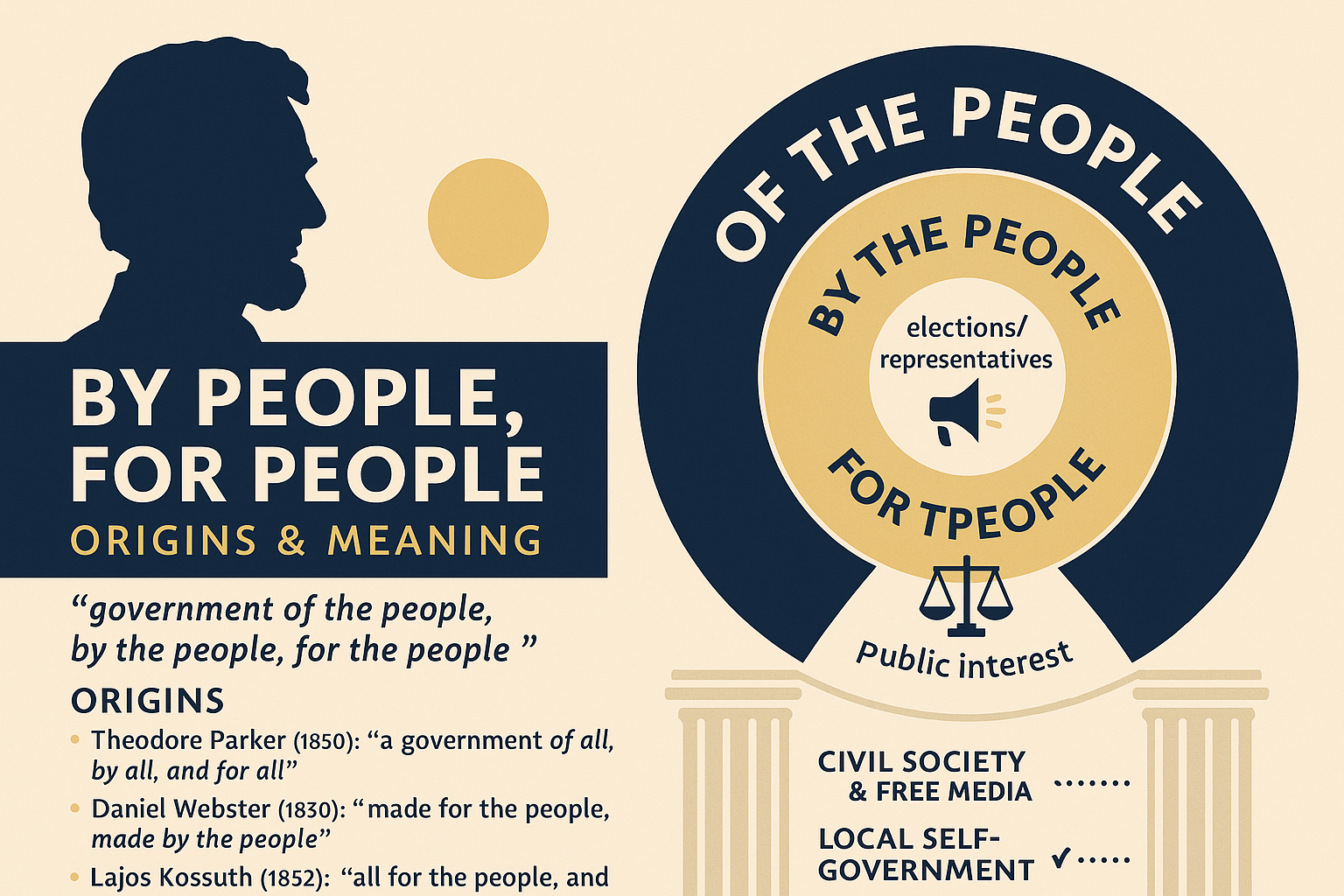
What each part means
The three parts of the phrase carry distinct meanings within the idea of a democratic government:
- “Of the people” means that the government originates from the people. The power to create and shape the government lies with the citizens.
- “By the people” means that the government is run by the people themselves, typically through elected representatives.
- “For the people” means that the government’s purpose is to serve the interests and benefit of the citizens, not the interests of a ruling class.
Earlier influences and similar phrasing, or Origins of the idea
While the specific phrasing is attributed to Lincoln, the concept did not originate with him. Historians have identified earlier uses of similar ideas and language:
- Theodore Parker: This abolitionist minister, who greatly influenced Lincoln, used a similar phrase in 1850 when he spoke of “a government of all, by all, and for all”.
- Daniel Webster: In a 1830 speech, the American politician described the federal government as “made for the people, made by the people, and answerable to the people”.
- Lajos Kossuth: A leader of the Hungarian Revolution of 1848, Kossuth said in a 1852 speech that the spirit of the age was “all for the people, and all by the people.”
In sum: By people, for people captures the democratic ideal in brief: legitimacy from the people, governance by the people, and outcomes for the people.
+++++++++++
Quotes from Other Leaders
- John Wycliffe (1384)
Quote: “The Bible is for the government of the people, by the people, and for the people.”
Similarity: Nearly identical to Lincoln’s phrasing, applying popular governance to spiritual authority. - Thomas Jefferson (1801)
Quote: “The will of the people is the only legitimate foundation of any government.”
Similarity: Stresses government deriving authority from the people, like “of the people.” - Pericles (431 BCE)
Quote: “Our constitution is called a democracy because power is in the hands of the whole people.”
Similarity: Highlights collective power, aligning with “by the people” and “for the people.” - Nelson Mandela (1994)
Quote: “The government we have formed is a government of the people, and for the people.”
Similarity: Mirrors Lincoln’s phrasing, emphasizing a government serving all citizens. - Jawaharlal Nehru (1947)
Quote: “The service of India means the service of the millions who suffer.”
Similarity: Focuses on governance for the people’s welfare, akin to “for the people.”
Quotes from Recent Leaders (2000–2025)
Here’s a concise list of quotes from leaders in the 21st century that echo Abraham Lincoln’s “government of the people, by the people, for the people,” focusing on democratic ideals of popular sovereignty, participation, and service. Each includes a brief note on its similarity.
- Barack Obama (2009)
Quote: “We remain a young nation, but in the words of Scripture, the time has surely come to set aside childish things. The time has come to reaffirm our enduring spirit; to choose our better history; to carry forward that precious gift, that noble idea, passed on from generation to generation: the God-given promise that all are equal, all are free, and all deserve a chance to pursue their full measure of happiness.”
Similarity: Emphasizes government’s role in serving the people’s equality and opportunity, akin to “for the people.” - Angela Merkel (2010)
Quote: “We want a Europe of the citizens, by the citizens and for the citizens.”
Similarity: Directly mirrors Lincoln’s phrasing, applying it to European democratic unity and citizen empowerment. - Justin Trudeau (2015)
Quote: “This is a government that will be of Canadians, for Canadians, and by Canadians.”
Similarity: Closely parallels Lincoln’s structure, stressing inclusive governance rooted in the people. - Jacinda Ardern (2017)
Quote: “A government that governs for all, by all, and with all.”
Similarity: Highlights collaborative and inclusive rule, aligning with “by the people” and “for the people.” - Volodymyr Zelenskyy (2022)
Quote: “Ukraine is, and will be, a democracy—a government of the people, by the people, for the people.”
Similarity: Explicitly invokes Lincoln’s words to affirm Ukraine’s democratic resilience against authoritarianism.
Notes: These quotes were selected for their direct thematic or linguistic ties to Lincoln’s ideals, drawn from verified speeches and historical records. They represent diverse global contexts.
+++++

+++++

One-sentence definition
Democracy is self-government by the people: political power ultimately rests with citizens and is exercised through equal participation, free and fair competition for office, and rule of law, with rights that protect individuals and minorities so the majority will never becomes majority tyranny.
Key principles of democracy
- Individual autonomy: The idea that people should have control over their own lives and not be subjected to rules imposed upon them by others.
- Rights & freedoms: speech, press, religion, association, assembly; protection of minorities.
- Free, fair, regular elections: genuine competition, universal choice to vote, secret ballot, impartial administration, peaceful transfer of power.
- Pluralism & deliberation: multiple parties, civil society, and a free media enable open debate and informed choices.
- Political Equality: The belief that every citizen should have an equal opportunity to influence the decisions that affect society. This is upheld through concepts like universal suffrage, or the right to vote for all adult citizens: one person, one vote; equal legal standing.
- Fundamental human rights: A genuine democracy protects freedoms such as expression, assembly, and religion. These rights are essential for citizens to participate meaningfully in their government and to ensure that the will of the majority does not ignore the rights of minorities.
- Consent of the governed: The government’s legitimacy comes from the consent and will of its people.
- Rule of law & constitutionalism: The idea that all citizens are subject to the same laws, and elected officials cannot exercise power arbitrarily. An independent judiciary is crucial for enforcing this principle.
- Accountability & transparency: checks and balances, oversight, access to information, anti-corruption.
Types of democracy
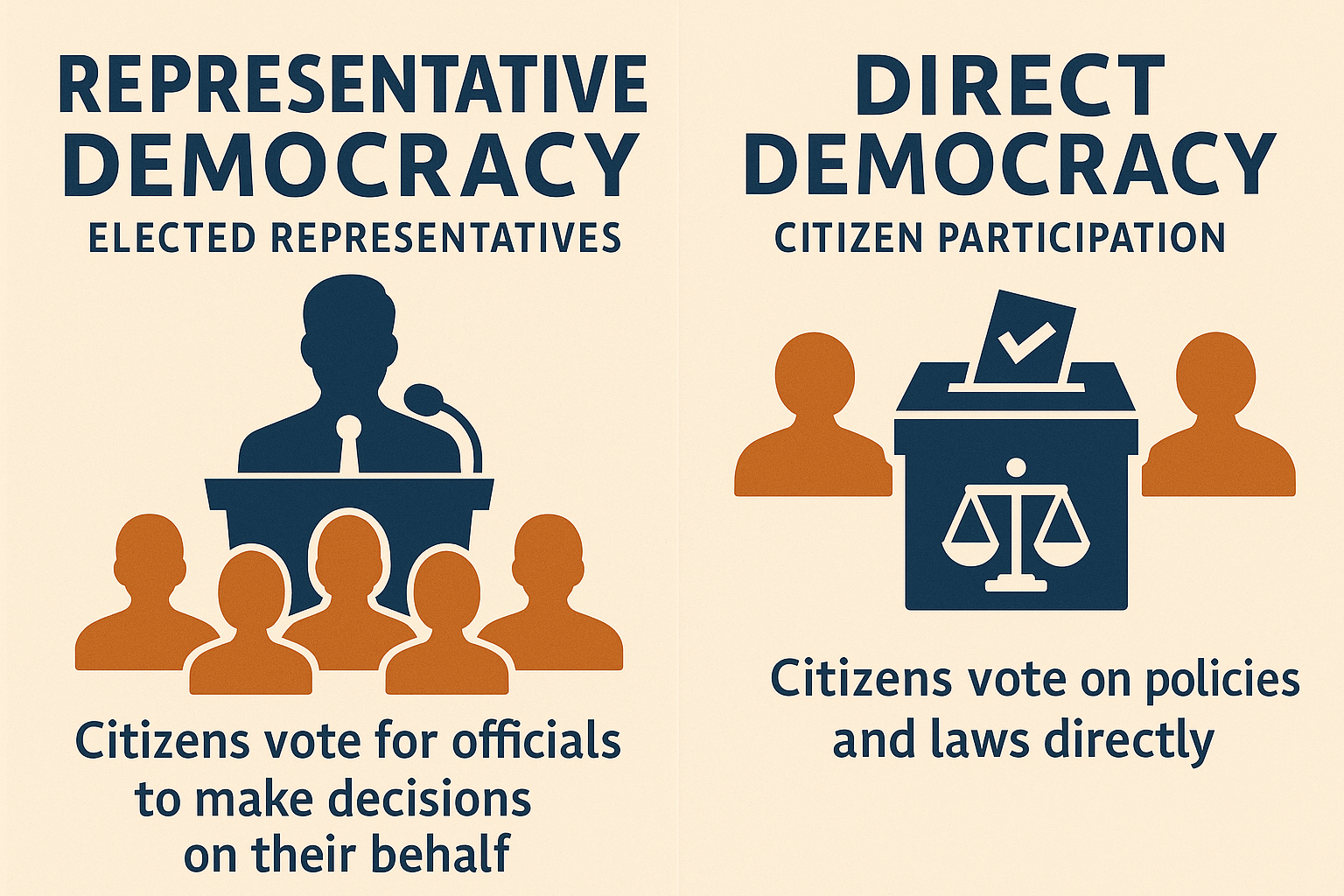
Democracy is not a single, rigid system. Its practical application can vary widely, with two major forms:
Liberal democracy: A representative democracy where the power of elected officials is limited by a constitution that protects individual rights and freedoms. How it works in practice
Direct democracy: In this system, citizens participate directly in making laws and public policies, rather than relying on elected officials. This model is rare in modern nation-states but can be found in some local governments, such as New England town meetings, or in national referendums, like those held in Switzerland.
Representative democracy: The most common form of democracy today, where citizens elect representatives to make decisions on their behalf. This can take several forms, including:
Parliamentary democracy: The executive branch (the government) is appointed by and accountable to the legislature (parliament).
Presidential democracy: The head of government (the president) is elected independently from the legislative branch.
- Representation: citizens choose leaders to make policy on their behalf; they can remove them at the next election.
- Institutions: legislature, executive, and courts with separated or shared powers; independent election bodies.
- Civil society & media: unions, NGOs, community groups, and a free press scrutinize power and inform voters.
- Local self-government: many democracies decentralize power to cities/regions for responsiveness.
Understanding democracy also involves contrasting it with what it is not:
- Just majority rule. Without rights, courts, and free media, elections alone can mask authoritarianism.
- One-party/rigged systems or plebiscites without real competition.
- Rule by unelected elites (military, clerical, or technocratic) without public consent.
- Autocracy or dictatorship: A single person holds unlimited power.
- Oligarchy: A small, elite group controls society.
- Authoritarianism: A regime where political pluralism is restricted, civil liberties are abused, and censorship is common.
How to tell if a democracy is healthy
- Competitive elections with real alternation in power
- Protected civil liberties and minority rights
- Independent courts and media
- Civilian control of the military
- Low corruption and high transparency
- Citizens who participate—and accept legitimate results
Conclusion
The whole meaning of democracy is a government system and philosophy where power originates from the people (of the people), is exercised through their participation (by the people), and exists to serve their collective welfare (for the people). It embodies equality, freedom, accountability, and inclusion, as reflected in quotes from leaders across time—Wycliffe’s spiritual democracy, Jefferson’s consent-based governance, and Merkel’s citizen-centric Europe, democratic stand.
Democracy isn’t a destination; it’s a continuous process that requires the active engagement of its citizens to protect freedoms and ensure the government truly remains of the people, by the people, and for the people.
+++++++++
++++++++++++++
The Importance of Daily Schedules: Benefits for Focus, Habits, and Well-Being
Daily scheduling – often done with the help of planners, calendars, or productivity apps – is a cornerstone of effective time management. By mapping out tasks and commitments each day, individuals create structure in their routine, which leads to better control over how time is spentlpsonline.sas.upenn.edu. As time management expert Stephen Covey famously noted, “The key is not to prioritize what’s on your schedule, but to schedule your priorities.”lpsonline.sas.upenn.edu In practice, maintaining a daily schedule yields numerous benefits, from enhanced focus and productivity to improved mental health. Below, we summarize the top advantages of using a daily schedule and why this habit is so important.
Improved Focus and Concentration
- Eliminates decision fatigue: Having a set daily plan means you spend less time deciding what to do next. This saves mental energy and willpower, allowing you to concentrate better on the task at handgetclockwise.com. By planning and time-blocking your day (assigning tasks to specific time slots), you remove guesswork and minimize distractions, keeping yourself focused on high-priority workgetclockwise.com.
- Clarifies goals and priorities: A schedule forces you to identify what tasks are most important each day. This clarity helps direct your attention to essential activities and prevents scattering your focus on less critical thingslpsonline.sas.upenn.edu. As a result, you can work on meaningful tasks without constant interruption or confusion about what to do next.
- Increases productivity: With improved focus comes higher productivity. Research on time management shows that when you schedule your time effectively, you inherently work more efficiently and get more donelpsonline.sas.upenn.edu. Sticking to a daily routine or “ritual” for work tasks can also put you in the right mindset faster each day, helping you enter a productive flow state more easily.
Habit Building and Consistency
- Encourages positive habits: Following a daily schedule provides structure that encourages habit formation. When you perform the same beneficial behaviors (like exercising, reading, or planning your day) at consistent times, those actions start to become automatic parts of your routineverywellmind.com. In other words, repetition through scheduling turns intentional actions into stable habits over time.
- Makes tasks feel easier over time: Once an activity becomes a habitual part of your daily routine, it requires much less mental effort to initiate and complete. Psychologists note that “once this becomes your normal routine, it’s easier to accomplish everything, because it becomes habit.”headspace.com By reducing the mental resistance to starting tasks, a consistent schedule helps you stick to good habits (and break bad ones) more reliably.
- Promotes discipline and consistency: A daily plan keeps you accountable to yourself. It’s harder to ignore a planned task when it’s written in your planner or set as a reminder. This regularity builds self-discipline and consistency, as you train yourself to follow through each day. Over time, this consistent behavior reinforces the habit loop, making it second nature to adhere to your schedule.
Stress Reduction and Mental Health
- Reduces uncertainty and anxiety: Having a routine schedule can significantly lower stress levels by adding predictability to your dayverywellmind.com. When you know what to expect and have a plan for handling tasks, it alleviates the anxiety of the unknown. In fact, researchers find that creating predictable scenarios through daily habits allows your mind to relax and “adjust, understand what to expect, and alleviate anxiety over the unknown”getclockwise.com.
- Increases sense of control: During times of unpredictability or high stress, sticking to a daily schedule can help you feel more in control of your situationverywellmind.comverywellmind.com. Instead of feeling overwhelmed by chaos, a routine gives you anchor points in the day. This sense of control and structure is linked to better mental health outcomes and can buffer against the effects of stressverywellmind.com.
- Prevents overload and burnout: Scheduling your tasks can prevent the last-minute rush and procrastination that often lead to stress. By spreading work out over days and routinely meeting deadlines, you avoid the panic of doing everything at once. Consistently following a plan means fewer forgotten duties and less worry. As one time management guide notes, by staying on schedule you can decrease worry and avoid chronic stress and burnoutlpsonline.sas.upenn.edu. Many people find that routines provide a calming rhythm to life, making day-to-day challenges feel more manageable.
Goal Achievement and Prioritization
- Breaks down big goals into steps: Daily schedules are powerful tools for goal achievement. They allow you to break larger long-term goals into smaller daily tasks or habits, which makes big objectives more achievable over timebrownhealth.org. Rather than leaving a goal as an abstract idea, scheduling ensures you’re consistently chipping away at it. Each day’s planned progress might be small, but these small wins accumulate and eventually lead to reaching the larger goal.
- Keeps you working on what matters: When you plan your day, you can intentionally prioritize high-value activities and schedule them during your peak productivity times. This prevents important but challenging tasks from being perpetually postponed. Experts recommend scheduling your most important (“priority”) tasks into your routine so they don’t get crowded outlpsonline.sas.upenn.edu. By ensuring that critical tasks (the “big rocks,” so to speak) have a slot on your daily agenda, a schedule helps you steadily advance your key projects and life goals.
- Improves time management: Using a planner or digital tool to organize tasks by priority each day leads to more effective use of time. One source notes that developing habits around planning and prioritizing can increase productivity and even improve your work-life balancebrownhealth.org. In practice, daily scheduling means you spend less time on trivial or ad-hoc activities and more time on actions aligned with your objectives. Over time, this focus on priorities translates into greater success in achieving both short-term targets and long-term ambitions.
Increased Motivation and Accountability
- Boosts motivation through accomplishment: A well-structured day can boost your motivation by providing regular feelings of accomplishment. For example, completing a meaningful task first thing in the morning (as part of your schedule) gives you a sense of achievement and sets a positive, motivated tone for the rest of the daylpsonline.sas.upenn.edu. Crossing items off your daily to-do list offers a little dopamine hit of success, which can spur you to tackle the next task with enthusiasm.
- Combats procrastination: Daily schedules serve as a safeguard against procrastination. When each task has a designated time slot, it’s harder to justify “I’ll do this later.” Scheduling even the tasks you tend to lack motivation for can push you to get them done. Psychologists advise that deliberately carving out time for tasks you’re tempted to avoid will keep you accountable and “help keep you on track and hopefully overcome the urge” to keep pushing them offverywellmind.com. In essence, your calendar or planner becomes a gentle but firm boss, reminding you that now is the time to act.
- Creates consistent momentum: Following the same routine daily builds momentum, because you’re engaging in productive behavior day after day. This momentum can be very motivating – as you start to see progress from yesterday’s efforts, you’re more driven to continue today. Over time, a daily routine eliminates the need to “find motivation” each day; the routine itself carries you forward. Additionally, knowing that certain times are set aside for work, exercise, or personal projects can mentally prepare and energize you to tackle those activities, making it easier to get started.
Enhanced Overall Well-Being and Balance
- Better mental health: Research consistently shows that maintaining regular routines is associated with better mental health and well-beingverywellmind.com. Routines help buffer against stress and can reduce symptoms of anxiety and depression by providing stability in daily lifeverywellmind.com. People who follow structured daytime schedules (e.g. consistent sleep and wake times, regular activity patterns) tend to have healthier sleep cycles and emotional states, whereas irregular routines can contribute to mood disturbancespsychologytoday.com. In short, having a daily schedule supports your mental well-being by promoting a sense of normalcy and control.
- Physical health benefits: A daily schedule often encourages healthier lifestyle choices, which improves overall physical well-being. When you plan your day, you are more likely to make time for healthful habits like exercise, meal planning, and adequate sleep – all of which have profound health benefitsbrownhealth.org. For instance, sticking to a regular sleep schedule and bedtime routine can enhance your sleep quality, leading to better energy and cognitive function during the daygetclockwise.com. Scheduling time for exercise or meal prep makes it more likely you’ll follow through, which contributes to improved fitness and nutrition. In the long run, these routine healthy behaviors lower the risk of various health issues and boost your energy level and immunitybrownhealth.org.
- Improved work-life balance: Daily scheduling isn’t just about work and chores – it also helps ensure time for rest, self-care, and relationships, which are crucial for overall well-being. By planning your day, you can intentionally allocate time to family, hobbies, or relaxation, preventing work from endlessly spilling over into personal time. This balance is important: effectively managed schedules allow you to “excel in all areas” of life while avoiding burnout, thereby fostering your physical and mental well-beinglpsonline.sas.upenn.edu. Moreover, when you handle essential tasks in an organized way, you often free up more time to enjoy leisure activities guilt-freeverywellmind.com. In this way, a good routine can lead to a more satisfying, well-rounded life.
- Greater life satisfaction: Overall, the combination of reduced stress, steady progress toward goals, and time for meaningful activities leads to higher life satisfaction. When daily schedules are serving you well, you tend to feel more productive, more in control, and more fulfilled on a day-to-day basisverywellmind.com. Instead of constantly reacting to problems or feeling “behind,” you’re proactively managing your life. This proactive stance can increase confidence and give a sense of purpose each day, contributing to a healthier and happier life experience.
Using Planners and Tools to Stay on Track
Implementing a daily schedule is made easier with the help of planners and modern productivity tools. Here are a few ways these tools support your time management routine and amplify the benefits described above:
- Planning calendars and apps: Traditional paper planners or digital calendars are indispensable for scheduling. They allow you to time block your day – dividing the day into segments and assigning specific tasks to each block. For example, one effective method is to map out every 24-hour day into manageable blocks and assign your tasks (with start and end times) in a planner or calendar applpsonline.sas.upenn.edu. By doing this, you ensure each important task has its place and reduce the chance of forgetting responsibilities. Many calendar apps also send reminders, helping you stick to the plan.
- Productivity apps for focus: Various tools (like focus apps or scheduling software) can optimize your routine. Some apps automatically schedule uninterrupted “focus time” blocks by analyzing your calendar, ensuring you have at least some deep work periods free from meetings or alertsgetclockwise.com. This supports the benefit of improved focus, as it guards your concentration time. Other tools use techniques like the Pomodoro timer to enforce work/break cycles, preventing burnout and maintaining your energy and attention.
- Task prioritization tools: To connect your daily schedule with your big-picture goals, prioritization frameworks can be useful. Techniques such as the Eisenhower Matrix or Getting Things Done (available as templates or apps) help you sort tasks by urgency and importancegetclockwise.com. By organizing tasks this way and then scheduling them, you make sure that high-priority items are addressed first each day. This approach aligns your daily actions with your long-term objectives, increasing the likelihood of achieving your goals.
- Habit tracking and accountability: Some people integrate habit-tracking apps or bullet journals into their daily schedule to reinforce habit building. Checking off routines (like “morning stretch” or “read 30 minutes”) in an app or journal provides a sense of accomplishment and a visual record of consistency. This kind of tool-driven feedback can boost motivation and keep you accountable to the habits and tasks on your schedule.
In summary, maintaining a daily schedule using planners or digital tools is a powerful practice that offers multiple benefits: sharper focus, stronger productive habits, lower stress, steady progress toward goals, higher motivation, and better overall well-being. Backed by expert insights and scientific findings, the evidence suggests that a structured routine isn’t limiting – it’s liberating. By scheduling your days, you create a framework that supports your best self, allowing you to use your time purposefully and live a more organized, healthy, and fulfilling life.
+++++
Schedules: Benefits, Importance, Trends
ContentsShare and exportCreate
The Architecture of Achievement: A Comprehensive Analysis of the Benefits, Advantages, and Importance of Daily Scheduling
The Foundation of Control: Deconstructing the Daily Schedule
The practice of daily scheduling represents a fundamental shift from passive reaction to intentional action. In a world defined by increasing complexity and constant demands on attention, a well-structured schedule serves as the primary instrument for imposing order, managing cognitive resources, and aligning daily efforts with long-term aspirations. It is a strategic framework for navigating the complexities of modern life, integrating both professional obligations and personal well-being into a cohesive, manageable whole.
Beyond the To-Do List: Defining the Modern Schedule
A daily schedule transcends the limitations of a simple to-do list by embedding tasks within the finite context of time. While a to-do list serves as an inventory of what needs to be done, a schedule dictates when and for how long it will be done. This distinction is critical for execution; research indicates that as many as 41% of items on a to-do list are never completed, often because they lack a specific, committed time for action. A schedule transforms a vague intention into a concrete appointment, dramatically increasing the likelihood of follow-through.
The modern schedule is a holistic document that provides a “clear roadmap” for the entire day, acknowledging the increasingly blurred boundaries between professional and personal spheres. It is built by first anchoring responsibilities that have no flexibility, such as work meetings, synchronous classes, or family commitments like picking up children from school. Around these fixed points, flexible responsibilities like study time, exercise, and household chores are strategically placed. This integrated approach ensures that all facets of life are given deliberate consideration, from career milestones to personal hobbies and family time.
Schedule vs. Routine: The Symbiotic Relationship Between Structure and Habit
While often used interchangeably, schedules and routines are distinct yet complementary concepts that work in synergy to optimize daily life. A schedule is a structured, time-based plan that organizes tasks and activities. A routine is a sequence of actions and habits performed regularly, often without significant conscious thought. The schedule provides the architectural framework, while routines are the automated processes that operate within that structure. For example, a schedule may designate the 6:30 AM to 7:30 AM block as “Morning Routine,” a period that contains a series of ingrained habits like exercise, meditation, or preparing a healthy breakfast.
This relationship is a powerful driver of efficiency. By establishing routines for recurring activities, the brain automates these processes, which in turn reduces the mental load and frees up cognitive energy for more complex, high-value tasks. The schedule enforces the discipline required to build these routines, and the routines, once established, make adherence to the schedule feel more natural and less effortful.
The Cognitive Economics of Planning: Reducing Decision Fatigue and Conserving Mental Energy
The primary function of a daily schedule extends beyond mere timekeeping; it operates as a sophisticated system for managing finite cognitive resources. Each day begins with a cascade of minor decisions—from whether to hit the snooze button to what to wear—that collectively induce stress and deplete mental energy, a phenomenon known as “decision fatigue”. A schedule dramatically mitigates this by making a vast number of these choices in advance. By pre-determining what task to work on at 10:00 AM, the schedule eliminates the need to expend mental effort on that decision in the moment.
This process can be understood through the lens of cognitive economics. Research suggests that cognitively demanding tasks deplete a form of “mental fuel”. The constant, low-level decision of “what should I do next?” is a persistent drain on this limited resource. A schedule externalizes and automates this decision-making process, effectively pre-paying the cognitive cost of planning. This conservation of mental energy allows for a more robust allocation of focus and willpower toward the actual execution of tasks. The result is a profound psychological shift from feeling overwhelmed and reactive to feeling in control and purposeful.
The Psychological Dividend: How Scheduling Rewires the Brain for Well-Being
Adopting a structured daily schedule yields significant psychological benefits, functioning as a powerful, non-pharmacological intervention for improving mental and emotional health. By introducing predictability and control, a schedule directly counteracts the primary drivers of modern anxiety and stress, while simultaneously fostering habits that are foundational to overall well-being.
Mitigating Anxiety and Stress Through Predictability
The human brain is wired to seek patterns and predictability. Uncertainty and ambiguity are primary sources of anxiety. A daily schedule provides a predictable rhythm, creating an “anchor of predictability that calms us” by letting us know what to expect and what to do next. This structure fundamentally reduces anxiety over the unknown and limits the potential for feeling overwhelmed. This effect is particularly pronounced in children, for whom predictable routines create a sense of safety and security, leading to fewer behavioral problems.
The sense of control that a schedule provides is a powerful antidote to stress. Research has demonstrated that consistent daily routines have far-reaching mental health benefits, with studies linking them to the alleviation of symptoms associated with conditions like bipolar disorder and anxiety disorders.
The Neurological Basis of Focus: Combating Distraction in an “Always-On” Culture
The contemporary work environment is rife with interruptions that shatter concentration. Studies show that it can take an average of 23 minutes to fully regain focus after a single interruption, and the average professional experiences only four hours or less of truly uninterrupted work per day. This constant task-switching comes at a high cognitive cost.
A schedule, especially one that employs techniques like time blocking, serves as a defensive wall against this onslaught of distractions. It creates protected, pre-committed windows for focused work, making it psychologically easier to ignore the siren call of email notifications, social media alerts, and other non-urgent demands. By defining a singular purpose for a specific block of time, the schedule provides the necessary structure to achieve the state of deep concentration required for high-quality, valuable work.
Improving Sleep, Health, and Overall Vitality Through Structured Days
A daily schedule’s effectiveness is deeply rooted in its ability to regulate the body’s fundamental biological systems. Consistent schedules for sleeping, eating, and exercising help synchronize the body’s internal clock, or circadian rhythms. This regulation is critical for health; disruptions to these cycles have been linked to depression and mood disorders. A regular sleep schedule improves the quality of rest, which in turn enhances mood, sharpens concentration, and boosts energy levels throughout the day.
Furthermore, a schedule facilitates the formation of other healthy habits. By allocating specific, non-negotiable time for meal planning, grocery shopping, and physical activity, it helps individuals avoid the trap of making unhealthy choices based on convenience or a lack of time. This creates a virtuous cycle: scheduled exercise promotes better sleep, and better sleep provides the energy for consistent exercise, with the daily schedule acting as the organizing principle for this positive feedback loop.
Building Resilience: The Role of Schedules in Navigating Change and Crisis
While routines provide stability in daily life, their importance is magnified during periods of significant change or crisis. For families navigating events like divorce, illness, or relocation, maintaining consistent daily routines provides a crucial sense of normalcy and security that helps individuals, especially children, cope more effectively. Even when major life events are beyond one’s control, the ability to maintain regularity in smaller, daily activities like mealtimes and bedtimes can preserve a sense of predictability and promote better psychological adjustment.
This principle also applies to personal challenges such as addiction recovery. A structured daily schedule is a powerful tool for replacing destructive habits with positive, healthy ones. By planning ahead and staying busy, individuals can stave off the boredom and lack of direction that often trigger a relapse.
The Productivity Engine: Translating Time into Tangible Outcomes
A daily schedule is the mechanism that converts time, a finite resource, into productivity, a measurable output. It moves individuals beyond the illusion of being “busy” to a state of being effective by ensuring that effort is consistently applied to tasks that generate the most significant results. This is achieved through strategic prioritization, the protection of time for deep cognitive work, and the integration of restorative breaks.
From Busy to Effective: The Principles of High-Leverage Task Management
The essence of productivity is not working harder or longer, but working smarter. A daily schedule is the primary tool for achieving this, as it forces a deliberate process of prioritization. By requiring tasks to be placed within a limited 24-hour framework, it compels an evaluation of what is truly important and urgent.
This process begins with identifying long-term goals and then systematically breaking them down into smaller, actionable steps—quarterly milestones, weekly objectives, and daily tasks. The schedule ensures that these crucial, goal-aligned actions are not deferred in favor of more immediate but less important demands. Furthermore, effective scheduling involves aligning the most cognitively demanding tasks with one’s natural energy peaks. Whether an “early bird” or a “night owl,” scheduling difficult work during periods of high alertness maximizes efficiency and the quality of the output.
The Art of Deep Work: Structuring the Day for Cognitive Intensity
In the modern knowledge economy, the ability to perform “deep work”—cognitively demanding tasks in a state of distraction-free concentration—is a key determinant of professional success. This type of work is what creates new value and is difficult for others to replicate. However, it cannot happen by accident; it requires a deliberately structured environment.
Professionals can adopt several scheduling philosophies to carve out and protect the necessary time for deep work. The “Rhythmic” approach involves blocking off a consistent, multi-hour period for deep work each day, making it a regular habit. The “Bimodal” approach is more intensive, dedicating entire days or even weeks to a single, focused project while leaving other times for shallower tasks. Regardless of the philosophy, creating a deep work ritual is paramount. This involves scheduling a specific time in a distraction-free location, setting a clear duration for the session, and proactively eliminating all potential interruptions, such as by turning off phone notifications and closing unnecessary browser tabs.
Strategic Time Allocation: A Comparative Analysis of Planning Methodologies
Effective scheduling is not about using a single tool but about deploying a “stack” of complementary methodologies in a logical sequence. A simple to-do list is an effective starting point for capturing all potential tasks, but it is insufficient for managing execution. The Eisenhower Matrix serves as the next layer—a strategic filter for prioritizing the captured tasks. Finally, time blocking is the execution layer, committing the prioritized tasks to a specific time on the calendar. This sequence transforms a chaotic list of intentions into an actionable, strategic plan.
| Methodology | Core Principle | Best Suited For | Primary Advantage | Potential Drawback | Integration Point in Workflow |
| To-Do List | A simple inventory of tasks to be completed. | Capturing all potential tasks and ideas in one place. | Simplicity and flexibility; ensures nothing is forgotten. | Can become overwhelming; lacks time context, leading to procrastination. | Step 1: Capture. The initial “inbox” for all tasks and obligations. |
| Eisenhower Matrix | Prioritizing tasks based on urgency and importance into four quadrants. | Strategic decision-making about what to focus on. | Provides clarity on priorities, enabling effective delegation and elimination of non-essential tasks. | It’s a prioritization tool, not a scheduling method; doesn’t manage time directly. | Step 2: Prioritize. Applied to the to-do list to determine the strategic value of each item. |
| Time Blocking | Assigning every task or activity to a specific block of time on a calendar. | Executing prioritized tasks with focus and realistic time constraints. | Provides structure, combats Parkinson’s Law, and gives a realistic view of daily capacity. | Can feel rigid if not implemented with buffers; requires discipline. | Step 3: Commit. The “Do” and “Schedule” tasks from the matrix are placed into time blocks. |
| Pomodoro Technique | Working in focused 25-minute intervals separated by short 5-minute breaks. | Maintaining high concentration on a single task and preventing burnout. | Improves focus and makes large tasks less daunting by breaking them into manageable sprints. | Frequent breaks can disrupt flow for some types of creative work. | Step 4: Execute. A micro-strategy used within a time block to manage focus and energy. |
The Power of the Pause: Integrating Rest and Recovery for Peak Performance
Sustained high performance is not possible without strategic rest. Human concentration is cyclical, and attempting to maintain intense focus for prolonged periods leads to cognitive depletion and diminished returns. Scheduling regular breaks is therefore not a luxury but a biological and psychological necessity.
Proven frameworks like the Pomodoro Technique, which advocates for 25-minute work sprints followed by 5-minute breaks, and the 52-17 Rule (52 minutes of work, 17 minutes of rest) are designed to align work patterns with the brain’s natural rhythms. Research confirms the efficacy of this approach; studies have shown that even short breaks can significantly improve attention and performance on cognitive tasks. By formally scheduling these pauses, individuals ensure they are taken consistently, preventing burnout and maintaining a higher average level of performance throughout the day.
The Work-Life Integration Blueprint
In the contemporary professional landscape, the concept of a clear separation between work and life has been replaced by the challenge of integration. A daily schedule is the essential blueprint for managing this integration, enabling individuals to establish firm boundaries, protect personal time, and build a life that is both professionally productive and personally fulfilling.
Establishing Digital and Psychological Boundaries
The rise of remote work and the “always-on” culture enabled by digital technology have made it increasingly difficult to disconnect from professional responsibilities. Without intentional boundaries, work tends to expand to fill all available time, leading to burnout and diminished well-being. A daily schedule is the most effective tool for creating and enforcing these boundaries.
This involves defining a specific start and end time for the workday and, crucially, adhering to it. An effective schedule includes a “shutdown ritual” at the end of the day—a series of actions like reviewing the next day’s plan, closing all work-related tabs, and tidying the workspace. This ritual acts as a psychological buffer, signaling to the brain that it is time to transition from a professional to a personal state, which aids in mental decompression and prevents work-related thoughts from intruding on personal time.
Scheduling for a Holistic Life: Prioritizing Self-Care, Relationships, and Personal Growth
A sustainable work-life balance is not achieved by fitting personal life into the leftover scraps of time around work. Rather, it requires proactively scheduling personal priorities with the same seriousness as professional commitments. Self-care, family time, and hobbies are not luxuries but necessities for long-term health and happiness.
This means placing “non-negotiable” personal events directly onto the calendar. Blocks for “Daily Workout,” “Family Dinner,” or “Reading Hour” should be treated as immutable appointments. This act of scheduling elevates their importance and protects them from being encroached upon by work demands. Furthermore, a truly balanced schedule is not packed from minute to minute. It incorporates intentional “nothing time”—unstructured buffer zones for rest, spontaneity, or simply catching one’s breath. These buffers make the schedule more resilient to life’s unpredictability and are essential for preventing burnout and fostering creativity.
Case Studies in Balance: Sample Schedules for Diverse Lifestyles
The principles of scheduling can be adapted to create a balanced structure for any lifestyle. The key is to align the schedule with one’s unique priorities and constraints.
- The Remote Worker: This schedule emphasizes a clear morning routine to start the day with intention, followed by a long, protected “deep work” block. Meetings are batched in the afternoon. A firm 5:00 PM log-off is followed by a transition activity, like a walk, to create a clear separation between work and home life, even when they occur in the same physical space.
- The Working Parent: This schedule is anchored around family commitments. It might involve an early morning work block before the children wake up, a standard workday structured around school hours, and a complete disconnect from work during the after-school and dinner period to allow for focused family time. If needed, a final, short work session can occur after the children are in bed.
- The Entrepreneur/Side Hustle: This individual’s schedule must protect time for their venture. This is often accomplished by “eating the frog” and dedicating the first 90 minutes of the day, before the primary job begins, to the side hustle. Another protected block might be scheduled in the evening. The rest of the day is structured around the primary job, with strict time management to ensure all obligations are met.
Tailored Architectures: Scheduling Strategies for Diverse Needs
The power of a daily schedule lies in its adaptability. While the core principles of planning and prioritization are universal, their application can be tailored to address the unique challenges and goals of specific populations. For groups such as students, professional teams, and individuals with ADHD, a schedule transcends its role as a productivity tool to become a developmental, collaborative, or even therapeutic intervention.
Academic Advantage: How Structure Fosters Success and Well-being in Students
For children and adolescents, a predictable daily schedule is a cornerstone of both academic success and emotional development. The structure provided by consistent routines for waking, meals, homework, and bedtime creates a secure and stable environment. This predictability reduces anxiety and minimizes behavioral problems, establishing the emotional equilibrium necessary for effective learning.
From a cognitive standpoint, a structured day reduces the mental load on a developing brain, freeing up resources for focus and information retention, which leads to improved academic performance. The process of following a schedule also actively builds crucial executive function skills—such as time management, organization, planning, and self-regulation—that are strong predictors of long-term success in all areas of life. Studies have consistently linked family routines to better grades, enhanced social skills, and greater resilience during times of stress.
The Collaborative Chronometer: Leveraging Shared Calendars for Team Synergy
In the modern workplace, productivity is rarely an individual endeavor; it is a collaborative one. The shared calendar has become an essential tool for orchestrating team synergy, moving beyond personal organization to optimize the collective efforts of a group. The evolution from a personal planner to a shared, transparent calendar represents a fundamental shift in the unit of productivity, from the individual to the team.
Shared calendars provide a centralized source of truth for all team activities, enhancing transparency by allowing members to see each other’s availability, workloads, and commitments. This visibility dramatically simplifies the process of scheduling meetings, preventing conflicts, and ensuring that tasks are delegated to individuals with available bandwidth. By clearly mapping out project milestones, deadlines, and responsibilities, shared calendars improve communication, foster a culture of accountability, and reduce the risk of critical tasks being overlooked. Features such as automatic notifications, time zone management, and access rights management further streamline coordination, particularly for remote and distributed teams.
An External Scaffold for the Brain: The Critical Role of Scheduling for Adults with ADHD
For adults with Attention-Deficit/Hyperactivity Disorder (ADHD), a daily schedule is not merely a convenience but a critical support system. The ADHD brain often faces challenges with internal executive functions, including time perception (or “time blindness”), task initiation, organization, and working memory. A well-designed schedule functions as an “external scaffolding,” providing the structure and predictability that may be lacking internally.
This external structure helps reduce the feeling of being overwhelmed that can lead to procrastination and paralysis. Certain scheduling techniques are particularly effective:
- Task Breakdown: Large, intimidating projects are broken down into small, concrete, and manageable steps on the schedule. Completing each small step provides a rewarding dopamine boost, which helps maintain momentum.
- External Timers: Using timers, such as in the Pomodoro Technique, makes the abstract concept of time tangible and visible. This helps combat time blindness and creates a gentle sense of urgency that aids focus.
- Habit Stacking: New habits are linked to established ones within a routine (e.g., “After I finish my morning coffee, I will plan my top three tasks for the day”). This creates a behavioral chain that is easier for the brain to follow automatically.
It is important to recognize that the ideal schedule for an individual with ADHD balances structure with flexibility, as an overly rigid plan can sometimes feel stifling. The key is to create a personalized system that provides support without feeling restrictive.
The Planner in Your Pocket: The Digital Tool Ecosystem
The principles of daily scheduling have been amplified and made more accessible through a sophisticated ecosystem of digital tools. Modern scheduling applications have evolved far beyond simple digital diaries, transforming into active partners that automate, organize, and optimize the planning process. This technological evolution is marked by a clear trajectory of increasing “cognitive offloading,” where the tools take on more of the mental work of scheduling, freeing up human users to focus on higher-level strategic thinking.
Anatomy of a Modern Scheduling App: Core and Advanced Functionality
Contemporary scheduling applications are built upon a foundation of core features that provide the essential building blocks for organization. These include the ability to create and manage to-do lists, set customizable reminders and notifications, prioritize tasks using flags or color-coding, and visualize the day, week, or month in an integrated calendar view.
However, the most powerful tools are distinguished by their advanced, dynamic functionalities:
- Auto-Scheduling: These features intelligently place tasks from a to-do list into open time slots on the calendar, taking into account priority levels, deadlines, and user-defined preferences.
- Flexible Repeating Tasks: Instead of creating rigid recurring events, these tools can manage repeating tasks with more intelligence, adapting their placement based on changes in the daily schedule.
- Multi-Calendar Integration: A crucial feature is the ability to sync with various calendar services (e.g., Google Calendar, Outlook, iCloud) to create a single, unified view of all personal and professional commitments, preventing double-booking.
- Cross-Platform Synchronization: For ubiquitous access, modern apps sync seamlessly and in real-time across all devices, including smartphones, computers, and smartwatches.
- Goal Setting and Progress Tracking: Advanced planners allow users to link daily tasks to larger, long-term goals, providing a clear line of sight between daily actions and overarching ambitions and enabling them to track their progress over time.
From Passive Record to Active Partner: The Evolution of Digital Calendars
The role of the digital calendar has fundamentally shifted. Once a passive digital ledger for recording appointments, it is now an active partner in the planning process. This evolution is aimed at handling the “intricacies of scheduling” so that the user can focus on execution.
Modern tools often include a “quick-capture inbox” or holding area, allowing users to jot down ideas and tasks as they arise without immediately having to decide when and where to schedule them. This prevents mental clutter and ensures that important thoughts are not lost. The most significant leap forward is the introduction of smart features like automatic rescheduling. If a meeting runs over or an urgent, unplanned task emerges, these tools can dynamically adjust the rest of the day’s schedule to accommodate the change, re-optimizing the plan without requiring constant manual intervention. This capability marks the transition from a static plan to a living, adaptable blueprint for the day.
The Horizon of Hyper-Personalization: The Future of Intelligent Scheduling
The future of daily scheduling is being reshaped by artificial intelligence (AI), which promises to transform the manual, often tedious process of planning into an automated, predictive, and deeply personalized experience. This technological frontier will move beyond simple task management to create schedules that are holistically optimized for an individual’s productivity, well-being, and life goals. The ultimate trajectory of this innovation is to make the act of scheduling itself invisible, with intelligent systems working in the background to seamlessly guide individuals through their optimally planned days.
The Rise of the AI Scheduling Assistant: Predictive Analytics and Automated Optimization
The current generation of scheduling tools is rapidly evolving from “smart,” rule-based systems to truly intelligent assistants powered by machine learning (ML) and large language models (LLMs). Unlike deterministic tools that follow pre-programmed rules, AI assistants learn from a user’s behavior, communication patterns, and stated preferences over time. This allows them to make increasingly accurate, context-aware, and personalized scheduling decisions.
Key capabilities of these emerging AI assistants include:
- Intelligent Task Placement: Analyzing a task’s priority, deadline, and nature to schedule it at the optimal time, potentially even considering the user’s historical energy and focus levels at different times of the day.
- Automated Conflict Resolution: Proactively identifying scheduling conflicts and automatically moving flexible meetings to protect and consolidate longer blocks of uninterrupted focus time, not just for an individual but for entire teams.
- Habit and Goal Protection: Actively “defending” time blocks that a user has designated for important habits (like exercise) or deep work on critical projects, preventing them from being easily overridden by incoming meeting requests.
Autonomous Agents and the End of Manual Planning
The next paradigm shift will be the advent of autonomous scheduling agents capable of managing entire scheduling workflows without direct human intervention. Leveraging Natural Language Processing (NLP), these agents will be able to read and understand scheduling requests from emails or chat messages. They will then negotiate with other individuals’ agents to find a mutually agreeable meeting time, handling all the back-and-forth communication that currently consumes a significant amount of administrative time.
This level of automation will fundamentally alter the nature of personal and professional productivity. The administrative burden of scheduling will be largely eliminated, with studies projecting that AI can reduce scheduling time by up to 50% and save the average employee more than five hours per week. This shift is reflected in market forecasts, which project the AI scheduling software market to grow to $633 million by 2025.
The Integrated Self: The Future of Wellness, Biometric, and IoT Data in Daily Planning
The ultimate frontier of intelligent scheduling lies in the integration of diverse, real-time data streams to create a truly holistic and responsive daily plan. This hyper-personalization will enable an AI assistant to craft a schedule that is optimized not just for productivity, but for an individual’s total well-being.
- Wellness and Biometric Data: An AI scheduler could sync with a user’s wearable device. After a night of high-quality sleep, it might schedule a high-intensity workout and a challenging deep work session. Conversely, if biometric data indicates high stress levels or poor sleep, the AI could proactively suggest a lighter workload, reschedule demanding meetings, and block out time for a restorative activity like meditation.
- Location and IoT Data: The system could automatically calculate and block travel time for in-person appointments by accessing real-time traffic data. It could also integrate with smart home devices to schedule household tasks more efficiently.
This convergence of data will shift the human’s role in the planning process. With the mechanical aspects of time management fully automated, the user’s primary responsibility will be to provide strategic direction—defining their goals, values, and priorities—and to manage their own energy. The human will set the vision, while the AI will handle the operational logistics, representing a profound evolution in what it means to be productive and to live an intentional, well-managed life.
Conclusion
The daily schedule has evolved from a simple timekeeping tool into a sophisticated architecture for personal and professional achievement. Its benefits are not confined to mere productivity but extend deep into the realms of psychological well-being, cognitive enhancement, and holistic life management. By providing structure and predictability, a schedule mitigates stress and anxiety, conserves finite mental energy by reducing decision fatigue, and creates the protected space necessary for deep, focused work. It serves as the foundational blueprint for building healthy habits, from consistent sleep and exercise to establishing firm boundaries that enable a sustainable work-life integration.
The analysis reveals that the most effective approach to scheduling involves a synergistic stack of methodologies: using to-do lists for capture, the Eisenhower Matrix for prioritization, and time blocking for commitment and execution. This strategic application can be tailored to meet the unique needs of diverse populations, serving as a developmental tool for students, a collaborative engine for teams, and a critical external support system for individuals with ADHD.
The ongoing digital transformation, propelled by artificial intelligence, is poised to further revolutionize this landscape. The emergence of intelligent scheduling assistants promises a future where the administrative burden of planning is automated, allowing individuals to shift their focus from the mechanics of time management to the strategic direction of their lives—managing their priorities, energy, and overall well-being. Ultimately, the daily schedule is more than a feature; it is a fundamental practice for anyone seeking to live with intention, control, and purpose in an increasingly demanding world.gmin
+++++++++++
+
grog
Please edit, rewrite, and correct the following writing for clarity and coherence. Please ensure that the final version is well-structured and easy to understand, while maintaining the original intent and details of the description.:
The Radiant Sun Sphere or Four Seasons Gardening Global Sun
Introducing a brilliantly designed family of glowing spheres, ranging from 1 centimeter to 1 meter to 100 meters in diameter.
These monumental orbs shine like miniature suns, featuring a bright, stylized shine, like a miniature sun, with vibrant, golden sunshine-like rays extending across their surface. They have energizing positive effects on the natural environment, as well as on the lives, minds, and bodies of those around them.
This eye-catching piece will hopefully be available in the future in a wide variety of sizes to perfectly suit any project or space, from inside a room to the top of a building, above the road or city, or at the summit of a mountain.
The Radiant Progression of Spheres:
A delicate pearl, just 1 cm wide.
A small globe, 10 cm in diameter.
A perfect sphere of 100 cm (1 meter).
Larger suns: 2 m, 3 m, and 4 m.
Expanding to giants: 10 m, 20 m, 30 m, and 40 m.
At last, a colossal sphere of 100 meters, rising like a radiant world of its own.
Together, these spheres form a cosmic ladder of light — from the smallest spark to a shining universe.
- Scientific Version – Visual Table / Infographic Style
Sphere No.Diameter (cm)Diameter (m)Notes11 cm0.01 mVery small, bead-sized210 cm0.10 mAbout the size of a grapefruit3100 cm1.00 mEquivalent to 1 meter4100 cm1 mStandard reference sphere5200 cm2 mHuman-height scale6300 cm3 mLarge installation size7400 cm4 mRoom-sized sphere81000 cm10 mComparable to a house92000 cm20 mSmall building scale103000 cm30 mMedium building scale114000 cm40 mLarge hall scale1210,000 cm100 mTowering sphere, monumental scale
This table is optimized for infographic display. Each column can be represented visually (for example, increasing circles aligned with the numbers) to show scale comparison.
- Poetic Version – Story-Like Flowing Paragraph
Picture a radiant sphere, one meter wide, glowing like a miniature sun crowned with golden rays. Around it stretches a family of orbs, each one a step in a cosmic ladder of light. At the smallest end rests a pearl-sized sphere, only a centimeter across, delicate as a dewdrop. Ten times larger, another sphere glimmers like a ripe fruit in the palm of your hand. Then come globes that grow steadily—one meter, two, three, and four—shining like suns of different strength. Beyond them rise the giants: spheres ten, twenty, thirty, and forty meters across, magnificent as celestial bodies drifting through space. Finally, a colossal orb, one hundred meters in diameter, towers above all, glowing with the grandeur of an entire world. Together, they form a continuum of light and scale—from the tiniest spark to a shining universe of spheres.
+++++++++
Option 1 (Polished and Professional)
This version is clear, well-organized, and suitable for a product description or catalog.
The Radiant Sun Sphere
Introducing a brilliantly designed sphere, featuring a bright, stylized sun with vibrant, sunshine-like rays extending across its surface. This eye-catching piece is available in a vast range of sizes to perfectly suit any project or space.
Available Diameters:
Small & Decorative: A versatile range from 1 centimeter up to 100 centimeters (1 meter).
Large & Impactful: 2 meters, 3 meters, and 4 meters.
Monumental & Grandiose: 10 meters, 20 meters, 30 meters, 40 meters, and up to an epic 100 meters.
Option 2 (Creative and Promotional)
This version uses more descriptive and exciting language, perfect for marketing, advertising, or your website www.best100plus.com.
Capture the Sun! Introducing the Solara Sphere.
Bring the brilliance of a sunbeam into your world with the Solara Sphere! Each ball is a masterpiece of design, decorated with a radiant sun and a dazzling corona of golden rays that shine with energy. Whether you need a tiny spark of light or a monumental star, the Solara Sphere is available in a galaxy of sizes.
For Desks & Decor (1 cm – 100 cm): Perfect as charming gifts, vibrant paperweights, or unique decorative accents for any room.
For Events & Exhibitions (2 m – 4 m): Create an unforgettable centerpiece for parties, galleries, and promotional events.
For Landmarks & Legends (10 m – 100 m): Make a spectacular statement with a massive, awe-inspiring installation for public parks, festivals, and architectural wonders.
Suggestions for Further Improvement:
The artificial sun spheres can be made from a variety of materials, including glass sculptures, inflatable beach balls, digital graphics, solid stone monuments, mirrors, powerful light bulbs, solar electricity, a series of Xenon short-arc lamps, special reflective material, or other creative, futuristic solutions.
For a variety of purposes: Knowing the use case (e.g., a toy, art, advertisement, brightening a specific area, four-season gardening, or…) can help tailor the language to the right audience.
With special features: For example, can the light be turned on or off, or adjusted to different brightness levels and colors, glow in the dark, can represent the sun, the moon, or the earth, or is it made from a special reflective material?
+++++
co-pilot
The Benefits, Advantages, and Importance of Daily Schedules in Digital Tools and Productivity Apps
Introduction
In the digital age, as demands on our time multiply and the line between work and personal life grows increasingly blurred, the ability to structure our days efficiently has become crucial for maintaining productivity, mental health, and work-life balance. The ubiquity of smartphones, computers, and cloud-based platforms has brought forth a new generation of digital tools and productivity apps centered around daily schedules. These advanced features have transformed the way individuals, teams, and organizations manage time, prioritize tasks, collaborate, and foster healthy routines.
This comprehensive report explores the benefits, advantages, and importance of the daily schedules feature in digital productivity tools and apps, examining its impact on time management, productivity, routine adherence, engagement, user satisfaction, team collaboration, and psychological well-being. Furthermore, this analysis includes detailed app and feature examples, a cross-platform comparison, case studies, and a synthesis of adoption trends and return on investment (ROI) data. The report draws on a diverse range of recent web sources and expert commentary to provide a robust, up-to-date understanding of this critical digital innovation.
1. Core Benefits of Daily Scheduling Features
1.1 Time Management Improvements
Daily scheduling features are fundamentally designed to help users regain control over their time, streamline workflow, and ensure nothing critical falls through the cracks. By visualizing commitments and allocating time for specific tasks, users can proactively manage competing priorities and deadlines.
Digital planners and schedule apps such as Motion, Any.do, Sunsama, Notion, and Google Calendar allow users to:
- Allocate time blocks for high-impact activities (time blocking)
- Sync and consolidate multiple calendar sources (work and personal)
- Set start and end times for tasks, ensuring accurate estimation and follow-through
- Instantly reschedule activities if conflicts arise, mitigating the risk of overcommitment or missed obligations
For instance, Motion leverages AI to automatically schedule and rearrange tasks based on changing priorities and calendar updates, offering a dynamic and realistic perspective of the user’s workload. Sunsama employs a guided daily planning ritual, prompting users to pull in tasks from integrated sources, estimate durations, timebox tasks, and manage routine workloads with clarity.
These tools support both granular day-to-day management as well as high-level planning over weeks and months. Research indicates that even just ten to twenty minutes of daily planning can boost personal productivity by up to 25%. Further, the time saved from not manually organizing and reprioritizing tasks adds up over weeks and months, leading to substantial improvements in output and efficiency.
1.2 Productivity Gains
A structured daily schedule is strongly correlated with increased productivity. By reducing ambiguity about what needs to be accomplished and providing clear cues for action, digital scheduling apps:
- Enable prioritization of tasks aligned with critical goals (often through features such as Most Important Tasks, time blocking, and priority tags)
- Reduce context switching by clustering similar activities or leveraging batch-processing strategies
- Prevent decision fatigue by automating or templating the planning process
AI-powered scheduling assistants like Motion and Reclaim offer automated suggestions for prioritizing and sequencing work based on urgency, estimated effort, and calendar availability, further boosting productivity by ensuring that the most value-generating activities are addressed first.
Mindful scheduling rituals, such as those found in Sunsama, also play a critical role by prompting users to realistically scope the day, flag potential overload, and build in buffer time for rest or contingency. This holistic approach helps keep users focused, avoid burnout, and maintain a sense of progress and accomplishment.
1.3 Routine Adherence and Habit Formation
Routines are at the heart of lasting behavioral change, and digital daily schedules make habit-building easier and more sustainable. Features such as recurring tasks, streak tracking, and habit checklists are commonly found in leading productivity apps like TickTick, Habitica, and Morningmate.
According to habit formation theory, repetition and positive reinforcement are key for embedding new routines and behaviors. Digital scheduling tools reinforce these principles by:
- Sending reminders and notifications at appropriate times
- Allowing users to “check off” activities, reinforcing a sense of achievement
- Providing graphical visualizations (streaks, progress bars) to motivate consistency
- Facilitating easy adaptation of routines as circumstances shift
The accessibility of these reminders across devices (smartphone, desktop, smartwatch) and their ability to quickly adapt to schedule changes ensures that the user’s intentions are continually supported in real time.
1.4 Reduced Stress and Enhanced Well-Being
One of the major psychological benefits of a structured daily schedule is reduced stress and increased mental well-being. Knowing in advance what needs to be done and when helps declutter the mind, minimize anxiety around forgotten tasks, and foster a sense of control.
Specific evidence-based benefits of routine and daily scheduling include:
- Lower stress levels due to decreased decision-making and better organization
- Improved sleep via consistent bed and wake times
- Better health through scheduled exercise, meals, and medication adherence
- Greater overall happiness due to time set aside for pleasurable activities, socializing, and self-care
In apps like Sunsama and Morningmate, visualizing progress throughout the day and conducting a shutdown or reflection ritual at the day’s end further reinforces psychological benefits by supporting closure and gratitude practices.
2. Key Advantages of Digital Daily Scheduling for Individuals and Teams
2.1 Cross-Platform Accessibility and Cloud Integration
Modern daily planner apps are accessible across smartphones, tablets, and computers, ensuring that users can plan, view, and update their schedule from anywhere. This flexibility is essential for today’s hybrid and remote work environments, where users may need to check availability, make quick adjustments, or join meetings while away from their desks.
Seamless integration with cloud-based services (Google Workspace, Microsoft 365, Apple iCloud, Slack, Zoom) ensures:
- Real-time syncing of events and tasks across devices and platforms
- Streamlined sharing and collaborative scheduling within teams or with external stakeholders
- Data security and centralized backup, reducing the risk of information loss
2.2 Calendar Integration and Unified Schedule Views
One of the standout features of digital daily scheduling tools is deep calendar integration. Apps like Motion, Any.do, Notion, and Sunsama sync with popular calendar services (Google, Outlook, Apple) to:
- Present a consolidated view of work and personal commitments
- Allow drag-and-drop scheduling and instant rescheduling
- Prevent double-booking and highlight potential conflicts
- Display availability for easy scheduling of team meetings or appointments
Notably, tools like Notion Calendar and Any.do provide tight integration of task lists and events, so users never have to switch between multiple apps to manage their day.
2.3 AI-Driven Scheduling Optimization
The emergence of AI-driven planners represents a significant leap forward in personal and team productivity. Apps such as Motion and Reclaim AI analyze user data (task completion rates, deadlines, preferences) to:
- Proactively sequence and slot tasks into the calendar based on priority and available time
- Instantly reschedule incomplete or interrupted tasks
- Automatically protect time for high-value activities or routines
- Predict and prevent overcommitment or burnout scenarios
AI-powered planners can also adapt to team member availability, workload, and collaborative dependencies, making them particularly well-suited for fast-moving, distributed workplaces.
2.4 Personalization, Reminders, and Notifications
Digital daily schedules thrive on relevant and timely reminders, leveraging personalization and user segmentation. These reminders can be one-off or recurring, time-based or location-based (in the case of context-aware mobile apps), and are often tuned to user preferences and past behavior.
Push notification studies indicate that well-timed, personalized reminders:
- Encourage habit formation and reinforce app usage
- Significantly improve app retention and reduce churn
- Support users in returning to important tasks or routines, even after distraction
Apps that employ AI personalization (like CleverTap, Headspace, and Any.do) further segment reminders by device, user behavior, and engagement, maximizing utility while minimizing notification fatigue.
2.5 Collaboration and Team Alignment
For teams, shared daily scheduling features are indispensable. Whether working remotely or on-site, real-time access to teammates’ schedules, availability, and task progress minimizes delays, duplicated effort, and communication overhead.
Advanced collaboration features found in tools like ClickUp, Monday.com, Asana, Morningmate, and Outlook include:
- Shared calendars and resource scheduling
- Assignment of tasks with dependencies and project-wide overviews
- Real-time commenting, chat integration, and document attachment
- Visibility into team member workloads and bottlenecks
By aggregating these capabilities in a single digital workspace, teams can seamlessly plan, execute, and track both individual and collective goals.
3.4 ROI and Business Case for Daily Scheduling Features
From an organizational perspective, daily scheduling tools deliver quantifiable ROI in multiple areas:
- Productivity Boost: Studies and case reports indicate a 15-20% rise in output and a reduction in time spent on planning and coordination.
- Administrative Overhead Reduction: AI-based scheduling cuts 30-40% of time spent on manual appointment booking, task delegation, and follow-up (Reclaim, Motion, Calendly).
- Better Deadline Adherence: Automated rescheduling and task roll-over features minimize costly project delays and missed milestones.
- Resource Optimization: Teams using shared scheduling see decreased meeting conflicts, improved resource usage, and reduced operational costs.
- Employee Satisfaction: By reducing uncertainty and overload, scheduling tools enhance employee morale and reduce attrition rates.
Recent market analyses point to significant business adoption and spending growth on these tools (projected at 15% CAGR, with the global market expected to reach $4.5 billion by 2032) as organizations increasingly recognize their value.
4. Implementation Examples: How Top Apps Use Daily Scheduling
4.1 Motion
Motion is widely recognized for its powerful AI-driven scheduling that integrates deeply with user calendars, automatically reprioritizing and fitting tasks into available gaps.
Standout Implementation Details:
- AI-Driven Rescheduling: Tasks are assigned and dynamically moved as conflicts or overruns occur.
- Calendar Consolidation: Support for multiple calendar sources (Google, Outlook, Apple).
- Team Management: Auto-distribution of tasks, time tracking, and resource planning for realistic project delivery.
- Deadline-Aware Planning: Prioritizes and rearranges schedules to ensure deadlines are met.
- Meeting Links: Integrated meeting scheduling, booking links, and buffer settings.
User Feedback: Users report substantial productivity gains and time savings; however, initial learning curves and relatively high subscription costs (compared to simpler planners) are cited as minor drawbacks.
4.3 Sunsama
Sunsama adopts a more mindful, guided approach built around daily rituals and time blocking.
Signature Implementations:
- Step-by-Step Planning Ritual: Prompts users to review unfinished tasks, set intentions, estimate durations, and realistically time box each item.
- Time Blocking: Tasks and meetings are visually scheduled, with overload warnings and shutdown rituals.
- Universal Inbox: Aggregates tasks from Notion, Trello, Slack, Gmail, Asana, and more.
- Reflection and Analytics: End-of-day shutdown routine encourages journaling, reflection, and realistic planning for tomorrow.
User Feedback: Highly valued for its calming approach and wellness focus; best suited to knowledge workers, freelancers, and those seeking mindful productivity.
4.4 Notion
Notion is distinguished by its flexibility; users can build fully customized daily, weekly, or project-based planners integrated directly with notes, databases, and workflows.
Capabilities:
- Database Scheduling: Calendar views, linked databases, full project tracking.
- Template Library: Extensive planner, habit tracker, journal, and goal templates.
- Collaboration: Real-time editing, comments, granular permissions.
- Third-Party Integrations: Notion Calendar links with external calendars for unified scheduling.
User Feedback: Loved for unparalleled customization, but requires time investment to set up tailored systems.
4.5 Google Calendar
Google Calendar remains a staple for individuals and teams seeking reliable, universal calendar access.
Features:
- Multiple Views: Day, week, month, schedule, and year.
- Task and Event Management: Supports recurring events, reminders, and meeting links (Google Meet).
- Shared and Group Calendars: Deep integration with Google Workspace for team visibility.
- Automated Agenda Emails: Daily agenda email feature provides a morning summary of the day’s events.
User Feedback: Universally accessible and reliable, though limited in advanced task management compared to dedicated planners.
5. Comparison Table: Daily Scheduling Feature Implementation Across Leading Apps
| App/Platform | AI Scheduling | Calendar Integration | Habit Tracking | Collaboration | UX Highlights | Unique Feature | Price (Monthly) |
|---|---|---|---|---|---|---|---|
| Motion | Yes | Google, Outlook, Apple | Yes | Yes | Unified tasks & calendar; auto-reschedule | Dynamic AI auto-scheduling | $19-$34 |
| Any.do | Limited* | Google, Outlook, Apple | Yes | Yes | Simple, clean; “Moment” planning | Daily planning prompt | Free-$4.99 |
| Sunsama | Partial | Google, Outlook | Yes | Yes | Ritual workflow; overload warnings | Guided planning, shutdown ritual | $20 |
| Notion | No | Notion Calendar (external) | Yes | Yes | Flexible template/database system | Fully customizable workspace | Free-$8+ |
| Google Calendar | No | Native, universal | Limited | Yes | Familiar UI; group calendars | Deep Google ecosystem integration | Free |
*AI in Any.do is emerging; current automation is primarily smart suggestions.
This comparative table underscores the diversity of approaches—some prioritize automation and intelligent delegation, others mindfulness, flexibility, or seamless collaboration.
Great question! I’m diving into a detailed report on the benefits, advantages, and importance of the daily schedules feature in digital tools and productivity apps. I’ll explore how this feature helps users manage time, boost productivity, and maintain routines, with examples from popular platforms. This will take a few minutes, so feel free to check back later—your report will be saved right here in our conversation.