+++++
+++
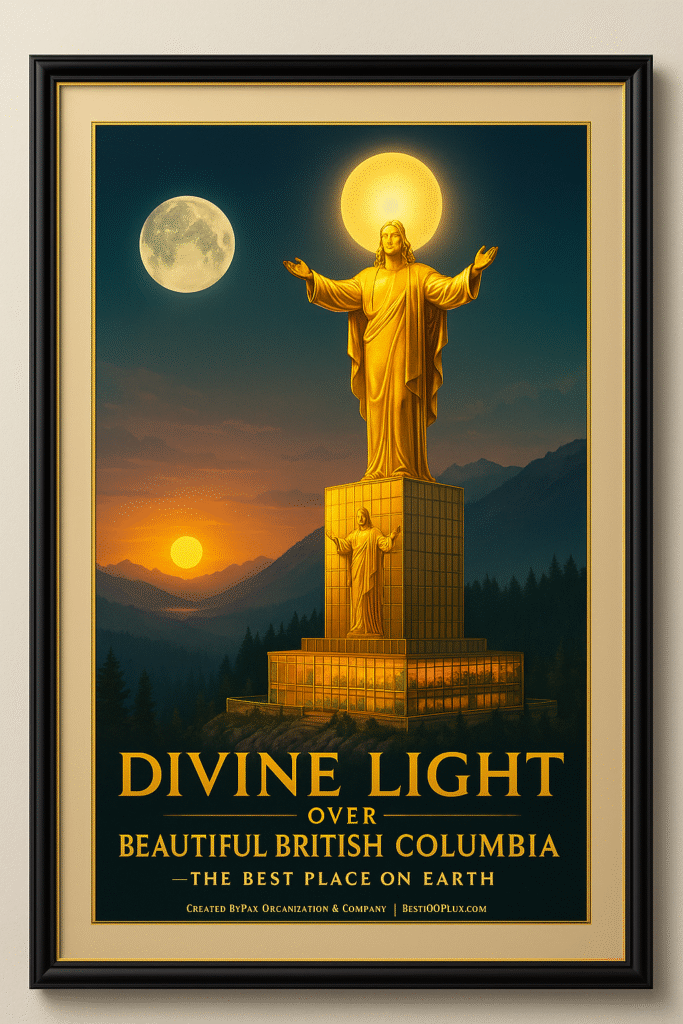
Statue of Jesus, Sun of God
A majestic statue of Jesus, the Sun of God, stands with open, prayerful hands—welcoming everyone into His Love, His light, His way, and His truth, creating a vision of spiritual guidance, peace, hope, and unity.
Tall, golden glass building, crowned with a 20-diameter majestic artificial sun that shines with a brilliant, golden light, much like the sunshine, 7/24/365 or 24 hours a day, 7 days a week, 365 days a year, forever.
The golden glass building stands majestically over Grouse Mountain in Vancouver, B.C., Canada (famous as Beautiful British Columbia or “The Best Place on Earth”).
Grouse Mountain Blowhard will be created from Lansdale Avenue and Trans-Canada Highway 1 to the top of Grouse Mountain, featuring a large parking lot building. From there, it will connect to the Golden Glass Building via covered glass sidewalks.
Grouse Mountain Blowhard will be created from Lansdale Avenue and Trans-Canada Highway 1, to the top of Grouse Mountain, featuring a vast parking lot building. From there, it will be connected by covered glass sidewalks to the golden glass building.
Four glass observation elevators offer panoramic views of Vancouver and Beautiful British Columbia as they move through the golden glass tower.
Rooftop Greenhouses & Buffet Area
Crowning the golden glass building is a rooftop sanctuary of light and life — a realm where four-season greenhouses bloom beneath the gentle radiance of a 20-meter-diameter, majestic artificial sun that shines with a brilliant, golden light, much like the sunshine.
During pleasant weather, the rooftop will remain open to the outdoors, offering a refreshing, top-of-Vancouver experience in beautiful British Columbia, or as “The Best Place on Earth”, with a unique panoramic view. In contrast, during rainy, cold, or unfavorable weather conditions, the space can be enclosed with a retractable glass roof, ensuring year-round comfort and usability.
Here, nature thrives year-round: vibrant flowers, edible plants, and fruit-bearing trees flourish within crystal-clear glass walls.
Visitors ascend into a world where science, beauty, and sustainability meet — an ever-living garden that mirrors the cycles of the earth yet remains untouched by the limits of season or climate. Each corner breathes vitality, nurturing both the soil and the soul.
Besides these gardens, a large all-you-can-eat buffet invites guests to dine in the middle of golden sunlight and green abundance. From sunrise breakfasts to sunset evening gatherings and dinners, the rooftop becomes a stage for joy — where delicious food, fresh air, and panoramic mountain views combine to awaken the senses.
Spiritual enlightenment and intellectual uplifting with A Symphony with Harmony for the Senses” offers sensational lovely experiences with all five senses.
Seeing, smelling, touching, drinking, and tasting, plus listening to joyful, happy, healing music.
Designed as a living example of education, ecology, and elegance, this rooftop symbolizes humanity’s harmony with nature — a shining crown for the building and a glowing tribute to the power of light, life, and learning.
The ground level
The ground level of the golden glass building will feature an open 20-meter-wide terrace encircling the first floor, a welcoming space where light, air, and beauty come together in harmony.
The surrounding area will be bordered by a one-meter-high transparent glass railing, providing both security and unobstructed panoramic views. This creates a perfect place for reflection, photography, and inspiration, allowing visitors to enjoy and capture photos or videos.
During pleasant weather, the terrace will remain open to the outdoors, offering a refreshing and scenic experience. In contrast, during rainy, cold, or unfavorable weather conditions, the space can be enclosed with a retractable glass roof, ensuring year-round comfort and usability.
To accommodate different events or visitor needs, the area can be left open and spacious or arranged with chairs, tables, equipment, and decorations for gatherings, exhibitions, or educational activities.

Please, edit, correct, and proofread this writing the best you can:
The Rooftop Ceremony & Events
Sunrise Ceremony
Each morning at sunrise, three or more participants gather on the rooftop and face the eastern horizon in quiet prayer. With hands joined at heart level, they slowly open their palms and lift their arms skyward, spreading them wide to symbolize the rise of sun to its highest point.
When the first rays touch them, they begin a joyful sun dance, moving with energy and gratitude. On some days, others join, and the dancing continues even until sunset.
Sunset Ceremony
Each evening at sunset, three or more participants face the western sky in prayer. They open their hands, raise their arms high, then sweep them wide before bringing their hands together and lowering them toward the horizon—signifying the sun’s gentle descent as daylight fades.
During Full Moon Monthly Celebrations, a special moon ceremony follows. Always, additional participants join in this shared moment of reflection.
Seasonal Celebrations
Summer Solstice Celebration The sunniest and longest day of the year, marking the first day of summer, will be celebrated with an all-day sun dance and numerous other events. This grand celebration will honor the peak of light and warmth.
Winter Solstice Celebration Conversely, the least sunny and shortest day of the year, signaling the first day of winter, will feature a continuous sun dance, day and night. This significant event will also include various other celebrations, marking the turning point when days gradually begin to lengthen and grow brighter.

Religious and spiritual events
Golden Glass Building Library
Sun of God Library (SGL)
Sun of God Library (SGL) will be organized and managed independently by a Chief Librarian as a Public Library Organization.
+++++++++++++++++
++++++++++++++
Sun of God Library (SGL)
A Public Resource for Sun-Centric Knowledge — Overview
Organization, Management & Model
The Sun of God Library (SGL) will operate as an independent public library, organized and managed by librarians.
Access & Services
As a public library, SGL will provide free access to:
- Books, e-books, and magazines
- Computers, internet connectivity, and AI-powered digital resources
- Lifelong-learning tools that foster education and community connection
Services will be available onsite and online to people of all ages—members and non-members alike.
Specialization — “Best 100+” Collections
SGL will collect the Best 100+ lists highlighting helpful and useful products and services for personal, local, national, and global use.
Collection Focus Areas
SGL’s collections and programs will emphasize:
- Sun & Celestial Knowledge: the Sun, Moon, Earth, and related sciences
- Nature & Seasons: four seasons and four-season gardening
- Four Essentials for Life & Sustainability:
- Sun, Energy (or Fire): Its power, effectiveness, uses solar technologies and symbolism.
- Water (and Drinks): access, quality, and healthy beverages
- Soil & Food: cultivation, nutrition, and sustainable agriculture, plus four-season gardening
- Weather (or Breathing): climate, breathing, and environmental health
- Languages & Communication: resources for multilingual learning and outreach
And much more, mostly connected to the sun’s related information, products, and services.
Global Alignment & Aspirations
SGL will align its mission with the UNESCO 2030 Sustainable Development Goals (SDGs) and aspires to contribute to the Top 100 achievements celebrated at the United Nations centennial in 2045.
+++++++++++++++++++
++++++++++++++
++++++++++++++++
☀️Sun of God Library (SGL)☀️
A Premier Destination for Inspiring, Sun-related information and Events
Mission & Focus
The Sun of God Library (SGL) provides sun-related information, educational programs, products, and services, connecting people to knowledge through inspiring indoor and outdoor spaces.
Venues & Spaces
- Grand Exhibition Halls
Ideal for workshops, educational sessions, trade shows, product showcases, festivals, and large public programs. - Flexible Meeting Rooms (various sizes)
Configurable for conferences, seminars, breakout sessions, and training. - Ballrooms & Signature Event Spaces
Suited to galas, large dinners, award ceremonies, and premium exhibitions. - Pre-Function Areas
Designed for registration, networking, poster displays, sponsor activations, and casual interaction. - Outdoor Plazas
Perfect for community events, live demonstrations, markets, and brand activations.
World-Class Amenities & Services
- State-of-the-art technology: professional A/V, lighting, sound, high-speed internet, and hybrid streaming support.
- Event services: on-site coordination, staging, furnishings, and customizable room setups.
- Comfort & accessibility: climate control, clear wayfinding, and barrier-free access.
Culinary & Hospitality
- Four-Season Garden Buffets and curated culinary services inspired by seasonal produce.
- Coffee bars and catering options to match the scale and style of any event.
Connectivity & Access
- Convenient access to hotels, nearby accommodations, and public transit.
- Thoughtfully designed circulation for easy arrivals, departures, and crowd flow.
of memorable events
+++++
1 to 4 floors of SGL for:
Sun of God
Sun, Sunshine, Sunshine energies, Sunshine solar energy,
Sunshine effect on humans, Sunshine and human health good enough blance Sunshine, to much or to little Sunshine,
Collection Focus Areas
SGL’s collections and programs will emphasize:
++++++++++++++++
+++++++++++++++++++
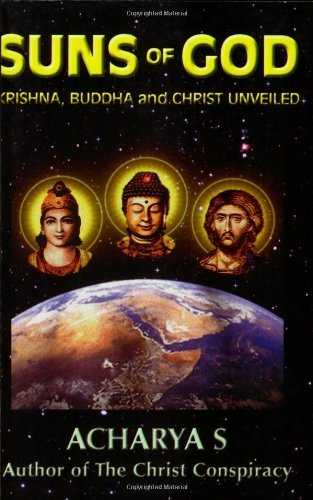
Suns of God: Krishna, Buddha and Christ Unveiled Kindle Edition
by Acharya S (Author)
+++++++++++

☀️The Sun of God Library (SGL)☀️ invites Christian and other religious, spiritual, and faith-based organizations to share their divine, sun-related teachings, resources, educational programs, products, and services, as well as connect people through inspiring indoor and outdoor spaces, and online platforms.
+++++++++++
+++++++++++++++
+++++++++++++
++++++++
+++++
+++++
+++++++
Quick definitions
- Temperature = how hot/cold something is.
- Energy here is given as a simple, useful metric (e.g., power output or energy density) where it helps context.
Cosmic and Celestial Temperatures 🌡️
The Universe’s Minimum and Maximum Temperature!
The universe’s minimum temperature is 0 Kelvin or -273 F.15°C. (absolute zero), The theoretical point of no atomic motion, while the maximum theoretical temperature is the Planck temperature, approximately 1.417 × 10³² K, at which current human understanding of physics breaks down.
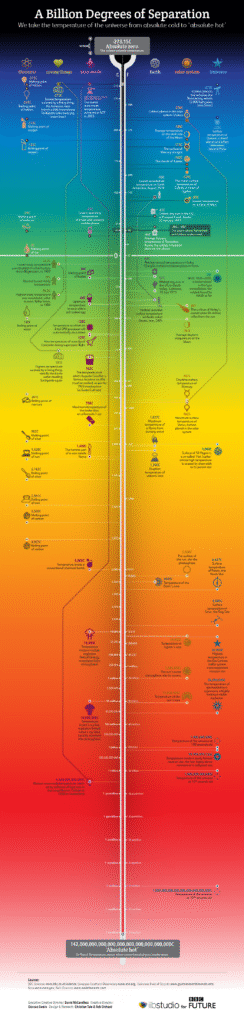
Energy is the capacity to do work, while temperature is a measure of the average kinetic energy of the particles in a substance. Essentially, the hotter something is, the faster its atoms and molecules are moving, and thus the more energy it possesses. Here’s a breakdown of temperatures across various environments in both Celsius and Fahrenheit.
Universe Vacuum
The vast emptiness of space isn’t entirely without energy. The background temperature of the universe is incredibly cold, but not absolute zero.
- Average Temperature: Approximately -270.45°C (-454.81°F). This is due to the cosmic microwave background radiation, a remnant from the Big Bang.
Milky Way Galaxy 🌌
Our home galaxy has a surprisingly high average temperature due to vast clouds of hot gas.
- Average Temperature: About 1,000,000 K (approximately 999,727°C or 1,800,000°F). It’s important to note that this is the temperature of a very thin gas, so it wouldn’t feel “hot” in the way we typically understand.
The Sun ☀️
Our star is a powerhouse of extreme temperatures, from its scorching core to its relatively cooler surface.
- Core: The Sun’s core is where nuclear fusion occurs, reaching an astonishing 15 million °C (27 million °F).
- Surface (Photosphere): The visible surface of the Sun is a much cooler 5,500°C (10,000°F).
The Moon 🌕
With no significant atmosphere to trap heat, the Moon experiences dramatic temperature swings between its sunlit and dark sides.
- Daytime: Temperatures can soar to 127°C (260°F).
- Nighttime: In the darkness, temperatures plummet to a frigid –173°C (-280°F).
Earth and Life 🌍
Our planet hosts a wide range of temperatures, creating diverse environments for life to thrive.
Average Temperature of Earth
The overall average temperature of our planet is quite moderate.
- Global Average: Approximately 15°C (59°F).
Temperatures for Living Beings
Life on Earth exists within a specific, though broad, range of temperatures.
- Range for Life: Organisms have been found to live in temperatures ranging from as low as -15°C (5°F) to as high as 122°C (252°F).
Human Body Temperature
Humans maintain a relatively stable internal body temperature.
- Normal Human Body Temperature: Generally accepted as 37°C (98.6°F), though it can range from 36.1°C (97°F) to 37.2°C (99°F).
+++++++
+++++
++++++
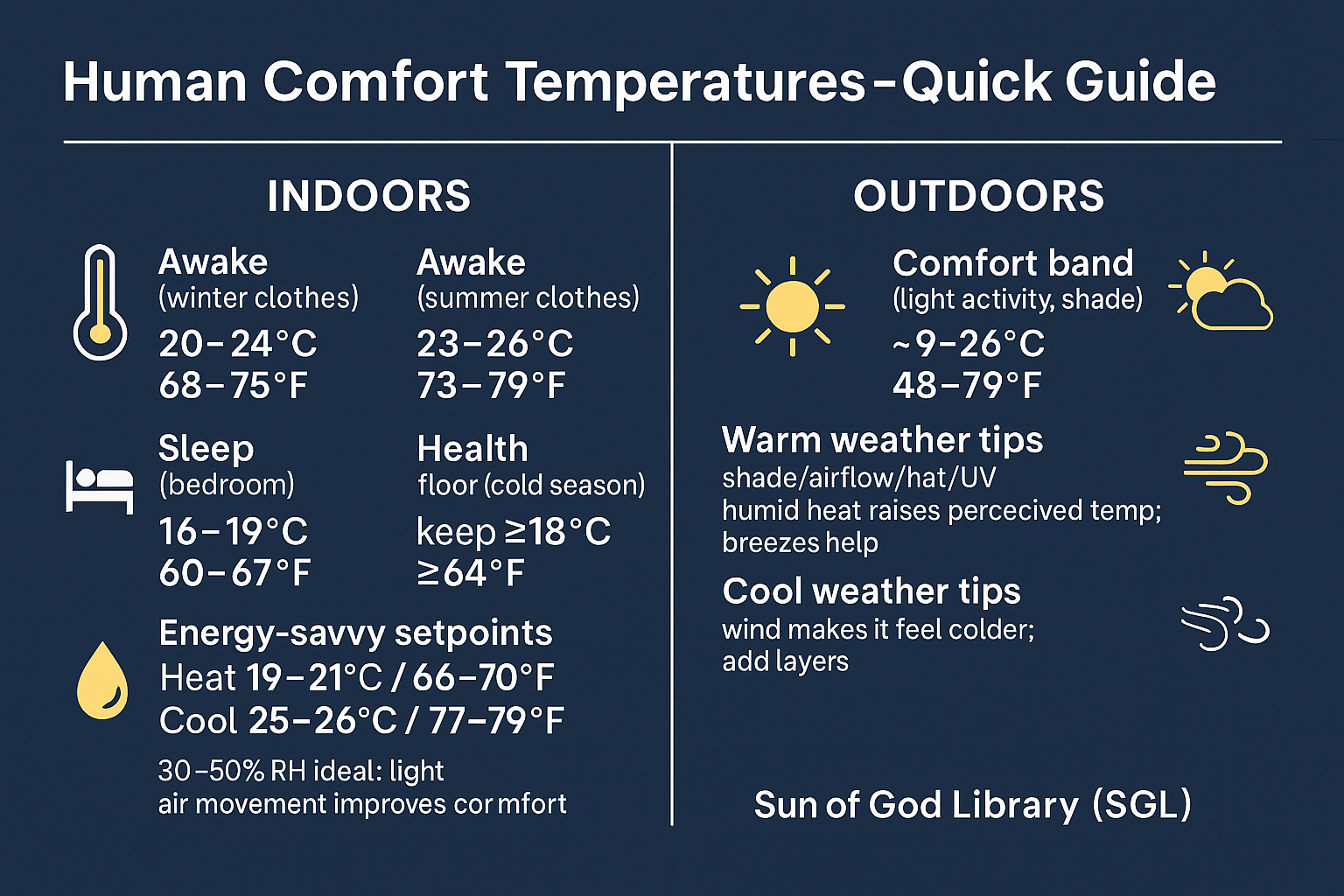
a concise guide to “most desired” human-comfort temperatures, indoors and out. Ranges vary with clothing, activity, humidity, and airflow, but these are good targets.
Quick recommendations
- Indoors (awake, winter clothes): 20–24 °C (68–75 °F). (ASHRAE)
- Indoors (awake, summer clothes): 23–26 °C (73–79 °F); energy-savvy cooling setpoint often ~26 °C / 78 °F. (The Washington Post)
- Indoors (sleep): 16–19 °C (60–67 °F) helps most adults sleep best. (Cleveland Clinic)
- Health floor (cold season): Keep indoor temps ≥ 18 °C (64–65 °F) to reduce health risks. (NCBI)
- Outdoors (light activity): “No thermal stress” typically ~9–26 °C (48–79 °F) on the UTCI comfort scale (wind/sun/humidity adjust this). (Climate-ADAPT)
Why these ranges?
- Thermal-comfort science (ASHRAE 55) defines comfort zones that shift with clothing and air movement; typical indoor comfort bands span roughly 20–26 °C (68–79 °F). (ASHRAE)
- Efficiency guidance commonly targets ~78 °F (26 °C) for cooling when you’re home, balancing comfort and energy. (Trane)
- Sleep research favors cooler bedrooms around 60–67 °F (16–19 °C); some guidance centers near 68 °F (20 °C). (Cleveland Clinic)
- Public-health guidance advises ≥ 18 °C indoors in colder seasons to protect health, especially for vulnerable groups. (NCBI)
+++++
The concept of the “best” and “most desired” temperature for humans is centered around the idea of thermal comfort. This is the condition of mind that expresses satisfaction with the thermal environment. It’s not just about a single number, but a range where the majority of people feel comfortable—not too hot and not too cold.
Here’s a breakdown of the most desirable temperatures for humans, both indoors and outdoors.
Best Indoor Temperatures 🏡
For the indoor environment, where we have control over the climate, the ideal temperature is well-studied. It generally depends on the season, as this affects our clothing choices and acclimatization.1
- During Winter: The generally recommended indoor temperature is between 20°C (68°F) and 22°C (72°F). This range assumes occupants are wearing typical winter clothing like sweaters.
- During Summer: The ideal indoor temperature is slightly warmer, typically between 22°C (72°F) and 25°C (77°F). This accounts for lighter summer clothing.
The World Health Organization (WHO) suggests a baseline of 18°C (64°F) as a safe and well-balanced indoor temperature for healthy and appropriately dressed individuals. For those who are very young, elderly, or unwell, they recommend keeping the temperature at a minimum of 20°C (68°F).
Factors like humidity, drafts, and personal preference also play a significant role in what feels comfortable.
Most Desired Outdoor Temperatures 🌳☀️
Outdoor temperature preference is much more subjective and depends heavily on the activity a person is doing. However, studies and general consensus point to a specific range where most people feel the greatest pleasure and comfort, often described as a “perfect day.”
- The “Feel Good” Range: The most desired outdoor temperature for most people, when engaged in light activities like walking or relaxing, falls between 21°C (70°F) and 25°C (77°F).
Within this range:
- A “perfect” day for many is often cited as being around 22°C (72°F) with light breezes and low humidity. This temperature is warm enough to feel pleasant on the skin without causing sweating or discomfort.
Of course, this changes with activity:
- For Running or Sports: Athletes often prefer cooler temperatures, typically between 10°C (50°F) and 14°C (57°F), to help dissipate the extra body heat they generate.
- For Swimming or Beach-going: Warmer temperatures, often 26°C (79°F) and above, are more desirable to make the water feel refreshing and the sun feel pleasant.
In summary, while personal preferences vary, the sweet spot for human comfort generally lies in the low to mid-20s Celsius (low to mid-70s Fahrenheit). This range requires the least effort from our bodies to maintain our stable internal temperature, allowing us to feel relaxed, comfortable, and happy.
++++
++++
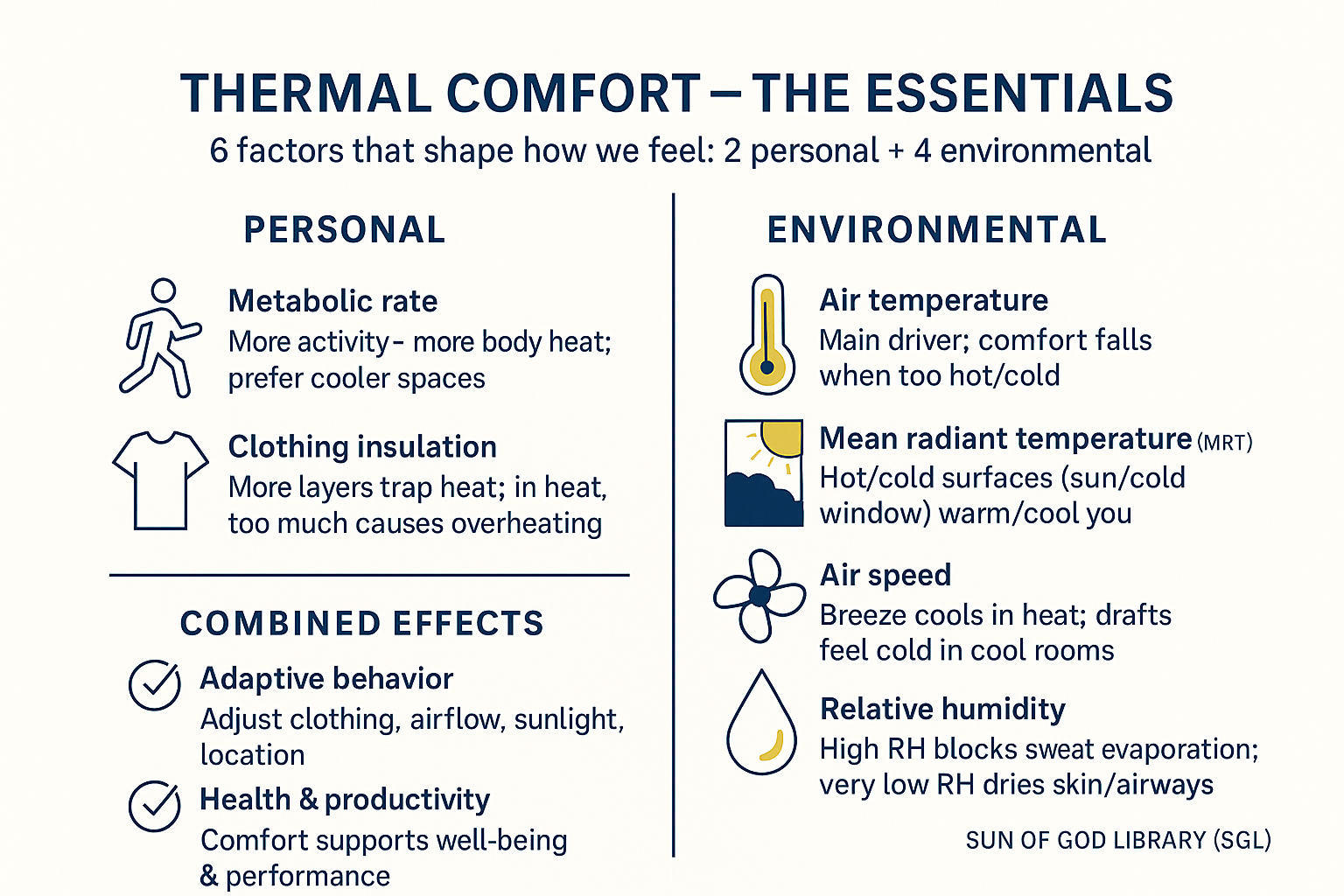
Thermal comfort — the essentials (short)
Definition: A person’s state of mind of satisfaction with their thermal environment, set by six factors: two personal, four environmental.
Personal factors
- Metabolic rate — More activity → more body heat → people feel warmer; prefer cooler spaces.
- Clothing insulation — More insulation traps heat (good in cold); too much in heat → overheating.
Environmental factors
- Air temperature — Main driver; comfort drops as it strays from one’s ideal.
- Mean radiant temperature (MRT) — Hot/cold surrounding surfaces warm/cool the body (e.g., sun vs. cold window).
- Air speed — Breeze cools in heat; feels drafty in cool conditions.
- Relative humidity — High RH blocks sweat evaporation (hotter feel); very low RH dries/irritates.
Combined effects
- Adaptive behavior — People adjust clothing, windows, sunlight, etc., to regain comfort.
- Health & productivity — Discomfort raises stress, cuts performance; extremes risk heat stress/hypothermia.
- Energy efficiency — Managing these factors smartly reduces heating/cooling energy use.
+++++
Thermal comfort factors and their effects
Thermal comfort is a person’s state of mind expressing satisfaction with their thermal environment. It is influenced by six primary factors, categorized as personal and environmental. The interplay between these factors determines whether an individual feels too hot, too cold, or just right.
Personal factors
Personal factors depend on the individual and can change with activity and circumstance.
- Metabolic rate: This is the rate at which the body produces heat from chemical energy and mechanical work.
- Effect: A higher metabolic rate increases internal heat production. People performing strenuous activity have a higher metabolic rate, feel warmer, and prefer cooler environments than those who are sedentary.
- Clothing insulation: The amount of insulation provided by a person’s clothing significantly impacts heat loss.
- Effect: Heavier clothing traps more heat, while lighter clothing allows more heat to escape. In cold conditions, proper insulation prevents heat loss, but in hot environments, excessive clothing can lead to overheating.
Environmental factors
Environmental factors describe the thermal conditions of the surrounding space.
- Air temperature: This is the temperature of the air around a person.
- Effect: A primary driver of thermal sensation, air temperature directly affects the rate of heat exchange between the body and the environment. Discomfort increases as the air temperature deviates from a person’s ideal range.
- Mean radiant temperature (MRT): This is the average temperature of all surfaces surrounding a person, such as walls, ceilings, and windows.
- Effect: Radiant heat can be absorbed or emitted by the body. For example, a person can feel cold in a room with a comfortable air temperature if they are near a cold window, or warm if they are in direct sunlight.
- Air speed: This refers to the rate of air movement, which affects heat transfer through convection.
- Effect: A breeze can have a cooling effect by increasing the rate of heat loss from the skin, which is pleasant in hot conditions. However, in cooler environments, the same airflow can feel like an unwanted draft.
- Relative humidity: This is the amount of moisture in the air compared to the maximum amount the air could hold at that temperature.
- Effect: High humidity hinders the body’s ability to cool itself through sweat evaporation, making a hot environment feel even warmer and more uncomfortable. Conversely, very low humidity can cause dryness and irritation.
Combined effects
The six factors interact in complex ways to determine overall thermal comfort.
- Adaptive behavior: Individuals often adjust personal factors in response to changing environmental factors. For example, a person may open a window (changing air speed), adjust their clothing (changing insulation), or move into or out of sunlight (changing radiant temperature) to feel more comfortable.
- Health and productivity: When occupants are not thermally comfortable, it can lead to stress and reduced productivity. Discomfort can also have serious health implications, including heat stress or hypothermia in extreme conditions.
- Energy efficiency: Understanding these factors is critical for designing and operating buildings efficiently. Tailoring environmental controls to maintain thermal comfort can significantly reduce energy consumption for heating and cooling.
++++
The Universe’s Minimum and Maximum Temperature!
The universe’s minimum temperature is 0 Kelvin or -273 F.15°C. (absolute zero), The theoretical point of no atomic motion, while the maximum theoretical temperature is the Planck temperature, approximately 1.417 × 10³² K, at which current human understanding of physics breaks down.
++
The Universe’s Minimum and Maximum Temperature!
The minimum temperature is 0 Kelvin or -273 F.15°C. (absolute zero)
the maximum theoretical temperature is the Planck temperature, approximately 1.417 × 10³² K,
at which current human understanding of physics breaks down.
++++++++
Temperatures for Living Beings
Range for Life: Organisms have been found to live in temperatures ranging from
as low as -15°C (5°F)
to as high as 122°C (252°F).
++++++
Human Body Temperature
Humans maintain a relatively stable internal body temperature.:
Generally accepted as 37°C (98.6°F), though it can range from 36.1°C (97°F) to 37.2°C (99°F).
++++++
Human Most Desired Outdoor Temperatures 🌳☀️
From around 20°C (68°F) to 24°C (75°F).or from around 20°C to 24°C
++++++
Other than natural events such as earthquakes, volcanic eruptions, etc., most of the disasters can be control by temprature produce by sun
With no sun, space temperature is about -270 or absolute zero, so all energy, seasons, Humanity now, in this age, in the 4 types of civilization, is around 0.5 to 0.75 skill, aiming to become a type 1 civilization plus +
to be able to have information, knowledge and abilities to control and keep temperatures around 10 to 30 c, and 20 to 24 c for living area, create and control
1+ abundant energy,
2+ stream weather changes,
3+ very cold or hot weather -20 to -40 or +30 to 40 and higher,
4+ forest fires,
5+ storms,
6+ hurricanes,
7+ heavy rain
8+ heavy snow,
9+ freezing,
10+ drying
11+ water,
12+ soil and
13+ food
14+
+++++++
“Skill of the +1 → +4 → +10 → +100” refers to a stepped Skills for Success model built on four core components: learning, planning, focusing, and sustained focus/persistence toward the best and highest standards of performance.
Helpful shorthand (optional)
+100 = excellence/records (sustained top performance)
+1 = foundation (learn the basics)
+4 = core skills (learn, plan, focus, persist)
+10 = mastery milestones (refine and apply at higher levels)
++++++++++++++++
Human Most Desired Outdoor Temperatures 🌳☀️
From around 20°C, to 21°C, to 22°C, to 23°C to 24°C
the year 2020, to 21, to 22, to 23, to 2024,
from 20th, to 21st, to 22nd, to 23rd, and to 24th centuries
From around 20°C, 21°C, 22°C, 23°C, 24°C
the year 2020, 21, 22, 2024, also 20th, 21st, 22nd, 23rd, and 24th centuries
What coincidence match to memorize and remember very important historical numbers, the year 2020, 21, 22, 2024, also 20th, 21st, 22nd, 23rd, and 24th centuries
+++++
+++++
Michio Kaku explains the meaning of the Kardashev scale and it’s importance in our society. Michio Kaku thinks that the possible transition from type 0 to type 1 is probably going to be the biggest transition in human history.
He mentions several examples from science fiction work to demonstrate and help us visualize the concepts involved when measuring a civilization’s energy output. As the name implies the Kardashev scale is named after the soviet astronomer Nikolai Kardashev who proposed a scale to measure the level of technological advancement based on the amount of energy the civilization in question is able to use.
A type 1 civilization is a Technological level of a civilization that is close to the level presently on our home planet. There are however
2 other types of civilizations. Michio Kaku mentions that a type 2 civilization is able to employ the same techniques as a type 1 civilization but to a large number of planetary systems. He explains that this type of civilization is capable of harnessing the energy radiated by its own star. They may be able to construct space mega-structures to attain their energy needs such as a Dyson sphere. Star lifting is another process where an advanced civilization could remove a substantial portion of a star’s matter in a controlled manner for their energy needs. 3. But perhaps the most fascinating type of civilization is type 3 which is also called a galactic civilization because they are able to colonize most if not all planets and are able to use the energy released from the stars in their host galaxy. Michio Kaku explains that currently humanity is at level 0. More precisely we may be at 0.7 We have a long way to go to reach the transition from type 0 to type 1 because we might carry a strong risk of self destruction.
For more info visit https://www.youtube.com/watch?v=PxwPfPWrOCA
The Sustainability Age or Ecological Age: This era emphasizes sustainable practices and a shift towards a harmonious coexistence with nature, growing concerns about climate change and environmental sustainability may lead to an age where society places a strong emphasis on eco-friendly technologies and renewable energy sources.
Abuandent Energy Age: This era anticipates the widespread use of clean and efficient fusion power and many other forms of energy production and usage as the primary source of energy, replacing traditional fossil fuels and reducing reliance on non-renewable resources.
Kardashev’s initial model was developed. He proposed a classification of civilizations into three types, based on the axiom of exponential growth:
- A Type I civilization is able to access all the energy available on its planet and store it for consumption. Hypothetically, they should also be able to control natural events such as earthquakes, volcanic eruptions, etc.
- A Type II civilization can directly consume a star‘s energy, most likely through the use of a Dyson sphere.
- A Type III civilization is able to capture all the energy emitted by its galaxy, and every object within it, such as every star, black hole, etc. Read more at, https://en.wikipedia.org/wiki/Kardashev_scale
+++++++
++++
+++++
Grouse Mountain Grouse Mountain
BBC Golden Glass Building or Sunshine Building
GMGGB/ GMGB
BCGB
sog/ SGB
Sun of God Building or SGBwill be organize and manage by VPL Vancouver Public Library Fundation
The Vancouver Public Library (VPL) is the public library system for the city of Vancouver, British Columbia, operating as a municipal department overseen by a Board of Trustees. It serves the community across 21 locations, with the VPL Foundation acting as an independent non-profit to raise funds and support the library’s programs, collections, and services. A separate volunteer organization, the Friends of the Vancouver Public Library, also supports the library.
+++++
The “BC public libraries branch” likely refers to the Public Libraries Branch of the Government of B.C., a provincial government body that administers the Library Act and supports the public library system through strategic leadership, policy, funding, and coordination of province-wide programs like the BC OneCard and the BC Summer Reading Club. Alternatively, it might refer to a specific physical branch of a public library system, such as a branch of the Vancouver Public Library (VPL) or Surrey Libraries.
++++++
Canada’s public library system is a network of municipal, regional, and provincial entities, overseen nationally by organizations like the Canadian Federation of Library Associations (CFLA), which is an umbrella group for various library associations. Provincial and territorial associations, such as the British Columbia Library Association (BCLA) and the Ontario Library Association (OLA), provide advocacy and support for their regions, often collaborating through The Partnership, a national network of these associations. Other key national organizations include the Canadian Urban Libraries Council (CULC) for large city libraries and the Association for the Advancement of Science and Technology of Documentation (ASTED).
++++
International Federation of Library Associations (IFLA):
Founded in 1927, the IFLA is a global organization whose mission is to foster high-quality library and information services worldwide. It is a partner in the IFLA-UNESCO Public Library Manifesto, which defines the public library as an essential agent for education, culture, and welfare.




Sunrise on Mars

Sunset on Mars
Images captured by InSight
Sol (borrowed from the Latin word for sun) is a solar day on Mars; that is, a Mars-day. A sol is the apparent interval between two successive returns of the Sun to the same meridian (sundial time) as seen by an observer on Mars. It is one of several units for timekeeping on Mars.
A sol is slightly longer than an Earth day. It is approximately 24 hours, 39 minutes, 35 seconds long. A Martian year is approximately 668.6 sols, equivalent to approximately 687 Earth days or 1.88 Earth years.
Length
A Mars-day. The average duration of the day-night cycle on Mars—i.e., a Martian day—is 24 hours, 39 minutes, and 35.244 seconds, equivalent to 1.02749125 Earth days.[4] The sidereal rotational period of Mars—its rotation compared to the fixed stars—is 24 hours, 37 minutes, and 22.66 seconds.[4] The solar day lasts longer because Mars’s rotation is the same.
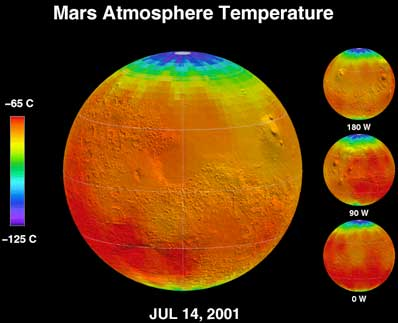
Latest global temperature map. Photo: NASA/JPL/ASU
Mars wide temperature range
Mars has a wide temperature range, with average temperatures around -63°C (-81°F) but can reach highs of about 20°C (68°F) at the equator during the day and plummet to approximately -153°C (-243°F) at the poles. The planet’s thin atmosphere allows for rapid heat escape, contributing to these dramatic temperature swings.
++++++
Grouse Mountain
https://en.wikipedia.org/wiki/Grouse_Mountain
Grouse Mountain is one of the North Shore Mountains of the Pacific Ranges in the District Municipality of North Vancouver, British Columbia, Canada. With a maximum elevation of over 1,200 m (4,100 ft) at its peak, the mountain is the site of an alpine ski area, Grouse Mountain Resort, which overlooks Metro Vancouver and has four chairlifts servicing 33 runs.
.JPG)
Grouse mountain’s snow terrain, as seen from Burnaby, featuring the Cut (left) and expert peak runs (right)
Present-day lodge and ski area
After a fire destroyed the original lodge in the winter of 1962, the two original lifts were removed in the 1970s. The government of British Columbia, seeing the possibilities for tourism, provided funding and permits for a new lodge to be built on the ridge, as well as an aerial tramway travelling to the mountaintop from the valley below. The tramway, known as the Blue Tram, was built by Austrian steel company Voestalpine and was opened and inaugurated on December 15, 1966, by Premier W. A. C. Bennett.
The average annual precipitation is 2730mm. Autumn is the wettest season with 421.4 mm (16.59 in) of precipitation falling in November alone. Winters are cool and snowy, with an average of 868.7 centimetres (342.0 in) of snow falling annually.
The ski and snowboard area, located on the southern slope of the mountain, operates in the winter months between December and May, approximately.
he most prominent run on the mountain is the Cut, one of two beginner runs, which is easily visible from the Vancouver area. It runs alongside the Screaming Eagle chairlift.[17] East of the Cut are several intermediate runs, which take skiers and snowboarders down to the Olympic Express, which accesses the mountain’s easternmost expert runs, most of which originate from the mountain’s 1,231-metre (4,039 ft) peak.[17] Altogether, Grouse Mountain features four green (beginner), sixteen blue (intermediate), seven black diamond (advanced) and three double black diamond (expert) runs.[There are also three freestyle terrain parks—the novice to intermediate Rookie Terrain and Paradise Parks, as well as the intermediate to expert Side Cut Terrain Park. Depending on snow conditions, there is also another terrain park for experts called the Cut Jump Line, which is located on the left (east) side of the Cut.[19] In 2022, a dedicated handle tow was built to service the Side Cut Terrain Park.
In addition to the 305 centimetres of annual natural snowfall, the mountain uses 37 snow guns, covering 75% of the ski and snowboard terrain, for artificial snowmaking.
Read more at https://en.wikipedia.org/wiki/Grouse_Mountain
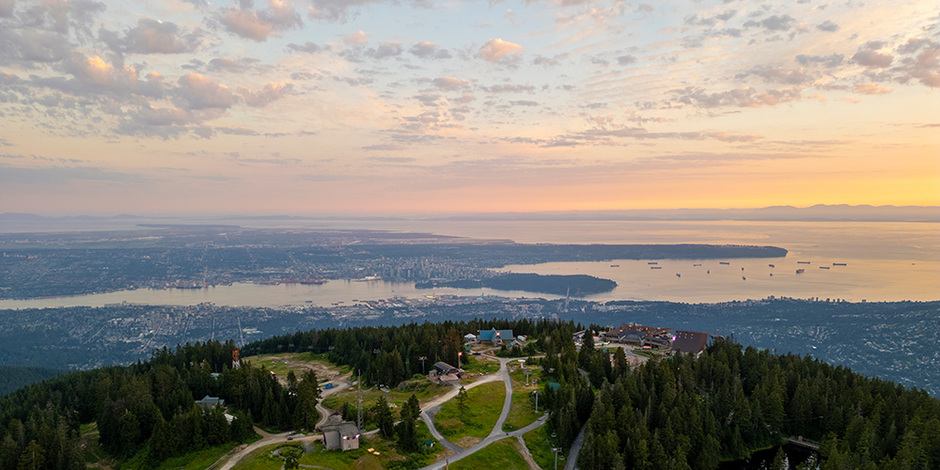
Grouse Mountain – The Peak of Vancouver
Grouse Mountainhttps://www.grousemountain.com
Discover your adventure with mountaintop activities. Read Explore & Book Activities > DINING AND SHOPPING Explore restaurants and retail outlets.The peak of Vancouver
Just 15 minutes from downtown, Vancouver’s premier attraction offers the perfect destination for a truly rewarding and memorable experience. With a variety of cultural, educational and outdoor adventures to choose from, we look forward to helping you plan your next visit.
Grouse Mountain is located on the unceded territories of the Coast Salish peoples: the Squamish, Musqueam, and Tsleil-Waututh First Nations. We value the opportunity to live, work, and share experiences on their ancestral territories.
Most of Grouse Mountain’s summer activities and winter activities are complimentary with a Mountain Admission ticket.
To learn more about Grouse Mountain’s social and environmental commitments, check out Blue Grouse Sustainability program.
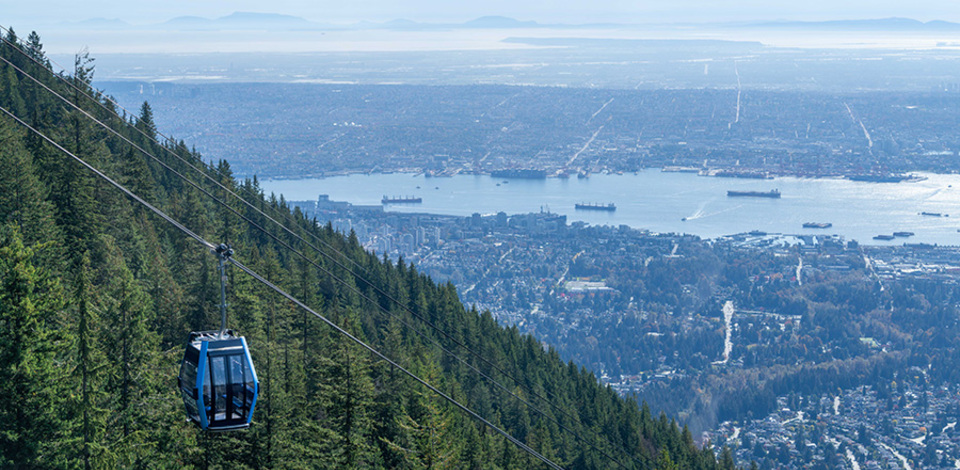
Sunset Special – $29 after 6 pm
This summer and fall, take advantage of our Sunset Special and enjoy evening mountain access for only $29 after 6 pm.
Take in stunning panoramic views from our scenic lookouts, watch the sun dip below the horizon from The Peak of Vancouver, and relax with dinner and drinks on the Altitudes Patio.
Sunset Special – $29 after 6 pm
https://www.grousemountain.com/news-events